T. Rex Behaviour and Intelligence: What the Fossil Record Shows

Photorealistic semi-infographic of Tyrannosaurus rex in the Hell Creek Formation showing behaviour and intelligence traits, including scent tracking, binocular vision, inner ear balance, healed bite marks, trackways, and taxonomically accurate Late Cretaceous flora assemblage.

At a Glance Field Information Species Tyrannosaurus rex Period Late Cretaceous (68–66 Ma) Brain size Large relative to body size for a non-avian dinosaur Sensory strengths Exceptional smell; binocular vision (~55° overlap) Social behaviour Almost certainly solitary; no confirmed pack hunting Communication Unknown; inferred from anatomy only T. rex had a relatively large brain for … Read more

T. Rex Discovery: Fossils, Specimens and the Science Behind Them

Photorealistic semi-infographic of Tyrannosaurus rex in a Hell Creek floodplain with exposed fossil skull, vertebrae, and femur in sediment, featuring labeled callouts, skeletal reconstruction, and stratigraphic layer diagram.

At a Glance Field Information Species Tyrannosaurus rex First described 1905 — Henry Fairfield Osborn, AMNH First material collected 1890s — Barnum Brown, Hell Creek Formation Known specimens 50+ partial skeletons Most complete Sue (FMNH PR 2081), Field Museum, Chicago Heaviest known Scotty (RSM P2523.8), Royal Saskatchewan Museum T. rex was formally named in 1905 … Read more

T. Rex Habitat: Where and How This Dinosaur Actually Lived

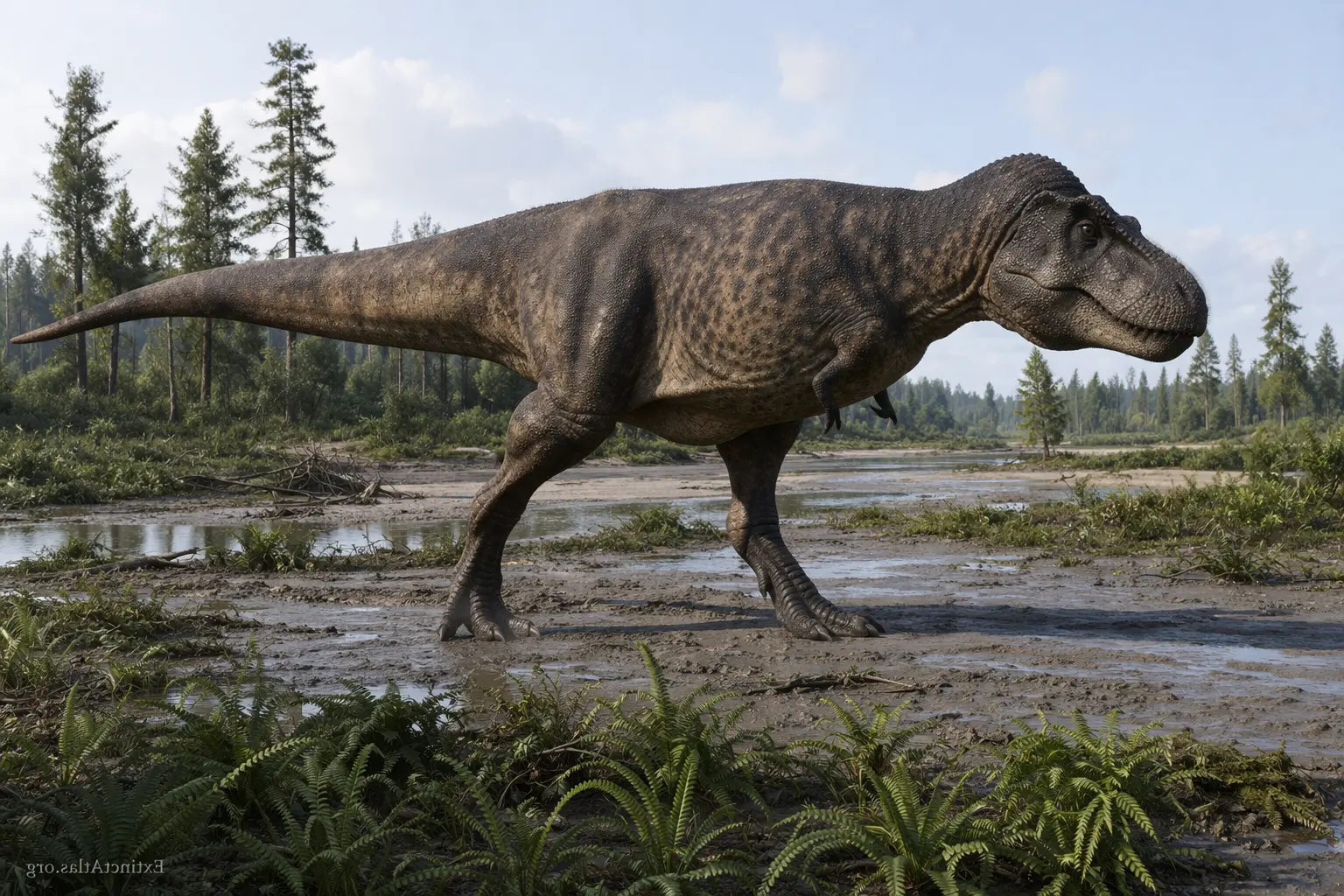
Photorealistic Tyrannosaurus rex walking across a muddy Hell Creek floodplain with shallow water channels, ferns in the foreground, scattered shrubs, and distant conifer trees under soft natural daylight.

At a Glance Field Information Species Tyrannosaurus rex Period Late Cretaceous (68–66 Ma) Geographic range Western North America (Laramidia) Key formation Hell Creek Formation (MT, ND, SD, WY) Environment Subtropical floodplains, dense forests, river systems Climate Warm and humid; no polar ice caps T. rex lived in the warm, humid floodplains and forests of western … Read more

T. Rex Extinction: When, Why, and What the Fossils Show

Scientifically accurate life reconstruction of Tyrannosaurus rex from the Late Cretaceous Hell Creek Formation, showing a robust, large-bodied theropod with reduced forelimbs, scaled integument, and balanced horizontal posture in a floodplain environment.

At a Glance Field Information Species Tyrannosaurus rex Period Late Cretaceous (68–66 Ma) Extinction event Cretaceous–Palaeogene (K-Pg) boundary Extinction date Approximately 66.043 million years ago Cause Chicxulub asteroid impact and subsequent environmental collapse Survivors None — T. rex lineage ended completely; birds (avian dinosaurs) survived Quick Answer: T. rex went extinct approximately 66 million years … Read more

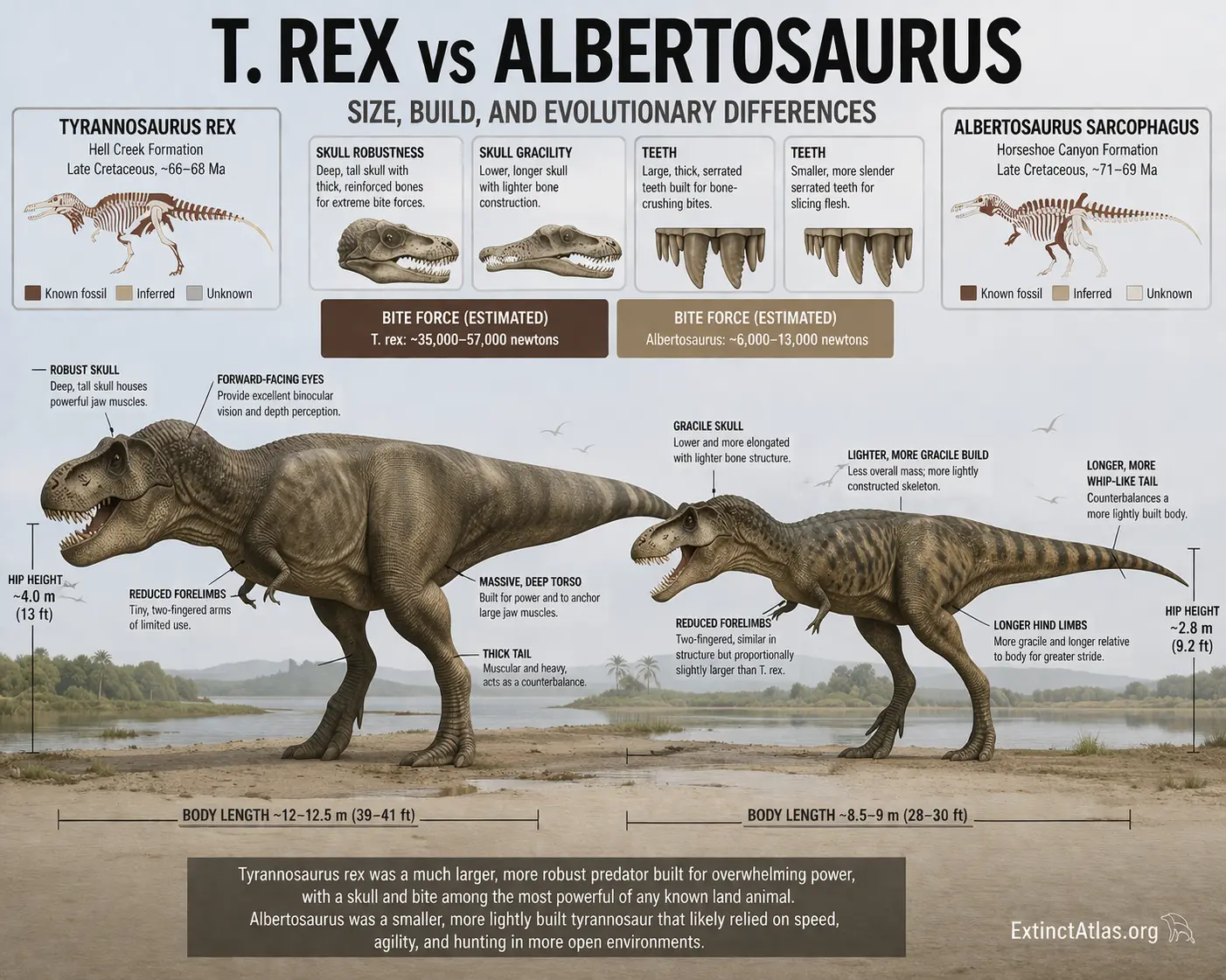
T. Rex vs Albertosaurus: Apex Predator vs Smaller Cousin

t-rex-vs-albertosaurus-size-build-evolution-comparison-infographic

At a Glance Feature T. rex Albertosaurus Period Late Cretaceous (68–66 Ma) Late Cretaceous (~76–70 Ma) Location Hell Creek Formation, North America Horseshoe Canyon Formation, Alberta, Canada Length 12–13 m (39–43 ft) ~8–9 m (26–30 ft) Weight 8,000–14,000 kg (17,600–30,900 lb) ~1,300–2,500 kg (2,900–5,500 lb) Bite force ~35,000–57,000 N Substantially lower — smaller skull and … Read more

T. Rex vs Spinosaurus: What the Fossil Evidence Actually Shows

Scientific infographic comparing Tyrannosaurus rex and Spinosaurus aegyptiacus, highlighting differences in skull shape, dentition, body proportions, paddle-like tail, sail structure, and semi-aquatic adaptations based on fossil evidence.

At a Glance Feature T. rex Spinosaurus Period Late Cretaceous (68–66 Ma) Early–Late Cretaceous (~99–93 Ma) Location North America North Africa (Egypt, Morocco) Length 12–13 m (39–43 ft) Possibly 14–15 m (46–49 ft) — highly uncertain Weight 8,000–14,000 kg (17,600–30,900 lb) Estimates vary widely; likely lighter than T. rex Ecological role Terrestrial apex predator Semi-aquatic, … Read more

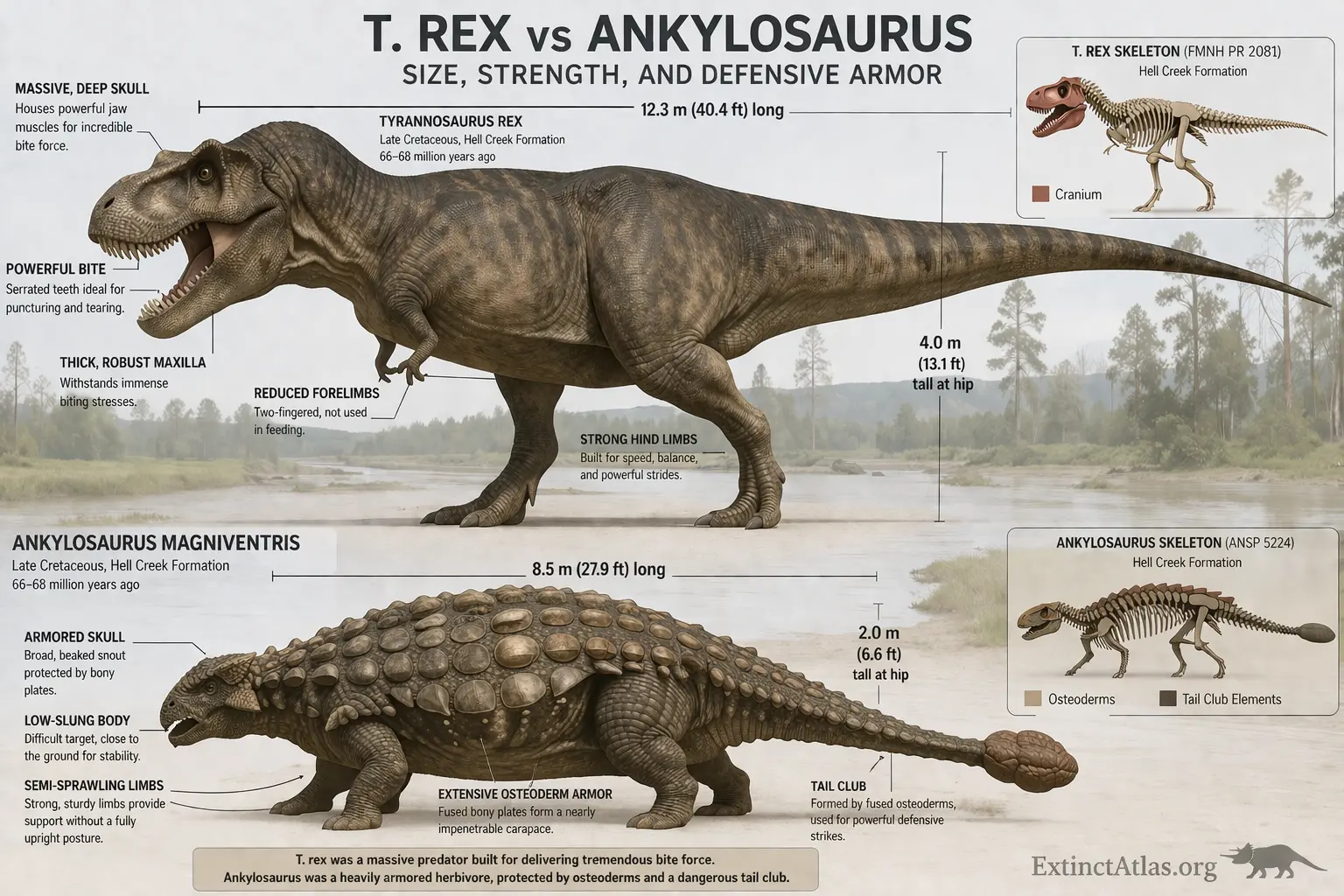
T. Rex vs Ankylosaurus: The Predator vs the Living Tank

Scientific comparison infographic showing Tyrannosaurus rex and Ankylosaurus magniventris with labeled anatomy, size differences, bite force versus defensive armor, osteoderms, tail club structure, and skeletal reconstructions from the Late Cretaceous Hell Creek ecosystem.

At a Glance Feature T. rex Ankylosaurus Period Late Cretaceous (68–66 Ma) Late Cretaceous (70–66 Ma) Weight 8,000–14,000 kg (17,600–30,900 lb) ~4,800–8,000 kg (10,600–17,600 lb) Primary weapon ~35,000–57,000 N bite force Bone-crushing tail club Shared formation Hell Creek Formation Hell Creek Formation Confirmed predation evidence None published — T. rex and Ankylosaurus shared the Hell … Read more

T. Rex vs Giganotosaurus: Size, Strength, and the Key Differences

Educational comparison infographic showing Giganotosaurus carolinii and Tyrannosaurus rex at equal scale with skull reconstructions, relative bite-force estimates, body-size comparison, and habitat differences. The image highlights Giganotosaurus' longer, lower skull and T. rex's deeper, more robust skull adapted for stronger bite forces.

At a Glance Feature T. rex Giganotosaurus Period Late Cretaceous (68–66 Ma) Late Cretaceous (99–95 Ma) Location North America South America (Patagonia) Length 12–13 m (39–43 ft) 12–13 m (39–43 ft) Weight 8,000–14,000 kg (17,600–30,900 lb) 6,000–8,000 kg est. (13,200–17,600 lb) Skull length ~1.5 m (5 ft) ~1.8 m (6 ft) Bite strategy Bone-crushing Slicing; … Read more

T. Rex vs Triceratops: Size, Weapons, and Fossil Evidence

Photorealistic semi-infographic comparing Tyrannosaurus rex and Triceratops horridus in side profile, showing accurate size difference, skull and horn weapons, serrated teeth, frill structure, and annotated fossil evidence with human scale reference.

At a Glance Feature T. rex Triceratops Period Late Cretaceous (68–66 Ma) Late Cretaceous (68–66 Ma) Length 12–13 m (39–43 ft) 8–9 m (26–30 ft) Weight 8,000–14,000 kg (17,600–30,900 lb) 6,000–12,000 kg (13,200–26,400 lb) Primary weapon Bone-crushing jaws, ~35,000–57,000 N bite force Three horns, neck frill, low centre of gravity Habitat Hell Creek Formation, North … Read more

What Did T. Rex Eat? Diet, Prey and Feeding Behaviour

Tyrannosaurus rex feeding on prey with biomechanically realistic jaw gape, showing serrated teeth and moderate facial tissue tension in a scientifically accurate diet reconstruction

At a Glance Field Information Species Tyrannosaurus rex Period Late Cretaceous (68–66 Ma) Diet type Carnivore Primary prey Triceratops horridus, Edmontosaurus annectens Feeding evidence Tooth-marked bones, coprolites, healed bite wounds Predator vs. scavenger Active predator; opportunistic scavenging also confirmed Quick Answer: T. rex was a carnivore that primarily ate large plant-eating dinosaurs, principally Triceratops and Edmontosaurus. … Read more