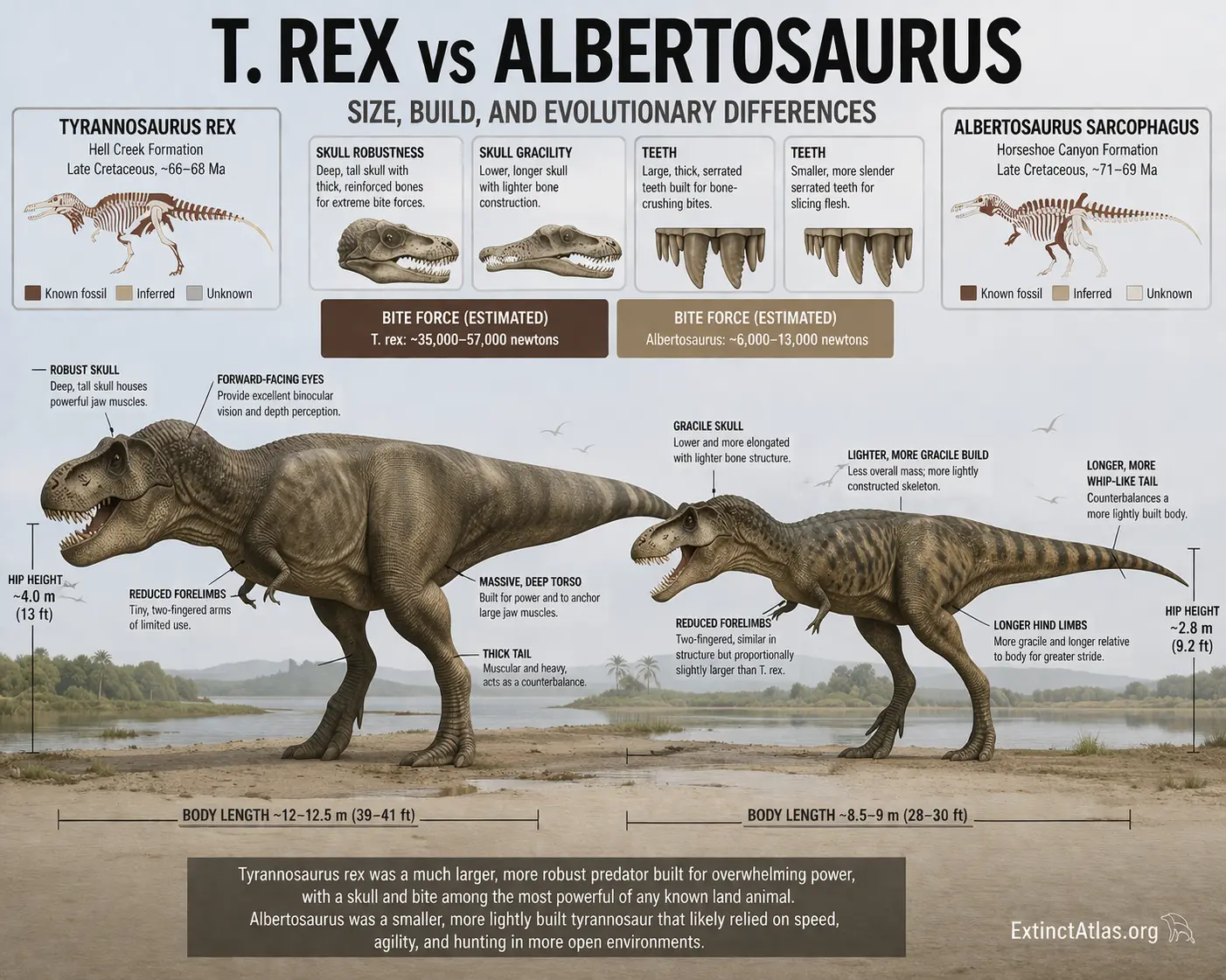
At a Glance
| Feature | T. rex | Albertosaurus |
|---|---|---|
| Period | Late Cretaceous (68–66 Ma) | Late Cretaceous (~76–70 Ma) |
| Location | Hell Creek Formation, North America | Horseshoe Canyon Formation, Alberta, Canada |
| Length | 12–13 m (39–43 ft) | ~8–9 m (26–30 ft) |
| Weight | 8,000–14,000 kg (17,600–30,900 lb) | ~1,300–2,500 kg (2,900–5,500 lb) |
| Bite force | ~35,000–57,000 N | Substantially lower — smaller skull and jaw muscles |
| Speed | ~17–24 km/h (10–15 mph) est. | Likely ~30–40 km/h (18–25 mph) est. |
| Did they meet? | Probably not — temporal and some geographic separation | Probably not |
Quick Answer: T. rex and Albertosaurus were both North American tyrannosaurs, but they lived approximately 4–10 million years apart and occupied somewhat different geographic ranges. Albertosaurus was significantly smaller and almost certainly faster; T. rex was larger, more powerful, and had a dramatically stronger bite. They represent different evolutionary stages of the tyrannosaur lineage rather than contemporaneous competitors.

This matchup is different from the T. rex vs Giganotosaurus or T. rex vs Spinosaurus comparisons. Those involve animals from entirely separate evolutionary lineages, different continents, and radically different ecologies. T. rex and Albertosaurus were close relatives — both tyrannosaurs, both North American, both apex predators of their respective ecosystems. Comparing them is more like comparing a modern lion to a leopard than comparing a lion to a crocodile.
Did They Ever Meet?
The temporal ranges of T. rex and Albertosaurus sarcophagus do not significantly overlap. Albertosaurus is primarily known from the Horseshoe Canyon Formation, dated to approximately 73–70 million years ago. T. rex’s confirmed range begins at approximately 68–66 million years ago. A gap of roughly 2–4 million years separates the end of the main Albertosaurus record from the beginning of T. rex’s, though the precise boundary depends on how individual formations are dated and whether isolated specimens from transitional zones represent genuine temporal overlap.
Additionally, Albertosaurus is primarily known from Alberta, Canada, slightly north and in different formations from the Hell Creek T. rex localities. Some geographic overlap in range may have occurred, but direct cohabitation of the two species in the same ecosystem at the same time is not confirmed.
How Do They Compare as Animals?
Size
This is the most striking difference. Albertosaurus reached approximately 8–9 metres (26–30 ft) in length and weighed roughly 1,300–2,500 kilograms (2,900–5,500 lb) — approximately one-fifth to one-third of T. rex’s estimated mass. The skull of Albertosaurus was proportionally smaller and more lightly built than T. rex’s, lacking the extreme robustness of the bone-crushing specialist.
Speed and Agility
Albertosaurus’s lighter build almost certainly translated to greater speed and agility. Biomechanical estimates suggest Albertosaurus could move at approximately 30–40 km/h (18–25 mph) — considerably faster than the 17–24 km/h (10–15 mph) estimated for adult T. rex. This speed difference was almost certainly associated with a different hunting strategy: Albertosaurus was probably a pursuit predator capable of running down large prey, while adult T. rex relied more on power and bulk.
Bite Force and Prey
T. rex’s bite force of approximately 35,000–57,000 newtons far exceeded anything Albertosaurus could generate. Albertosaurus had blade-like teeth — more typical of theropods generally — rather than the bone-crushing banana-shaped teeth of T. rex. This reflects different prey: Albertosaurus hunted hadrosaurs and other large herbivores of the slightly earlier Horseshoe Canyon ecosystem, but without T. rex’s ability to process bone.
Brain and Senses
Both tyrannosaurs had relatively large brains for non-avian dinosaurs, with well-developed olfactory and visual processing regions. T. rex’s olfactory bulbs were proportionally larger than Albertosaurus’s, suggesting an even greater reliance on scent detection. Forward-facing eyes providing binocular vision were present in both, though the degree of overlap may have differed.
Group Behaviour: The Albertosaurus Bonebed
One of the most significant aspects of Albertosaurus biology is a bonebed discovered in Alberta containing the remains of at least 26 individuals of different ages — juveniles, sub-adults, and adults — in the same deposit. This is unusual for large theropods and has been interpreted by some researchers as evidence of gregarious behaviour, possibly pack or group hunting. [Freshness flag: interpretation of the bonebed as evidence of social behaviour remains debated — other explanations, including drought concentration at a water source, are also proposed]
If the group behaviour interpretation is correct, Albertosaurus may have used coordinated hunting tactics that T. rex — apparently solitary — did not. This would represent a meaningful strategic difference between the two tyrannosaurs, compensating to some degree for Albertosaurus’s smaller individual size.
Evolutionary Relationship
Albertosaurus occupies an important position in the tyrannosaur family tree. It belongs to the subfamily Albertosaurinae within Tyrannosauridae — a sister group to Tyrannosaurinae, the subfamily that includes T. rex, Tarbosaurus, and Daspletosaurus.
The evolutionary trajectory from albertosaurine-grade tyrannosaurs to T. rex involved increasing body mass, increasing skull robustness and bite force, reduction of arm proportions, and the development of the specialised bone-crushing dentition. T. rex represents the culmination of this trend toward larger, more powerful, bite-force-dominant tyrannosaurs. Albertosaurus represents an earlier, less extreme point on the same lineage — not a primitive animal, but a less specialised one by T. rex’s standards.
Related and Contemporary Species
- Daspletosaurus torosus — an earlier tyrannosaurine that was roughly intermediate in size between Albertosaurus and T. rex; may have coexisted with Albertosaurus in some formations.
- Gorgosaurus libratus — another albertosaurine tyrannosaur from approximately the same time and place as Albertosaurus; similar in build and likely similar in ecology. (The taxonomic relationship between Gorgosaurus and Albertosaurus is occasionally revisited.)
- Tarbosaurus bataar — a tyrannosaurine close to T. rex from Asia; comparison with Albertosaurus illustrates the full size range achieved by the tyrannosaurid family.
- Edmontosaurus regalis — the northern relative of E. annectens; a common large hadrosaur in Albertosaurus’s ecosystem, likely its primary prey.
Frequently Asked Questions
Could Albertosaurus have killed T. rex?
A confrontation between the two is essentially hypothetical, given their temporal and geographic separation. If one occurred, T. rex’s massive size advantage — five to ten times Albertosaurus’s mass — and vastly greater bite force would make it a severe mismatch. Albertosaurus’s speed advantage would likely be insufficient to compensate for the difference in offensive capability once engaged.
Were T. rex and Albertosaurus ever in the same place at the same time?
Probably not, based on current evidence. Their primary fossil formations are temporally separated by approximately 2–4 million years. Some geographic range overlap may have occurred during transitional periods, but confirmed sympatry has not been established.
Is Albertosaurus the ancestor of T. rex?
No — Albertosaurus is a close relative, not a direct ancestor. Both belong to the tyrannosaur family, but Albertosaurus is on the albertosaurine branch while T. rex is on the tyrannosaurine branch. They shared a common ancestor earlier in tyrannosaur evolutionary history but represent separate lineages.
References
Currie PJ. 2003. Cranial anatomy of tyrannosaurid dinosaurs from the Late Cretaceous of Alberta. Acta Palaeontologica Polonica. 48(2):191–226.
Currie PJ. 1998. Possible evidence of gregarious behavior in tyrannosaurids. Gaia. 15:271–277.
Carr TD. 2020. A high-resolution growth series of Tyrannosaurus rex was obtained from multiple lines of evidence. PeerJ. 8:e9192.
Brochu CA. 2003. Osteology of Tyrannosaurus rex: insights from a nearly complete skeleton and high-resolution computed tomographic analysis of the skull. Society of Vertebrate Paleontology Memoir. 7:1–138.
Holtz, T. R. Jr. 2004. Tyrannosauroidea. In: Weishampel DB, Dodson P, Osmólska H, editors. The Dinosauria. 2nd ed. Berkeley: University of California Press. p. 111–136.
Loewen MA, Irmis RB, Sertich JJW, Currie PJ, Sampson SD. 2013. Tyrant dinosaur evolution tracks the rise and fall of Late Cretaceous oceans. PLoS ONE. 8(11):e79420.
Eberth DA, Currie PJ. 2010. Stratigraphy, sedimentology, and taphonomy of the Albertosaurus bonebed at Dry Island Buffalo Jump Provincial Park, Alberta, Canada. In: Ryan MJ, Chinnery-Allgeier BJ, Eberth DA, editors. New Perspectives on Horned Dinosaurs. Bloomington: Indiana University Press. p. 247–282.
Featured Museum Collections
Museum-quality paleoart and educational poster
collections based on evidence-informed prehistoric
Life reconstructions.