Parasaurolophus Size: How Big Was It and What Did It Look Like?
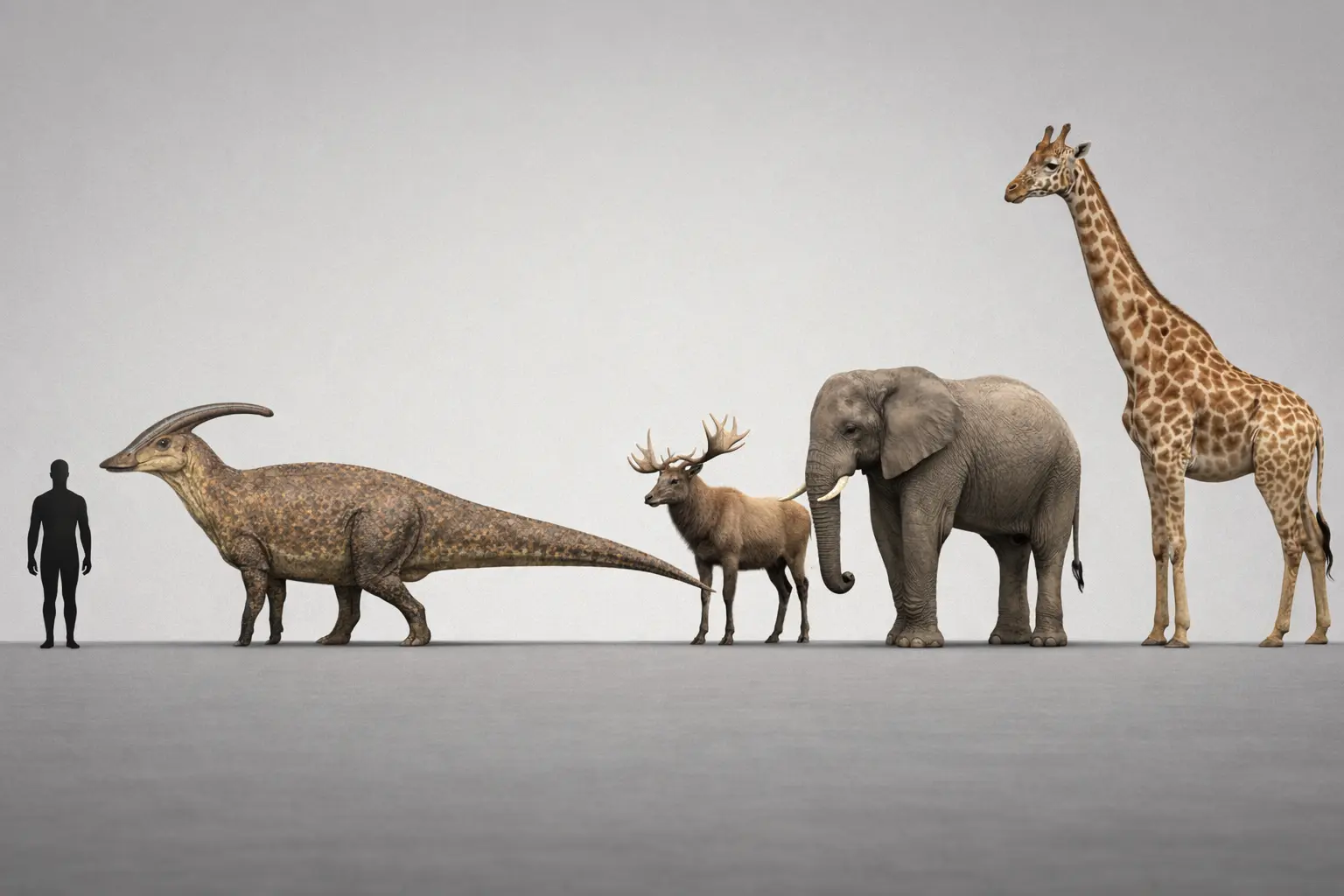
Size comparison of Parasaurolophus walkeri with human silhouette, elk-like ungulate, African elephant, and giraffe shown side by side in accurate scale

At a Glance Field Information Species Parasaurolophus walkeri, P. tubicen, P. cyrtocristatus Period Late Cretaceous (76.5–73 Ma) Length 9.5–11 m (31–36 ft) depending on species Height at hip Approximately 2.5–3 m (8.2–9.8 ft) Weight Estimated 2,500–4,000 kg (5,500–8,800 lb) — varies by species and model Posture Habitually quadrupedal; capable of bipedal locomotion Quick Answer: Parasaurolophus … Read more
Parasaurolophus Crest: Anatomy, Function, and What the Science Shows

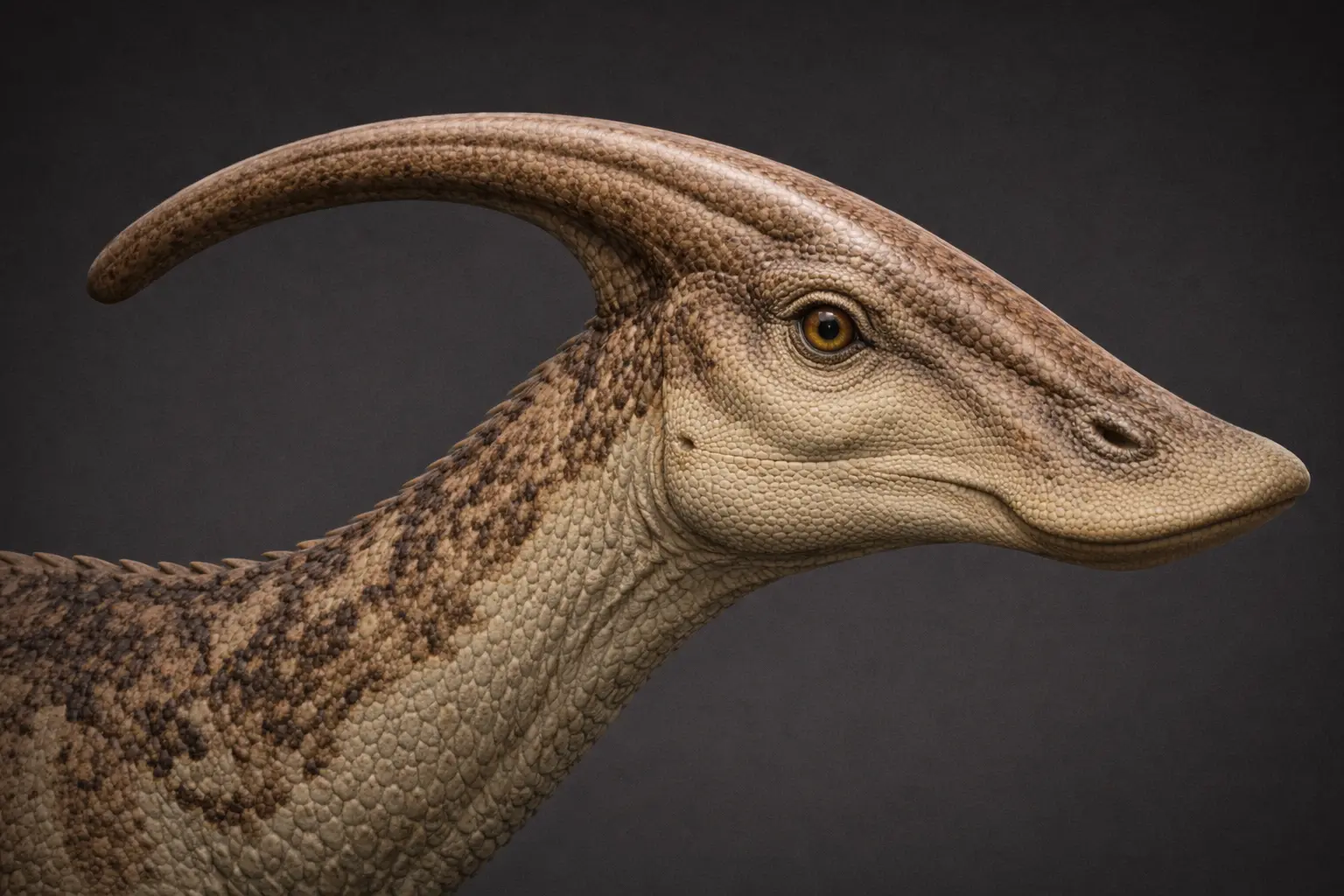
Photorealistic anatomical illustration of Parasaurolophus walkeri showing elongated tubular cranial crest and broad spatulate bill in three-quarter profile on a dark neutral background

At a Glance Field Information Species Parasaurolophus walkeri, P. tubicen, P. cyrtocristatus Period Late Cretaceous (76.5–73 Ma) Crest length Up to 1.8 m (5.9 ft) in P. walkeri Crest structure Hollow, formed by elongated nasal passages looping through the crest and back to the skull Primary function Acoustic resonance and species/individual recognition — supported by … Read more

Pachycephalosaurus Discovery and Fossil History

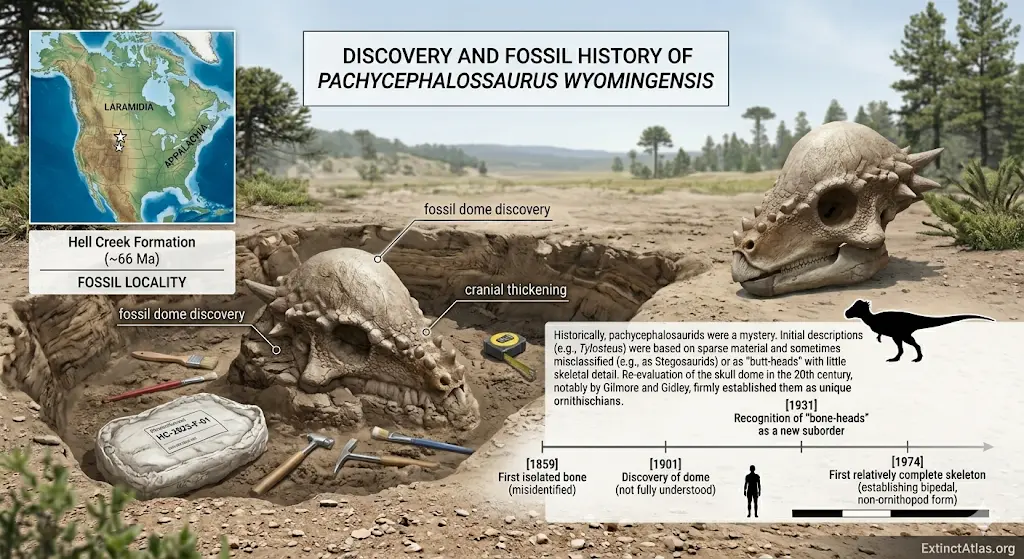
A semi-infographic photorealistic rendering of a Pachycephalosaurus wyomingensis fossil excavation in the Hell Creek Formation. The image features a partially unearthed domed skull in a sedimentary pit surrounded by paleontological tools like brushes and a plaster field jacket. A fully reconstructed skull and a bipedal silhouette are shown for reference, alongside a discovery timeline from 1859 to 1974 and a paleomap of Laramidia.

The fossil history of Pachycephalosaurus is a story of patience and incremental progress, spanning over 150 years from the first fragmentary discoveries to remarkably complete skulls acquired in 2024. Unlike dinosaurs known from multiple complete skeletons, Pachycephalosaurus remains are represented primarily by skull material, with the rest of the skeleton still poorly understood. This fragmentary … Read more

Pachycephalosaurus vs Tyrannosaurus Rex: Predator and Prey in the Hell Creek Formation

Photorealistic semi-infographic showing Pachycephalosaurus wyomingensis in the foreground and Tyrannosaurus rex in the background within the Hell Creek Formation, featuring radial callouts, paleomap inset, scale bar, and human silhouette for size comparison, illustrating Late Cretaceous predator–prey ecological context.

Popular media frequently depict Pachycephalosaurus battling Tyrannosaurus rex in dramatic confrontations, with the dome-headed herbivore using its skull as a weapon against the apex predator. The scientific reality is more sobering: these animals did share the same landscape during the final million years of the Cretaceous Period, and fossil evidence confirms T. rex hunted herbivorous … Read more

Is Dracorex the Same as Pachycephalosaurus? The Ontogeny Debate

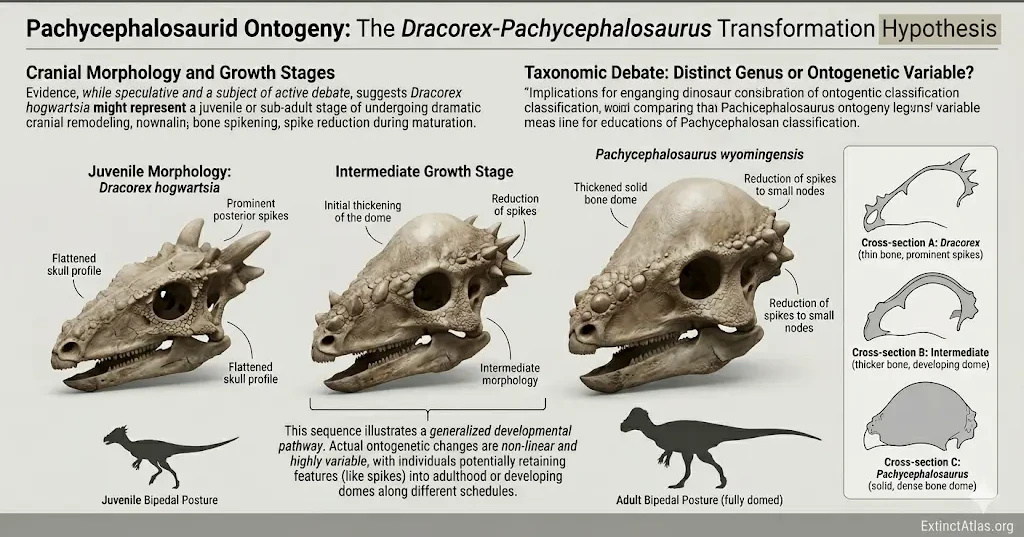
A museum-style infographic illustrating the ontogenetic transformation hypothesis of pachycephalosaurid dinosaurs. The image shows three photorealistic skulls arranged left-to-right: a flat-headed juvenile (Dracorex morphology) with slightly softened spikes, an intermediate growth stage, and a fully domed adult (Pachycephalosaurus). Diagrams and text callouts highlight bone densification and spike reduction, while captions emphasize that this non-linear developmental pathway is a speculative hypothesis subject to taxonomic debate.

One of the most significant debates in pachycephalosaur paleontology centers on whether Dracorex hogwartsia and Stygimoloch spinifer—two dinosaurs with dramatically different skull shapes from Pachycephalosaurus—represent distinct species or simply juvenile and subadult growth stages of Pachycephalosaurus wyomingensis. If the ontogenetic (growth-based) hypothesis is correct, it would eliminate two dinosaur species from the fossil record while … Read more

Pachycephalosaurus Dome Skull: Structure, Function, and Evolution

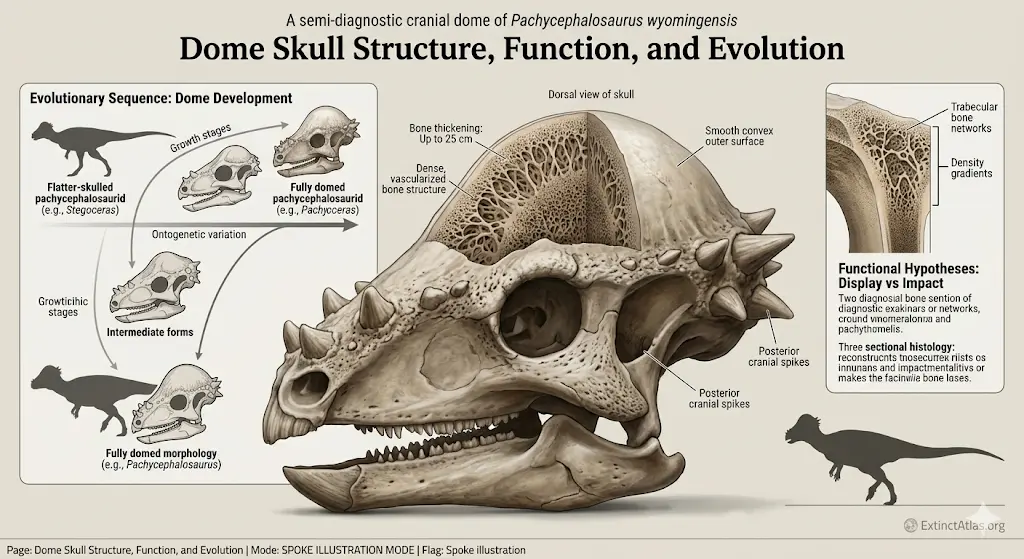
Semi-infographic showing Pachycephalosaurus dome skull structure with cross-section of thick bone, labeled anatomy, and evolutionary development from flat-headed ancestors to fully domed skulls

The skull dome of Pachycephalosaurus is one of the most distinctive features in the entire dinosaur fossil record—a massive, rounded structure of solid bone rising from the top of the skull, reaching thicknesses of up to 25 centimeters (10 inches) in the largest adults. This extraordinary cranial architecture has fascinated paleontologists for decades and sparked … Read more

What Did Pachycephalosaurus Eat? Diet and Feeding Evidence

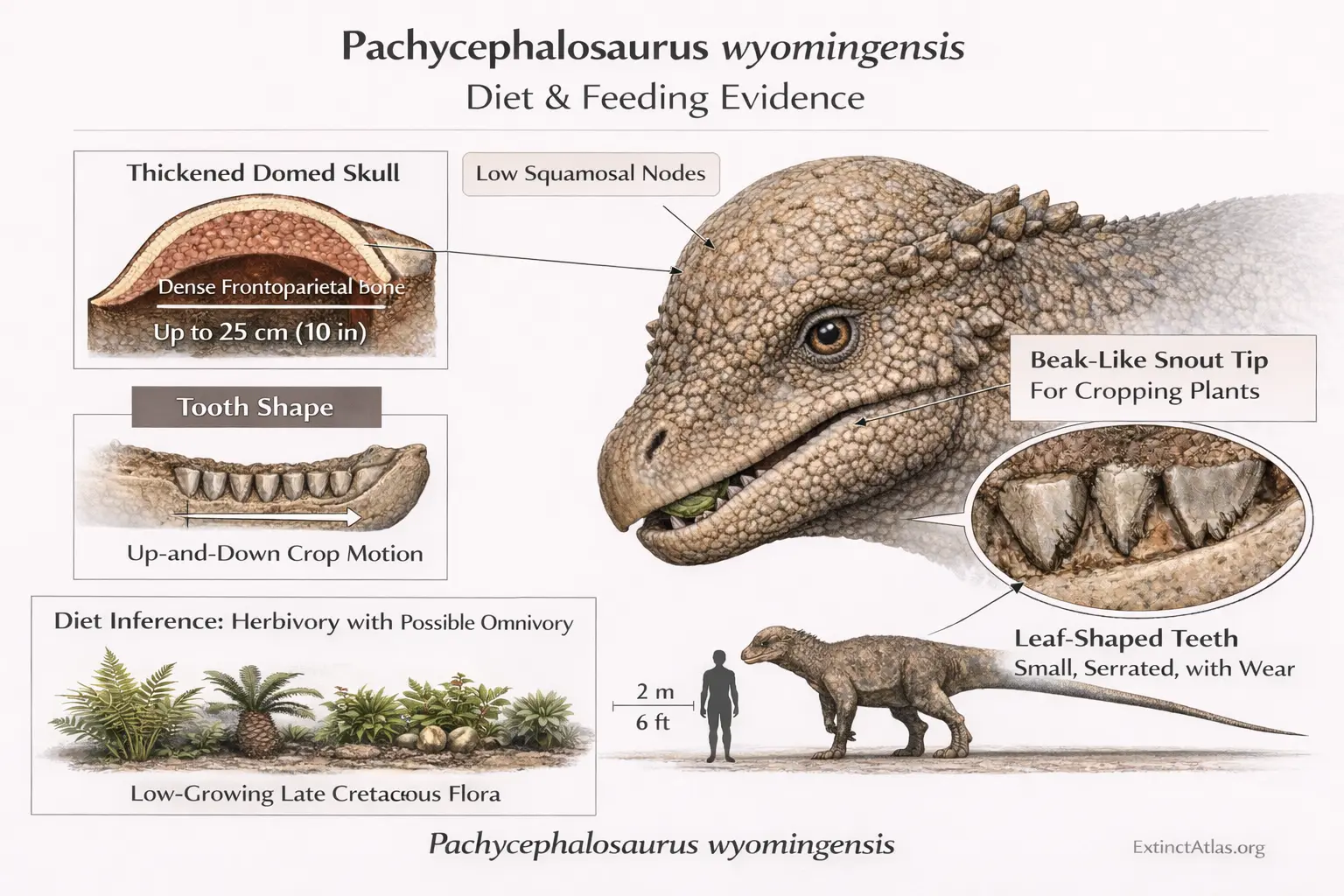
Semi-infographic scientific reconstruction of Pachycephalosaurus wyomingensis highlighting feeding anatomy, including keratinous beak-like snout, leaf-shaped teeth with wear, refined domed skull texture with low squamosal nodes, enlarged torso, extended stiff tail, and Late Cretaceous low-growing flora, with labeled jaw motion and diet inference (primarily herbivory, possible omnivory).

Pachycephalosaurus has traditionally been classified as a herbivore, browsing on Late Cretaceous vegetation with its leaf-shaped teeth. However, a 2018 discovery of juvenile skull material revealed unexpectedly sharp, serrated front teeth that suggest at least some individuals may have consumed animal protein, potentially including insects, small vertebrates, or carrion. This finding has reopened debate about … Read more

Did Pachycephalosaurus Headbutt? The Science Behind the Behavior

Scientific infographic comparing hypothesized behaviors of Pachycephalosaurus wyomingensis, showing oblique dome contact and flank-butting scenarios, cranial dome cross-section with trabecular structure, stress distribution diagrams, conservative scaly integument, and human scale reference (~4.5 m length), with behavior noted as hypothetical.

The image of two Pachycephalosaurus smashing their domed skulls together has dominated popular depictions for decades, but the scientific reality is far more nuanced. Modern research suggests that if these dinosaurs engaged in combat at all, they likely struck each other’s flanks rather than colliding head-on, and the dome may have served primarily as a … Read more

What Did Velociraptor Eat? Diet of the Feathered Predator

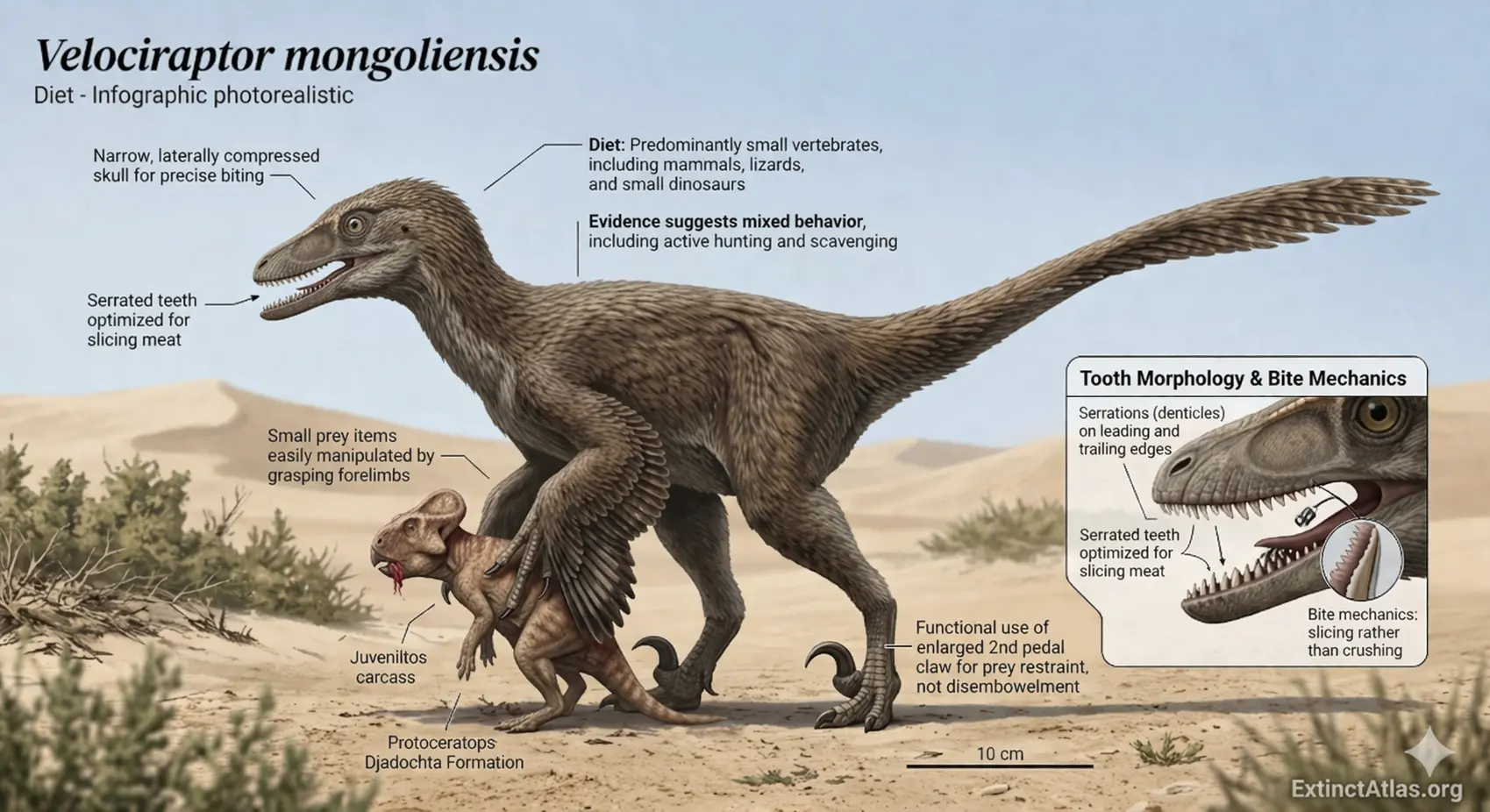
Photorealistic infographic of Velociraptor mongoliensis showing feathered body, reduced orbital size skull, serrated teeth, and hunting behavior with small prey in a desert environment, including tooth morphology and bite mechanics details.

At a Glance Field Information Species Velociraptor mongoliensis Diet Type Carnivore (opportunistic) Primary Prey Small vertebrates, 1–10 kg Known Prey Protoceratops, pterosaurs, small mammals Feeding Strategy Active hunting + scavenging Teeth Count 26–28 serrated teeth Quick Answer: Velociraptor was a carnivore that primarily hunted small mammals, lizards, and juvenile dinosaurs while also scavenging carrion when … Read more

Velociraptor Size: How Big Was This Dinosaur Really?

Alt Tag: A photorealistic size comparison infographic featuring a feathered Velociraptor mongoliensis standing alongside a human silhouette, a Common Raven, a Red-tailed Hawk, and a Secretary Bird to illustrate its true scale.

At a Glance Field Information Species Velociraptor mongoliensis Period Late Cretaceous (75–71 Ma) Length 1.5–2.07 m (5–6.8 ft) Hip Height 0.5 m (1.6 ft) Weight 14–20 kg (31–43 lb) Size Comparison Turkey-sized Quick Answer: Velociraptor measured approximately 2 meters (6.5 feet) from nose to tail and stood only 0.5 meters (1.6 feet) tall at the … Read more