

At a Glance
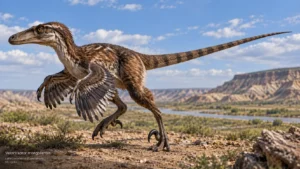
| Field | Information |
|---|---|
| Species | Velociraptor mongoliensis |
| Period | Late Cretaceous (75–71 Ma) |
| Length | 1.5–2.07 m (5–6.8 ft) |
| Hip Height | 0.5 m (1.6 ft) |
| Weight | 14–20 kg (31–43 lb) |
| Size Comparison | Turkey-sized |
Quick Answer: Velociraptor measured approximately 2 meters (6.5 feet) from nose to tail and stood only 0.5 meters (1.6 feet) tall at the hip. Adults weighed between 14 and 20 kilograms (31–43 pounds)—roughly the size of a modern turkey, not the human-sized predators portrayed in popular films.
The skeletal remains lie mounted in the Gobi Desert sand, preserved exactly where they fell 75 million years ago. The skull measures barely 25 centimeters long. The legs, though clearly built for speed, would have barely reached an adult human’s knee. This is Velociraptor—not the towering nightmare of cinema, but a turkey-sized predator whose true dimensions tell a far more interesting story than Hollywood ever did.
How Big Was Velociraptor Really?
Velociraptor was a small to medium-sized dromaeosaurid dinosaur. Adult specimens ranged from 1.5 to 2.07 meters in total length, with approximately half that length consisting of the stiff, rod-like tail. At the hips, where paleontologists measure dinosaur height, Velociraptor stood roughly 50 centimeters tall—about the height of a medium-sized dog.
The most complete specimens suggest an average adult weighed between 14 and 19.7 kilograms. The largest known individuals may have reached 20 kilograms, but this remained well below the mass of most adult humans. One particularly well-preserved specimen (IGM 100/981) represents an animal estimated at 1.5 meters long and 15 kilograms in weight.
These measurements come from multiple fossil skeletons discovered primarily in Mongolia’s Djadochta Formation. Over a dozen described specimens provide paleontologists with reliable size data, making Velociraptor one of the better-understood dromaeosaurids in terms of physical dimensions.
Body Proportions and Build
Velociraptor possessed a lightweight skeletal structure with hollow bones—an adaptation it shared with modern birds. The skull measured up to 25 centimeters in length, appearing long and low with an upturned snout. The neck was slender and flexible, connecting to a compact body built for agility rather than power.
The forelimbs were relatively short compared to the hindlimbs, measuring approximately 47 centimeters from the shoulder to the tips of the three-fingered hands. The hindlimbs were proportionally longer and more robust, with the femur (thigh bone) and tibia (shin bone) indicating a cursorial lifestyle adapted for running.
The tail comprised more than half the total body length. Ossified tendons and elongated vertebral processes created a stiff, inflexible structure that functioned as a dynamic counterbalance during high-speed pursuit and rapid directional changes. This tail design was characteristic of dromaeosaurid dinosaurs and crucial to their hunting strategy.
Size Variation and Growth
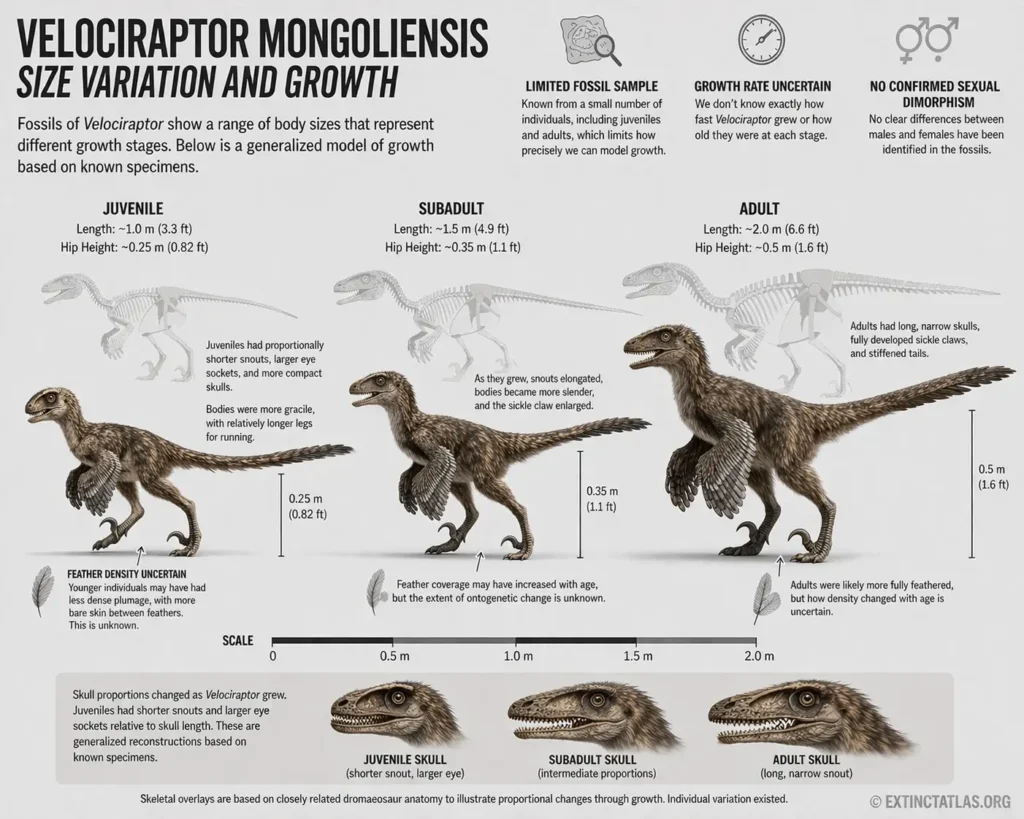
Like most dinosaur species, Velociraptor exhibited some size variation between individuals. Juvenile specimens show proportionally shorter snouts and larger eye sockets relative to skull length—features typical of young animals across many vertebrate groups.
The smallest confirmed Velociraptor specimens suggest hatchlings or very young juveniles were considerably smaller than adults, though complete growth series data remain limited. Based on bone histology studies of related dromaeosaurids, Velociraptor likely reached adult size within several years of hatching, though growth rates varied depending on environmental conditions and food availability.
Sexual dimorphism—size differences between males and females—has been proposed for some dromaeosaurid species, but definitive evidence for Velociraptor remains elusive. The known specimens fall within a relatively narrow size range that could represent either a single sex or minimal dimorphism between sexes.
Why Velociraptor Looked Bigger in Jurassic Park
The larger, human-sized “raptors” depicted in films are based primarily on Deinonychus rather than Velociraptor.
The movie’s “Velociraptors” were actually modeled after Deinonychus antirrhopus, a larger North American dromaeosaurid that lived 30 million years before Velociraptor. Deinonychus could reach 3.4 meters in length and weighed 60–73 kilograms. Author Michael Crichton chose the name “Velociraptor” for his novel because it sounded more dramatic than “Deinonychus,” and the films followed this naming convention.
Director Steven Spielberg later stated he preferred the larger, more imposing design for cinematic impact. The film’s paleontological advisor acknowledged the size inaccuracy but noted the creative team prioritized entertainment value over strict scientific accuracy.
Velociraptor Compared to Modern Animals
The most accurate modern comparison for Velociraptor’s size is a large turkey or a small wolf. A male wild turkey can reach 11 kilograms and stand 1.2 meters tall—dimensions remarkably close to Velociraptor’s build, though the dinosaur’s long tail extended its total length beyond any modern bird.
In terms of predatory behavior and proportions, Velociraptor more closely resembled modern birds of prey like hawks or eagles. A female golden eagle weighs 4–7 kilograms with a wingspan of 2 meters, sharing Velociraptor’s predatory adaptations and hunting strategy despite being smaller in body mass.
Red foxes provide another useful comparison. An adult red fox weighs 5–7 kilograms and measures roughly 60 centimeters at the shoulder, slightly larger than Velociraptor at the hips, but similar in overall predatory niche as a small to medium-sized carnivore.
How Velociraptor’s Size Affected Its Hunting
Velociraptor’s modest size dictated its prey selection and hunting strategy. At 15–20 kilograms, it was too small to regularly tackle large herbivorous dinosaurs like adult Protoceratops (which could exceed 180 kilograms). Instead, paleontological evidence suggests Velociraptor targeted prey closer to its own size or smaller.
Its lightweight build and powerful hindlimbs indicate a focus on balance, coordination, and rapid directional movement rather than sustained high-speed pursuit.
The relatively short metatarsus (foot bones) suggests Velociraptor sacrificed some speed for foot strength. This anatomical feature appears in modern birds of prey that pin down struggling victims rather than simply chasing them to exhaustion. The compact size allowed Velociraptor to leap onto prey, using body weight and the famous sickle claws to restrain animals of comparable mass.
Fossil evidence, including a pterosaur bone found in one Velociraptor’s gut, indicates these predators also scavenged carrion when opportunities arose. The small size meant Velociraptor could exploit food sources larger predators might ignore—stealing eggs, hunting young dinosaurs, and feeding on carcasses without needing to defend them from bigger competitors.
Related and Contemporary Species
Velociraptor shared its Late Cretaceous ecosystem with several related and comparable species that provide context for its size. Protoceratops andrewsi, though not closely related, appears frequently in association with Velociraptor fossils and represents a prey species several times larger than the predator. The famous “Fighting Dinosaurs” fossil preserves both animals locked in combat, demonstrating that Velociraptor occasionally attempted to take down larger prey despite the size mismatch.
Within the dromaeosaurid family, Velociraptor was considerably smaller than its North American relatives. Deinonychus antirrhopus reached 3.4 meters in length and 60–73 kilograms in weight—approximately three times heavier than Velociraptor. Utahraptor ostrommayorum dwarfed both species, potentially reaching 7 meters long and 500 kilograms, making it comparable to a large bear rather than a turkey.
Microraptor zhaoianus, a contemporary from China, was even smaller than Velociraptor at roughly 40–90 centimeters in length and 0.5–1 kilogram in weight. This crow-sized dromaeosaurid had four wings and may have been capable of gliding, demonstrating the size diversity within the family.
Tsaagan mangas, another Mongolian dromaeosaurid, was similar in size to Velociraptor and may have competed for the same resources. The two species appear to have occupied similar ecological niches in their respective time periods and locations.
Frequently Asked Questions
Was Velociraptor the smallest raptor?
No. Velociraptor was small to medium-sized within its family. Microraptor from China was significantly smaller, measuring only 40–90 centimeters in length and weighing less than 1 kilogram—about crow-sized. Several other dromaeosaurids, including some specimens of Bambiraptor and Hesperonychus, were smaller than Velociraptor. However, Velociraptor was indeed much smaller than its famous relatives, Deinonychus and Utahraptor, which appeared larger in the fossil record.
Could Velociraptor kill a human?
While Velociraptor was a capable predator with sharp teeth and sickle claws, its turkey-sized dimensions would have made killing a healthy adult human extremely difficult. At 15–20 kilograms, it weighed less than many dog breeds that rarely pose fatal threats to adult humans.
The sickle claw could inflict serious puncture wounds, and the teeth could cause lacerating injuries, but a human’s size advantage and ability to use tools or defend themselves would likely prevent a fatal outcome. Velociraptor evolved to hunt small mammals, lizards, and juvenile dinosaurs—not large primates with opposable thumbs and problem-solving abilities.
Did Velociraptor hunt in packs to compensate for its small size?
Despite popular depictions, evidence for pack hunting in Velociraptor remains weak. Unlike Deinonychus, where multiple individuals have been found associated with single prey animals, Velociraptor fossils are typically discovered in isolation.
One trackway from China shows six large dromaeosaurids moving together, but the species identification is uncertain,n and the behavior could represent migration rather than cooperative hunting. Modern raptorial birds of similar size, like hawks and eagles, are largely solitary hunters. Velociraptor’s size suggests it hunted prey comparable to or smaller than itself, reducing the need for pack coordination.
Conclusion
Velociraptor’s true size—turkey-sized rather than human-sized—reveals a predator perfectly adapted to its ecological niche. The compact, lightweight build enabled speed, agility, and the ability to exploit food sources unavailable to larger carnivores, while the powerful hindlimbs and specialized claws made it a formidable hunter within its weight class.
References
Norell MA, Makovicky PJ. 1999. Important features of the dromaeosaur skeleton II: information from newly collected specimens of Velociraptor mongoliensis. American Museum Novitates. 3282:1–45.
Turner AH, Makovicky PJ, Norell MA. 2012. A review of dromaeosaurid systematics and paravian phylogeny. Bulletin of the American Museum of Natural History. 371:1–206.
Barsbold R, Osmólska H. 1999. The skull of Velociraptor (Theropoda) from the Late Cretaceous of Mongolia. Acta Palaeontologica Polonica. 44(2):189–219.
Persons WS IV, Currie PJ. 2016. An approach to scoring cursorial limb proportions in carnivorous dinosaurs and an attempt to account for allometry. Scientific Reports. 6:19828.
Manning PL, Payne D, Pennicott J, Barrett PM, Ennos RA. 2006. Dinosaur killer claws or climbing crampons? Biology Letters. 2(1):110–112.
Ostrom JH. 1969. Osteology of Deinonychus antirrhopus, an unusual theropod from the Lower Cretaceous of Montana. Peabody Museum Bulletin. 30:1–165.
Xu X, Norell MA, Wang X, Makovicky PJ, Wu X. 2002. A basal troodontid from the Early Cretaceous of China. Nature. 415(6873):780–784.
Recommended Paleontology & Natural History Books
As an Amazon Associate, Extinct Atlas may earn from qualifying purchases.
The Rise and Fall of the Dinosaurs
A compelling history of dinosaurs, tracing their origins, diversification, 200-million-year reign, extinction, and enduring legacy.
Dinosaurs and Prehistoric Life
A richly illustrated visual reference exploring dinosaurs, fossils, evolution, and prehistoric life across geological time.
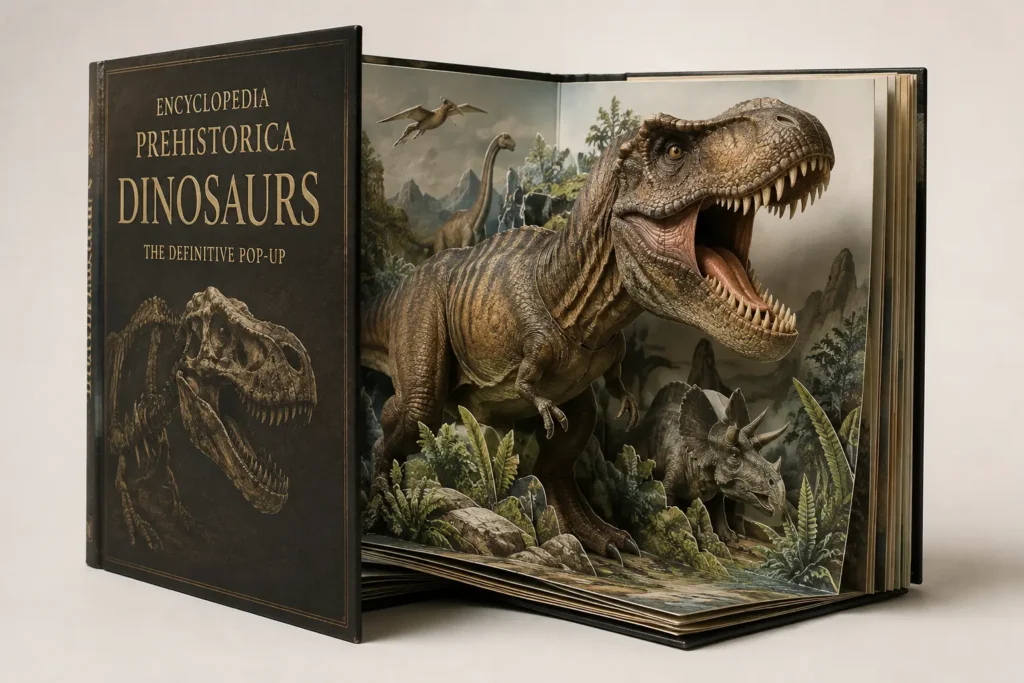
Encyclopedia Prehistorica: Dinosaurs
An interactive dinosaur book featuring spectacular three-dimensional pop-ups, particularly suited to young readers and families.
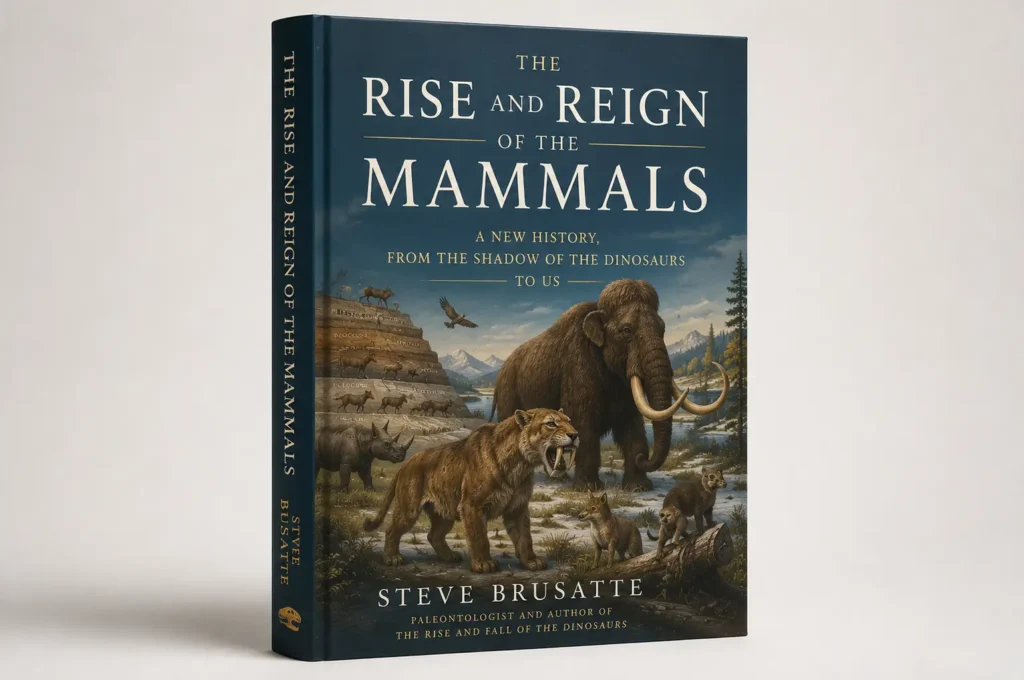
The Rise and Reign of the Mammals
A sweeping history of mammalian evolution, from their origins alongside dinosaurs through the Cenozoic and the emergence of humans.