

| Attribute | Detail |
|---|---|
| Scientific name | Velociraptor mongoliensis |
| Pronunciation | veh-loss-ih-RAP-tor mon-GOH-lee-en-sis |
| Name meaning | Swift thief |
| Period | Late Cretaceous |
| Lived | 75–71 Ma |
| Found in | Mongolia, northern China |
| Diet | Carnivore — small vertebrates, lizards, possibly Protoceratops |
| Length | ~2 m |
| Weight | ~15–20 kg |
| Classification | Dinosauria, Theropoda, Dromaeosauridae |
Quick Answer: Velociraptor was a small, feathered predator that lived in the Gobi Desert around 75–71 million years ago. About the size of a large turkey, it was far smaller than its Jurassic Park portrayal. It is best known for its enlarged sickle claw, confirmed feathers, and the extraordinary Fighting Dinosaurs fossil that preserves it locked in combat with Protoceratops.
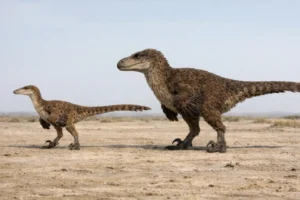
Few dinosaurs are more famous — and more misunderstood. The Velociraptor of popular culture is a human-sized, scaly, pack-hunting monster. The real animal was a feathered predator roughly the weight of a border collie, hunting lizards and small mammals across ancient Mongolian dunes. The gap between myth and fossil evidence is the most interesting thing about it.
Size and Physical Appearance
Velociraptor reached approximately 2 metres in length and weighed between 15 and 20 kilograms — comparable to a large turkey or a small dog. Its body was lightly built, with hollow bones, a long, stiffened tail used for balance, and forward-facing eyes that gave it good depth perception. For a full breakdown of its dimensions and how it compares to related species, see Velociraptor Size.
Diet and Hunting Strategy
Velociraptor was a carnivore. Fossil evidence suggests it fed primarily on small vertebrates — lizards, small mammals, and possibly juvenile dinosaurs. The Fighting Dinosaurs specimen confirms it attacked Protoceratops, though whether this represents active predation or scavenging remains debated. For a detailed examination of its diet and feeding behaviour, see What Did Velociraptor Eat.
The Famous Sickle Claw
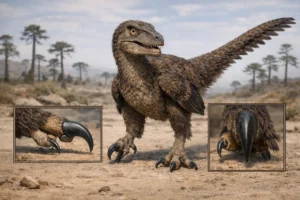
The enlarged, sickle-shaped claw on the second toe of each foot is Velociraptor’s most distinctive anatomical feature. Current evidence indicates it functioned as a gripping and pinning tool rather than a slashing weapon — used to anchor onto struggling prey rather than inflict lacerating wounds. For the full anatomy and function of this structure, see Velociraptor Sickle Claw.
Feathers and Flight
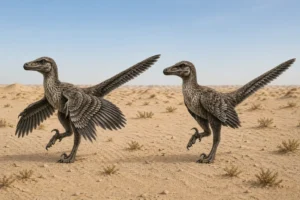
Velociraptor had feathers. Quill knobs preserved on a forearm bone confirm this directly. It could not fly — its arms were too short and its body too heavy — but feathers likely served for insulation, display, or brooding. This single discovery fundamentally changed how the animal is reconstructed. For the full evidence and what the feathers were for, see Did Velociraptor Have Feathers.
How Velociraptor Compares to Deinonychus
Deinonychus was roughly three to four times heavier than Velociraptor and nearly twice as long. The two are frequently confused because Jurassic Park used Velociraptor’s name while basing the animal’s size and behaviour largely on Deinonychus. They lived on different continents and were separated by approximately 35 million years — a direct encounter was impossible. For a full comparison, see Velociraptor vs Deinonychus.
Discovery and Famous Fossils
Velociraptor was first discovered in 1923 in Mongolia’s Gobi Desert during an American Museum of Natural History expedition. The species was formally named by Henry Fairfield Osborn in 1924. The most celebrated specimen — the Fighting Dinosaurs fossil, found in 1971 — preserves a Velociraptor and a Protoceratops locked in combat at the moment of death. For the full discovery history, see Velociraptor Discovery.
Intelligence and Behavior
Velociraptor had a relatively large brain for its body size compared to most non-avian dinosaurs, which scientists associate with enhanced sensory processing and coordination rather than abstract reasoning. The popular idea of pack-hunting raptors coordinating like wolves is not directly supported by fossil evidence — current evidence indicates solitary or opportunistic hunting is more consistent with what the fossils show. The pack-hunting hypothesis derives largely from Jurassic Park rather than palaeontology.
Velociraptor in Popular Culture
The Jurassic Park franchise made Velociraptor one of the most recognisable dinosaurs on earth — and one of the most inaccurately depicted. The film’s raptors were human-sized, scaly, and portrayed as highly coordinated pack hunters. The real animal was roughly a third of that size, feathered, and almost certainly not the cooperative social predator the films depict. The name was chosen by Michael Crichton partly for dramatic effect, with the animal’s physical characteristics drawn more from Deinonychus. This cluster is dominated by major entertainment and media publishers and is not a realistic target for specialist content.
When and Where Velociraptor Lived
Velociraptor lived during the Late Cretaceous, approximately 75–71 million years ago, in what is now the Gobi Desert of southern Mongolia and northern China. Fossil evidence shows it inhabited a semi-arid landscape of dunes, sparse vegetation, and seasonal water sources—very different from the lush tropical environments often portrayed in films. It shared this ecosystem with dinosaurs such as Protoceratops, Oviraptor, and Pinacosaurus, along with other small theropods. Two species are currently recognised: Velociraptor mongoliensis and Velociraptor osmolskae.
Related and Contemporary Species
- Protoceratops andrewsi — ceratopsian preserved in direct combat with Velociraptor in the Fighting Dinosaurs fossil; the most intimately documented animal in Velociraptor’s fossil record
- Deinonychus antirrhopus — larger North American dromaeosaurid; frequently confused with Velociraptor due to Jurassic Park
- Microraptor gui — a small four-winged dromaeosaurid from China; among the best-preserved feathered dinosaurs in the family
- Utahraptor ostrommaysorum — largest known dromaeosaurid; closest in size to the Jurassic Park depiction
- Tsaagan mangas — Mongolian dromaeosaurid contemporary with Velociraptor; contextualises the Central Asian raptor fauna
Common Questions About Velociraptor
Was Velociraptor really as big as in Jurassic Park?
No. The real Velociraptor was approximately 2 metres long and weighed 15–20 kilograms — a small, lightly built predator. The Jurassic Park animal was based more closely on Deinonychus, which was significantly larger, and was scaled up further still during production.
Did Velociraptors hunt in packs?
There is no direct fossil evidence of pack hunting in Velociraptor. The behaviour is widely assumed because of Jurassic Park, but current evidence points toward solitary or opportunistic hunting. Some dromaeosaurids may have gathered at carcasses, but coordinated group predation is not supported by the fossil record.
How fast was Velociraptor?
Velociraptor was likely capable of speeds in the range of 25–40 kilometres per hour, based on biomechanical modelling. Its lightly built frame and long legs suggest it was adapted for agility and maneuverability rather than explosive sprinting, making it an effective hunter of small, fast-moving prey.
Was Velociraptor the smartest dinosaur?
Velociraptor had a relatively large brain for its body size compared to many non-avian dinosaurs, suggesting advanced sensory processing and coordination. However, it was not uniquely “intelligent,” and similar or higher encephalisation levels are seen in closely related groups such as troodontids.

🦷 Anatomy


Recommended Paleontology & Natural History Books
As an Amazon Associate, Extinct Atlas may earn from qualifying purchases.
The Rise and Fall of the Dinosaurs
A compelling history of dinosaurs, tracing their origins, diversification, 200-million-year reign, extinction, and enduring legacy.
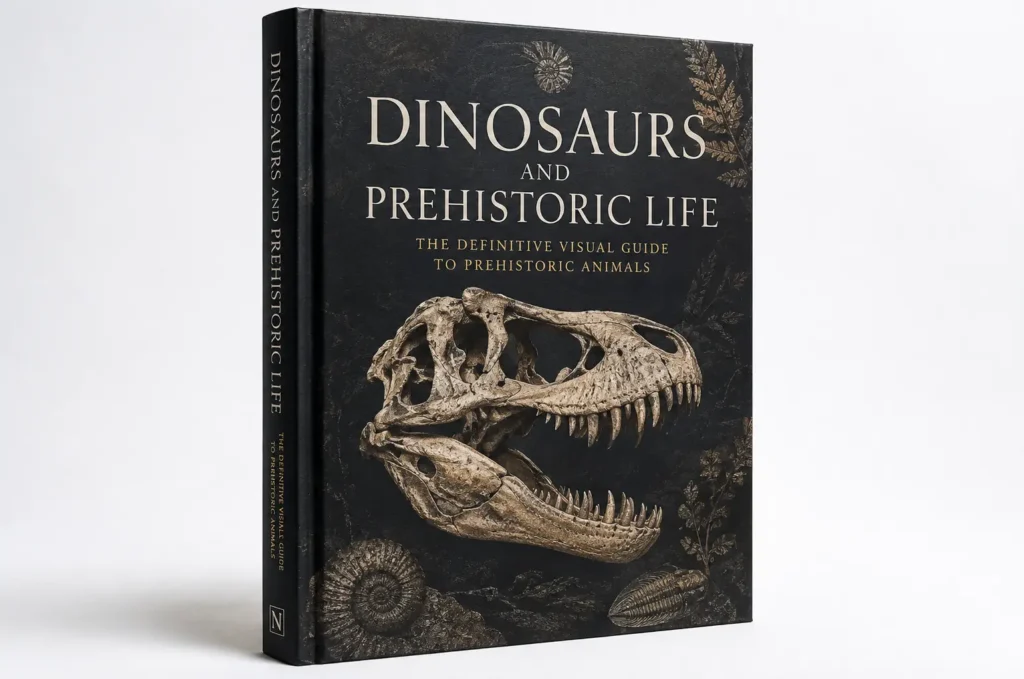
Dinosaurs and Prehistoric Life
A richly illustrated visual reference exploring dinosaurs, fossils, evolution, and prehistoric life across geological time.
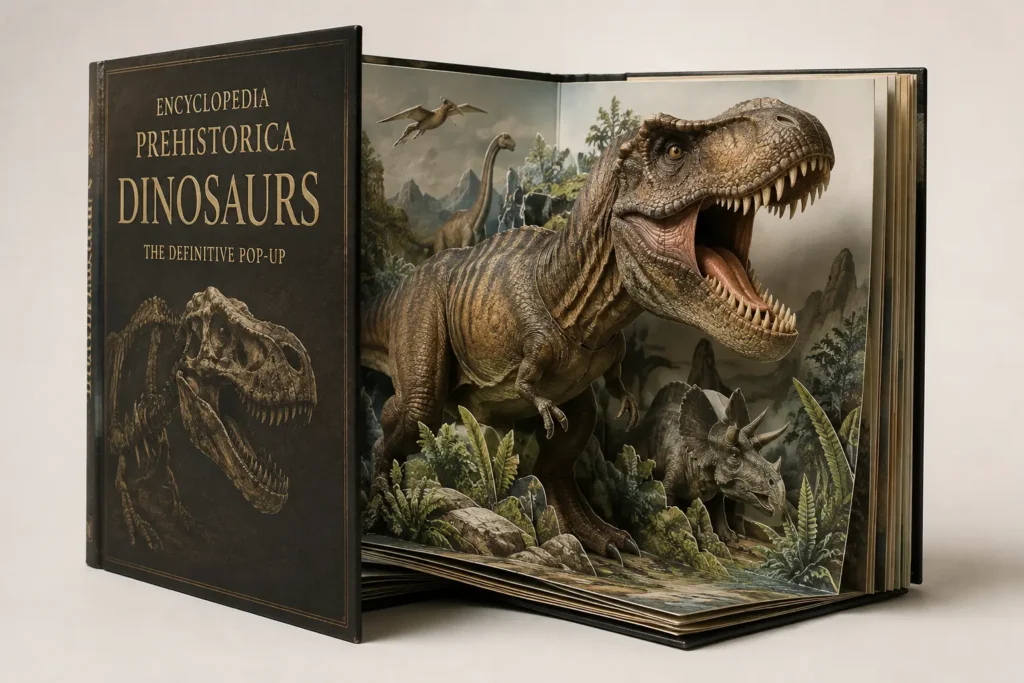
Encyclopedia Prehistorica: Dinosaurs
An interactive dinosaur book featuring spectacular three-dimensional pop-ups, particularly suited to young readers and families.
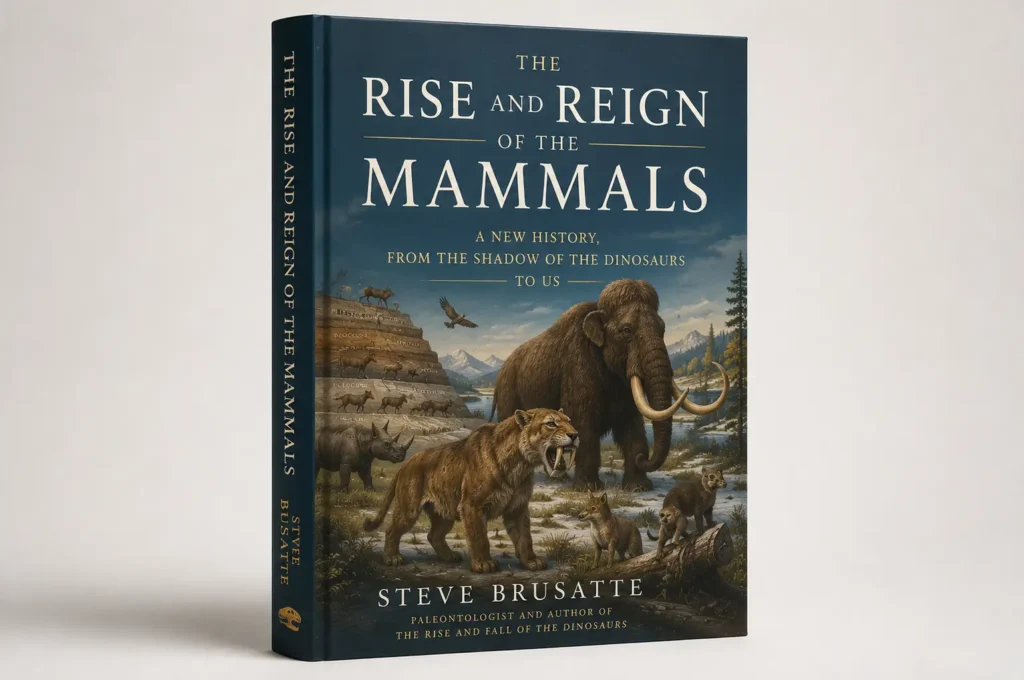
The Rise and Reign of the Mammals
A sweeping history of mammalian evolution, from their origins alongside dinosaurs through the Cenozoic and the emergence of humans.