
Quick Info
| Field | Information |
|---|---|
| Species | Ankylosaurus magniventris — Ornithischia, Ankylosauridae |
| Geological Period | Late Cretaceous |
| Geological Stage | Late Maastrichtian |
| Approximate Age Range | Known fossil occurrence: approximately 68–66 Ma |
| Known Formations | Hell Creek Formation; Lance Formation |
| Extinction Horizon | Cretaceous–Paleogene (K–Pg) boundary, 66.0 Ma |
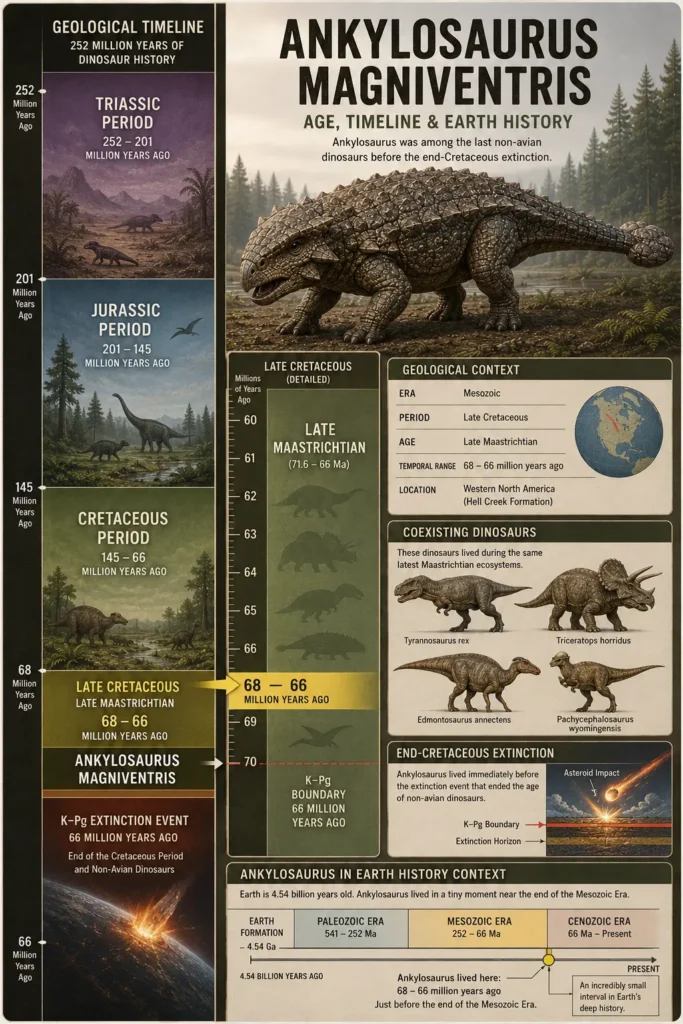
Quick Answer: Ankylosaurus magniventris lived during the latest part of the Late Cretaceous, approximately 68–66 million years ago in the late Maastrichtian. It was among the final non-avian dinosaurs known from North America before the end-Cretaceous mass extinction.

When Did Ankylosaurus Live?
Ankylosaurus magniventris is known from the late Maastrichtian stage of the Late Cretaceous, approximately 68–66 million years ago. Fossils attributable to the species come primarily from the Hell Creek Formation and the broadly equivalent Lance Formation of western North America, both representing ecosystems from the closing interval of the Cretaceous.
The Maastrichtian itself spans approximately 72.1–66.0 million years ago, but Ankylosaurus is not known throughout that entire interval. Current fossil evidence places the genus within the final portion of the stage, making it one of the latest known non-avian dinosaur genera.
Because Ankylosaurus occurs so close to the end of the Mesozoic, it is frequently described as one of the latest known non-avian dinosaur genera from North America. This is accurate in temporal terms, though many other dinosaur taxa also persisted into the latest Maastrichtian.
Relationship to the End-Cretaceous Extinction
The known temporal range of Ankylosaurus ends near the Cretaceous–Paleogene (K–Pg) boundary at 66.0 million years ago, the global extinction horizon associated with the Chicxulub impact event and broader environmental collapse.
This extinction event eliminated all non-avian dinosaurs, alongside many marine reptiles, ammonites, and numerous other lineages.
However, it cannot currently be demonstrated that Ankylosaurus survived literally until the final moments before the boundary. Fossil occurrence data rarely provide that level of temporal precision at the species scale.
The strongest defensible statement is that Ankylosaurus lived during the latest Maastrichtian and disappeared as part of the end-Cretaceous extinction interval.
Geological Context
The late Maastrichtian ecosystems inhabited by Ankylosaurus existed during the final phase of the Western Interior Seaway’s retreat, when western North America consisted of broad coastal plains, river systems, wetlands, and forested habitats.
This was a biologically rich interval containing iconic contemporaries such as Tyrannosaurus, Triceratops, and Edmontosaurus, all living during the final chapter of non-avian dinosaur evolution.
Why the Time Range Matters
Knowing when Ankylosaurus lived is important for interpreting its ecology and evolution.
As one of the latest ankylosaurids, it represents a highly derived armored dinosaur lineage surviving until the close of the dinosaur era. Its anatomy reflects tens of millions of years of ankylosaur evolution, culminating immediately before the K–Pg extinction event, which reset terrestrial ecosystems globally.
How Is the Age of Ankylosaurus Determined?
The age of Ankylosaurus magniventris is determined through stratigraphic correlation and high-precision geochronology applied to the rock units in which its fossils occur, rather than direct radiometric dating of the bones themselves.
Ankylosaurus specimens are known from the latest Cretaceous sedimentary formations, principally the Hell Creek Formation and the Lance Formation. Because sedimentary rocks generally cannot be dated directly with the same precision as igneous units, paleontologists constrain age using datable volcanic ash horizons (bentonites), regional stratigraphy, magnetostratigraphy, and biostratigraphic correlation.
Volcanic ash layers associated with the Hell Creek sequence have been dated using uranium–lead (U–Pb) and argon-based radiometric methods, producing highly refined age constraints for the latest Maastrichtian and the Cretaceous–Paleogene boundary at approximately 66 million years ago.
The commonly cited ~68–66 million year range for Ankylosaurus reflects its stratigraphic occurrence within these late Maastrichtian deposits rather than species-specific direct dating.
Although the Hell Creek Formation is among the best-constrained latest Cretaceous terrestrial formations globally, assigning a precise first appearance date for Ankylosaurus remains limited by fossil sampling and taxonomic occurrence rather than geochronological uncertainty alone.
Where Does Ankylosaurus Fit in the History of Life?
Ankylosaurus occupied the final chapter of non-avian dinosaur evolution.
The Mesozoic Era spanned approximately 252 to 66 million years ago, encompassing the Triassic, Jurassic, and Cretaceous periods. Ankylosaurus lived only during the final part of this immense interval, making it a very late representative of dinosaur evolutionary history.
As a derived ankylosaurid, Ankylosaurus belonged to a lineage of armored ornithischian dinosaurs with origins considerably earlier than its own appearance. The earliest definitive ankylosaurs are known from the Jurassic, with the clade diversifying long before the Late Cretaceous giant forms emerged.
This makes Ankylosaurus not an early armored dinosaur, but one of the most evolutionarily specialized late survivors of a long-established lineage.
The Stegosaurus Comparison
A useful temporal comparison helps illustrate deep dinosaur timescales.
Stegosaurus lived during the Late Jurassic, approximately 155–150 million years ago, whereas Ankylosaurus lived around 68–66 million years ago. This places roughly 80–90 million years between them.
That separation exceeds the time between Ankylosaurus and the present.
This means the common popular depiction of Stegosaurus and Ankylosaurus as ecological contemporaries is entirely incorrect. They were separated by a vast evolutionary interval, occupying profoundly different ecosystems and geological worlds.
The Maastrichtian Stage: Global Context
The Maastrichtian, the final stage of the Cretaceous Period (approximately 72.1–66.0 million years ago), was a time of significant environmental and geological transition.
Global sea levels remained elevated relative to the modern world, but they had declined from earlier Late Cretaceous highs. As a consequence, major inland seaways—including the Western Interior Seaway in North America—were retreating, reshaping continental habitats and altering regional ecosystems.
Global climates remained substantially warmer than today, consistent with the Late Cretaceous greenhouse world, although multiple datasets suggest climatic instability and possible long-term cooling trends during parts of the Maastrichtian. The precise magnitude, timing, and ecological consequences of these changes remain active research topics.
One of the most significant geological events of the interval was the emplacement of the Deccan Traps large igneous province in present-day India. These eruptions released major volumes of greenhouse gases and sulfur-bearing aerosols, with probable climatic and ecological consequences. The extent to which Deccan volcanism contributed to late Maastrichtian environmental stress—independently or in combination with the Chicxulub impact—remains scientifically debated.
Ankylosaurus lived within this dynamic environmental backdrop during the final interval of non-avian dinosaur history.
A small but important precision point: while Ankylosaurus lived during the latest Maastrichtian, current fossil evidence does not demonstrate that individual populations survived literally until the final instant of the K–Pg boundary. The defensible statement is that the genus belonged to the extinction interval that eliminated non-avian dinosaurs.
Related and Temporal Comparison Species
- Tyrannosaurus rex — a confirmed late Maastrichtian contemporary from the same North American ecosystems, representing the clearest predator comparison for Ankylosaurus.
- Triceratops — a direct contemporary from the Hell Creek and equivalent formations, sharing the same late Cretaceous ecological setting.
- Edmontosaurus annectens — another exact latest Maastrichtian contemporary and major herbivorous component of the same ecosystem.
- Stegosaurus armatus — a useful temporal contrast rather than a contemporary species. Although often associated with Ankylosaurus in popular culture, Stegosaurus lived roughly 80–90 million years ago in the Late Jurassic.
- Euoplocephalus tutus — a closely related ankylosaurid from the earlier Campanian, illustrating that Ankylosaurus represents a late-surviving member of an already well-established armored dinosaur lineage.
Frequently Asked Questions
How long ago did Ankylosaurus live?
Ankylosaurus magniventris lived approximately 68–66 million years ago during the late Maastrichtian stage of the Late Cretaceous. This age range is established through stratigraphic correlation and radiometric dating of associated volcanic ash horizons within the latest Cretaceous rock sequences that preserve their fossils.
It’s known fossil record places it within the final roughly two million years of the Cretaceous, immediately before the end-Cretaceous mass extinction.
Did Ankylosaurus live at the same time as Stegosaurus?
No.
Stegosaurus lived during the Late Jurassic, approximately 155–150 million years ago, whereas Ankylosaurus lived approximately 68–66 million years ago in the Late Cretaceous.
This means the two genera were separated by roughly 80–90 million years, longer than the time separating Ankylosaurus from the present day.
Their frequent pairing in popular media is historically inaccurate.
Was Ankylosaurus one of the last dinosaurs?
Yes—Ankylosaurus was among the final known non-avian dinosaurs.
Its fossils come from the latest Maastrichtian deposits very close to the Cretaceous–Paleogene (K–Pg) boundary, placing it within the final chapter of dinosaur evolution before the extinction event that eliminated non-avian dinosaurs.
However, the statement should be framed carefully: fossil evidence does not demonstrate that Ankylosaurus survived literally until the final instant before the boundary. The defensible conclusion is that it belonged to the latest known dinosaur faunas eliminated during the end-Cretaceous extinction interval.
Scientific Note
The exact first and last appearance boundaries of Ankylosaurus remain constrained by available fossil sampling rather than absolute species-level dating. While its placement in the latest Maastrichtian is well established, finer temporal resolution may improve as stratigraphic and geochronological datasets expand.
Conclusion
Ankylosaurus magniventris lived during the final phase of the Cretaceous, approximately 68–66 million years ago, making it one of the latest known armored dinosaurs and among the last non-avian dinosaur genera.
Its age is unusually well constrained compared with many dinosaur taxa because of the high-resolution stratigraphic framework of the Hell Creek and equivalent formations. As a late-surviving ankylosaurid, Ankylosaurus represents the closing stage of a long evolutionary lineage that ended in the Cretaceous–Paleogene mass extinction.
References
Peer-Reviewed Literature
Renne, P.R., Deino, A.L., Hilgen, F.J., Kuiper, K.F., Mark, D.F., Mitchell, W.S., Morgan, L.E., Mundil, R. & Smit, J. (2013). Time scales of critical events around the Cretaceous–Paleogene boundary. Science, 339(6120), 684–687. https://doi.org/10.1126/science.1230492
Fastovsky, D.E. & Sheehan, P.M. (2005). The extinction of the dinosaurs in North America. GSA Today, 15(3), 4–10. https://doi.org/10.1130/1052-5173(2005)015<4:TEOTDI>2.0.CO;2
Sprain, C.J., Renne, P.R., Vanderkluysen, L., Pande, K., Self, S., & Mittal, T. (2019). The eruptive tempo of Deccan volcanism in relation to the Cretaceous–Paleogene boundary. Science, 363(6429), 866–870. https://doi.org/10.1126/science.aav1446
Clyde, W.C., Wilf, P., Iglesias, A., Slingerland, R.L., Barnum, T., Bijl, P.K., Bralower, T.J., Brinkhuis, H., Comer, E.E., Huber, B.T., Harrington, G.J., Schueth, J.D., Ting, S., Zamaloa, M.C. & others (2016). New age constraints for the Salamanca Formation and lower Río Chico Group in Patagonia: Implications for Cretaceous–Paleogene extinction recovery and land mammal age correlations. Geological Society of America Bulletin, 128(1–2), 289–306.
Geological Reference Works
Hartman, J.H., Johnson, K.R. & Nichols, D.J. (Eds.). (2002). The Hell Creek Formation and the Cretaceous–Tertiary Boundary in the Northern Great Plains. Geological Society of America Special Paper 361. https://doi.org/10.1130/0-8137-2361-2
Foundational Reference Works
Weishampel, D.B., Dodson, P. & Osmólska, H. (Eds.). (2004). The Dinosauria (2nd ed.). University of California Press.
Featured Museum Collections
Museum-quality paleoart and educational poster
collections based on evidence-informed prehistoric
Life reconstructions.