Quick Info
| Field | Information |
|---|---|
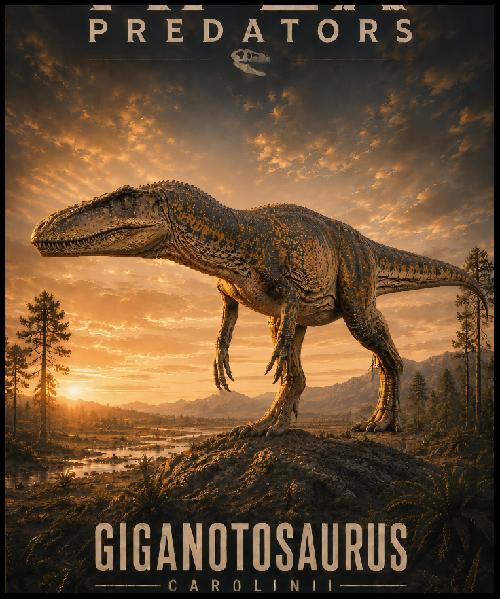
| Species | Giganotosaurus carolinii — Saurischia, Carcharodontosauridae |
| Period | Late Cretaceous (Cenomanian), approximately 99–97 million years ago |
| Estimated Length | Approximately 12–13 m (39–43 ft) |
| Estimated Mass | Most estimates fall between approximately 6–8 tonnes (6,000–8,000 kg; 13,200–17,600 lb), although lower and higher figures have been proposed |
| Skull Length | Reconstructed length exceeding 1.5 m (5 ft) |
Quick Answer
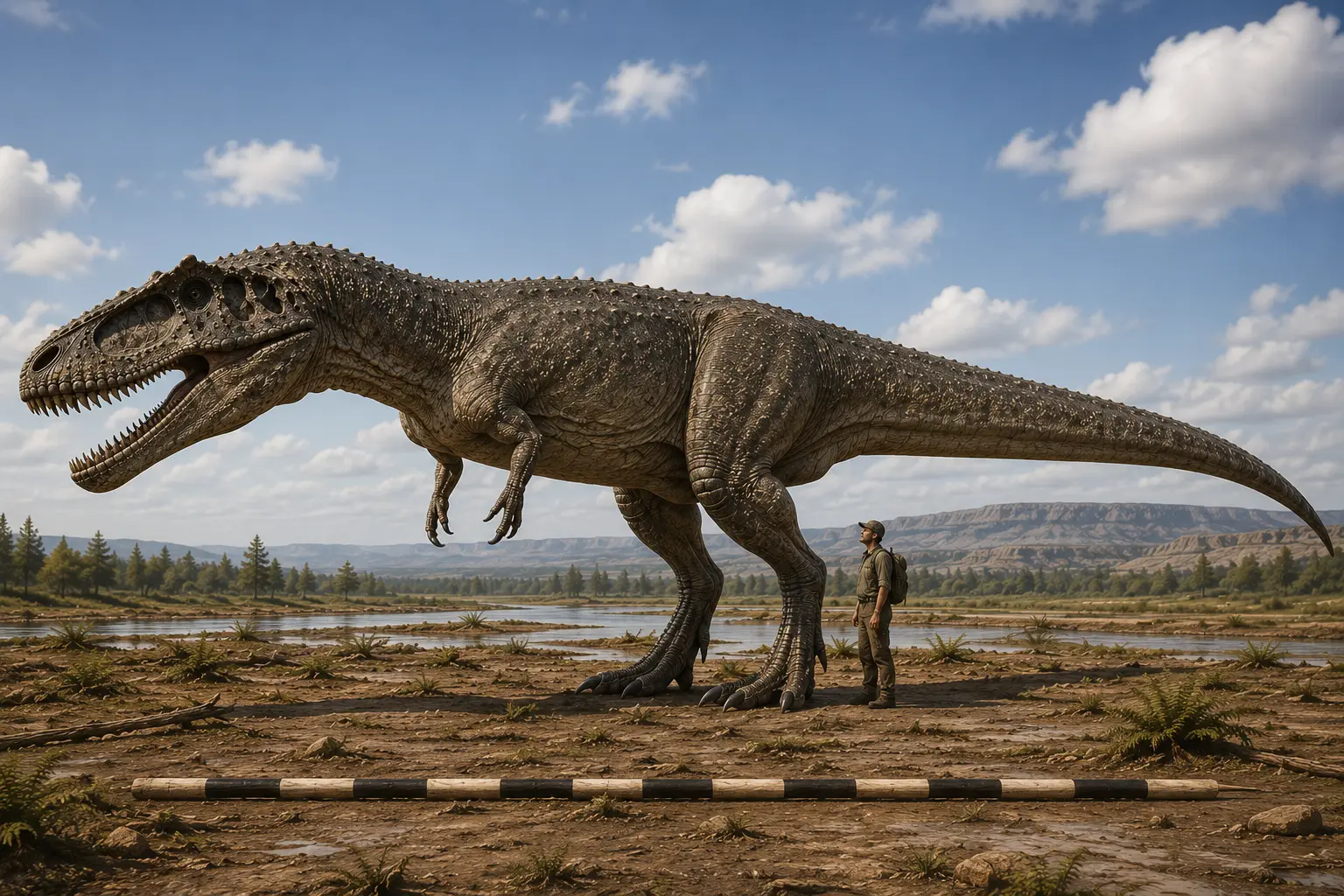
Giganotosaurus carolinii is generally estimated to have reached approximately 12–13 metres (39–43 ft) in length, making it one of the largest terrestrial carnivorous dinosaurs known from the fossil record. Most modern mass estimates place it in the range of roughly 6–8 tonnes, although published figures vary depending on the reconstruction method and assumptions used. In overall length, it was comparable to the largest known individuals of Tyrannosaurus rex, but it possessed a more elongated skull and a less robust body build.

Variation in mass estimates is expected and reflects the challenges of reconstructing the weight of an extinct animal from an incomplete skeleton. While skeletal dimensions provide a reasonably reliable basis for estimating length, body mass depends heavily on assumptions about soft tissues, musculature, body depth, and overall proportions. For this reason, palaeontologists typically treat mass as a range rather than a single definitive value.
Understanding this uncertainty is important because it reflects the limits of the fossil evidence rather than a lack of scientific rigour. As new analytical techniques and fossil discoveries become available, estimates of Giganotosaurus size may continue to be refined.
How Big Was Giganotosaurus?
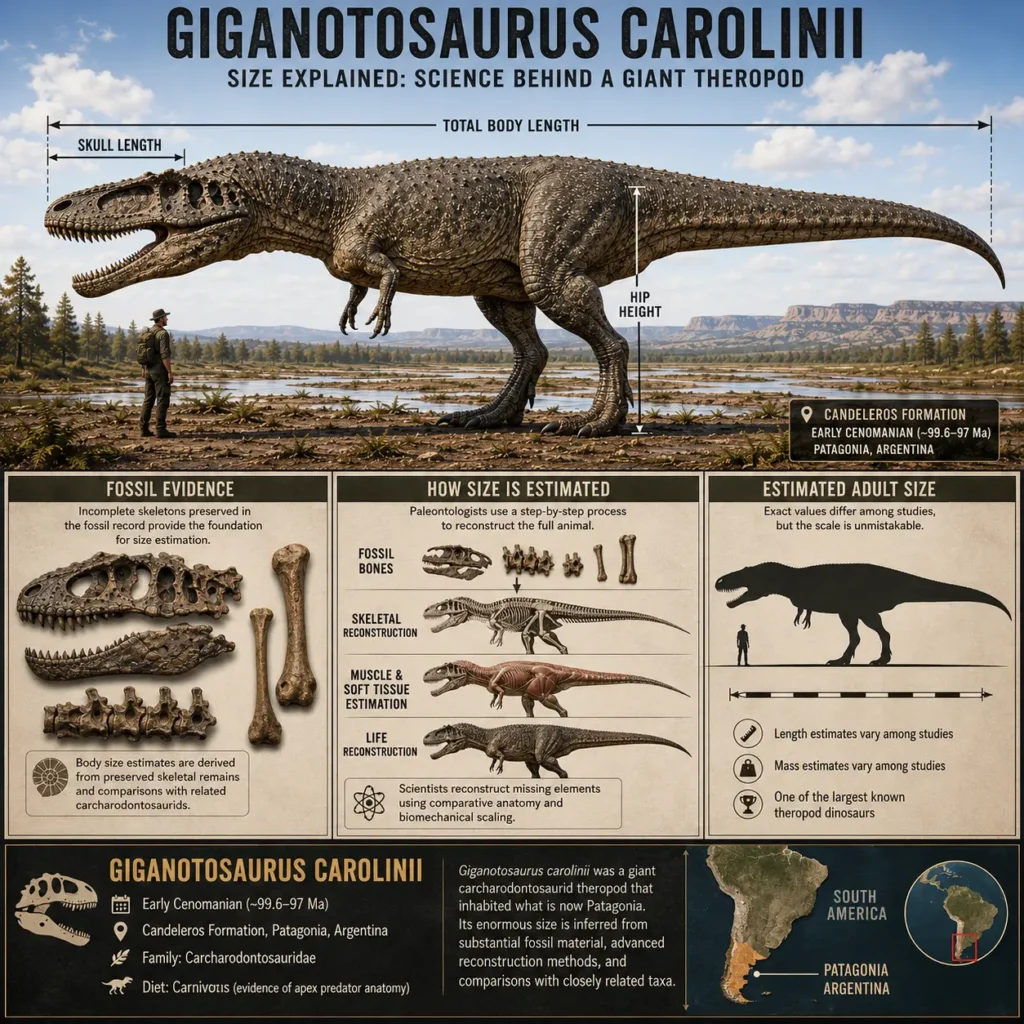
Most published estimates place Giganotosaurus carolinii at approximately 12–13 metres (39–43 ft) in total length, based on scaling from the preserved remains of the holotype specimen, MUCPv-Ch1. This places it among the largest theropod dinosaurs known, alongside giants such as Tyrannosaurus rex, Spinosaurus aegyptiacus, and Carcharodontosaurus saharicus.
A second specimen, MUCPv-95, has been referred to Giganotosaurus and may represent an individual somewhat larger than the holotype. Because this material is considerably less complete, however, its exact size and taxonomic assignment remain more uncertain than those of MUCPv-Ch1.
Estimating body mass is considerably more difficult than estimating length. While most modern studies place Giganotosaurus in the range of approximately 6–8 tonnes (6,000–8,000 kg), both lower and higher estimates have been proposed. These differences reflect variations in methodology rather than disagreements about the fossil material itself. As a result, body mass should be viewed as a scientifically informed estimate rather than a precisely known value.
Why Do Mass Estimates Vary So Much?
Estimating the mass of an extinct animal is inherently challenging because soft tissues—including muscles, organs, fat deposits, and skin—are rarely preserved in the fossil record. Researchers must therefore reconstruct these missing components using anatomical evidence and biomechanical modelling.
Several methods are commonly used. One approach is volumetric modelling, in which a three-dimensional reconstruction of the animal is created, and its volume is calculated before applying an estimated body density. Another is limb-bone scaling, which uses relationships between body mass and the circumference of weight-bearing limb bones observed in living animals. Researchers may also compare the skeleton with closely related species whose size has been studied in greater detail.
Each method relies on different assumptions and produces a range of plausible results rather than a single definitive figure. Because the known Giganotosaurus specimens are incomplete, some anatomical features must themselves be reconstructed, introducing additional uncertainty into mass estimates.
For this reason, palaeontologists generally place greater confidence in length estimates than in body-mass estimates. Any specific weight figure should be considered within the context of the method used to produce it, and ranges are usually more informative than single numbers.
Giganotosaurus Size by the Numbers
| Measurement | Estimate | Basis |
|---|---|---|
| Total body length | Approximately 12–13 m (39–43 ft) | Scaling from the holotype specimen (MUCPv-Ch1) |
| Body mass | Most estimates approximately 6–8 tonnes (6,000–8,000 kg; 13,200–17,600 lb) | Volumetric and skeletal-scaling studies |
| Skull length | Reconstructed length exceeding 1.5 m (5 ft) | Preserved skull material and reconstruction |
| Holotype specimen | MUCPv-Ch1 | Primary source of anatomical information |
| Additional referred specimen | MUCPv-95 | Fragmentary material tentatively referred to Giganotosaurus |
How Complete Is the Skeleton?
The size estimates for Giganotosaurus carolinii are based primarily on the holotype specimen, MUCPv-Ch1. The fossil preserves substantial portions of the skull, lower jaw, vertebral column, pelvis, and limb elements, making it one of the most informative giant theropod specimens known from South America.
Although the preserved material provides a strong basis for estimating overall body length and proportions, the skeleton is incomplete. Missing or fragmentary elements require reconstruction using comparisons with related carcharodontosaurids and other large theropods. As a result, some uncertainty remains regarding the animal’s exact dimensions.
Mass estimates are particularly sensitive to these uncertainties. Unlike length, which can often be reconstructed directly from preserved bones, body mass depends heavily on assumptions about soft tissue volume, musculature, body depth, and overall proportions. Small differences in these assumptions can produce substantial differences in the final estimate.
For this reason, palaeontologists generally regard length estimates for Giganotosaurus as more reliable than body-mass estimates. While most studies broadly agree on its approximate length, estimates of weight remain more dependent on modelling methodology.
Was Giganotosaurus Bigger Than T. rex?
Whether Giganotosaurus was larger than Tyrannosaurus rex depends on the measurement being considered.
In terms of length, Giganotosaurus appears to have been broadly comparable to the largest known Tyrannosaurus rex individuals and may have been slightly longer. Most estimates place Giganotosaurus at approximately 12–13 metres (39–43 ft), while the largest known T. rex specimens are generally estimated at around 12–12.3 metres (39–40 ft).
Body mass tells a different story. Most recent studies suggest that large Tyrannosaurus rex individuals were heavier than similarly sized Giganotosaurus individuals because of their more robust skeletal construction, deeper torso, and heavier limb bones. As a result, T. rex is generally regarded as the more massive animal despite being similar in overall length.
The question of which species was “bigger” therefore depends on the metric being used. Giganotosaurus may have matched or slightly exceeded T. rex in length, whereas T. rex was likely heavier and more heavily built. A detailed comparison of these two iconic predators is explored in the dedicated comparison article.
Related and Contemporary Species
- Tyrannosaurus rex — the large theropod most frequently compared with Giganotosaurus. Although similar in overall length, most studies suggest that large T. rex individuals were heavier due to their more robust skeletal structure and deeper body proportions.
- Spinosaurus aegyptiacus — generally regarded as the longest known theropod dinosaur, although its anatomy, ecology, and probable semi-aquatic lifestyle differed substantially from those of Giganotosaurus.
- Carcharodontosaurus saharicus — a closely related carcharodontosaurid from North Africa that reached comparable sizes and demonstrates the widespread distribution of giant apex predators during the Cretaceous.
- Mapusaurus roseae — a closely related South American carcharodontosaurid known from multiple individuals. Its discovery has contributed significantly to discussions of variation, ecology, and possible social behaviour among giant carcharodontosaurids.
- Argentinosaurus huinculensis — one of the largest known dinosaurs. Its immense size illustrates the scale reached by herbivorous dinosaurs in Cretaceous Patagonia and provides important ecological context for understanding the environments inhabited by giant predators such as Giganotosaurus.
Frequently Asked Questions
Was Giganotosaurus bigger than T. rex?
The answer depends on which measurement is being considered. Most published estimates place Giganotosaurus at approximately 12–13 metres (39–43 ft) in length, making it broadly comparable to the largest known individuals of Tyrannosaurus rex. Some reconstructions suggest that Giganotosaurus may have been slightly longer.
Body mass presents a different picture. Most modern studies indicate that large Tyrannosaurus rex individuals were heavier than similarly sized Giganotosaurus individuals because of their more robust skeletons, deeper bodies, and heavier limb bones. As a result, Giganotosaurus may have matched or slightly exceeded T. rex in length, whereas T. rex was likely the more massive animal.
Conclusion
Giganotosaurus carolinii ranks among the largest terrestrial carnivores known from the fossil record. Current evidence supports an estimated length of approximately 12–13 metres (39–43 ft), while body-mass estimates remain dependent on the reconstruction methods used. Although uncertainty remains regarding its exact weight, the available fossil evidence clearly indicates that Giganotosaurus was one of the largest predatory dinosaurs ever discovered.
The continuing debate over its mass is not a weakness of the science but a reflection of the challenges involved in reconstructing extinct animals from incomplete fossil remains. As new analytical techniques and fossil discoveries emerge, estimates of its size may continue to be refined, improving our understanding of this remarkable Patagonian predator.
References
A. Primary Taxonomic Sources
Coria, R.A. & Salgado, L. (1995). A new giant carnivorous dinosaur from the Cretaceous of Patagonia. Nature, 377, 224–226. https://doi.org/10.1038/377224a0
B. Peer-Reviewed Literature
Hutchinson, J.R., Bates, K.T., Molnar, J., Allen, V. & Makovicky, P.J. (2011). A computational analysis of limb and body dimensions in Tyrannosaurus rex with implications for locomotion, ontogeny, and growth. PLoS ONE, 6(10), e26037.
Calvo, J.O. & Coria, R.A. (1998). A new specimen of Giganotosaurus carolinii (Coria & Salgado, 1995) supports it as the largest theropod ever found. Gaia, 15, 117–122.
Sellers, W.I., Hepworth-Bell, J., Falkingham, P.L., Bates, K.T., Brassey, C.A., Egerton, V.M. & Manning, P.L. (2013). Minimum convex hull mass estimations of complete mounted skeletons. PLOS ONE, 8(5), e56040. https://doi.org/10.1371/journal.pone.0056040
C. Books and Reference Works
The Princeton Field Guide to Dinosaurs. Princeton University Press.
Featured Museum Collections
Museum-quality paleoart and educational poster
collections based on evidence-informed prehistoric
Life reconstructions.