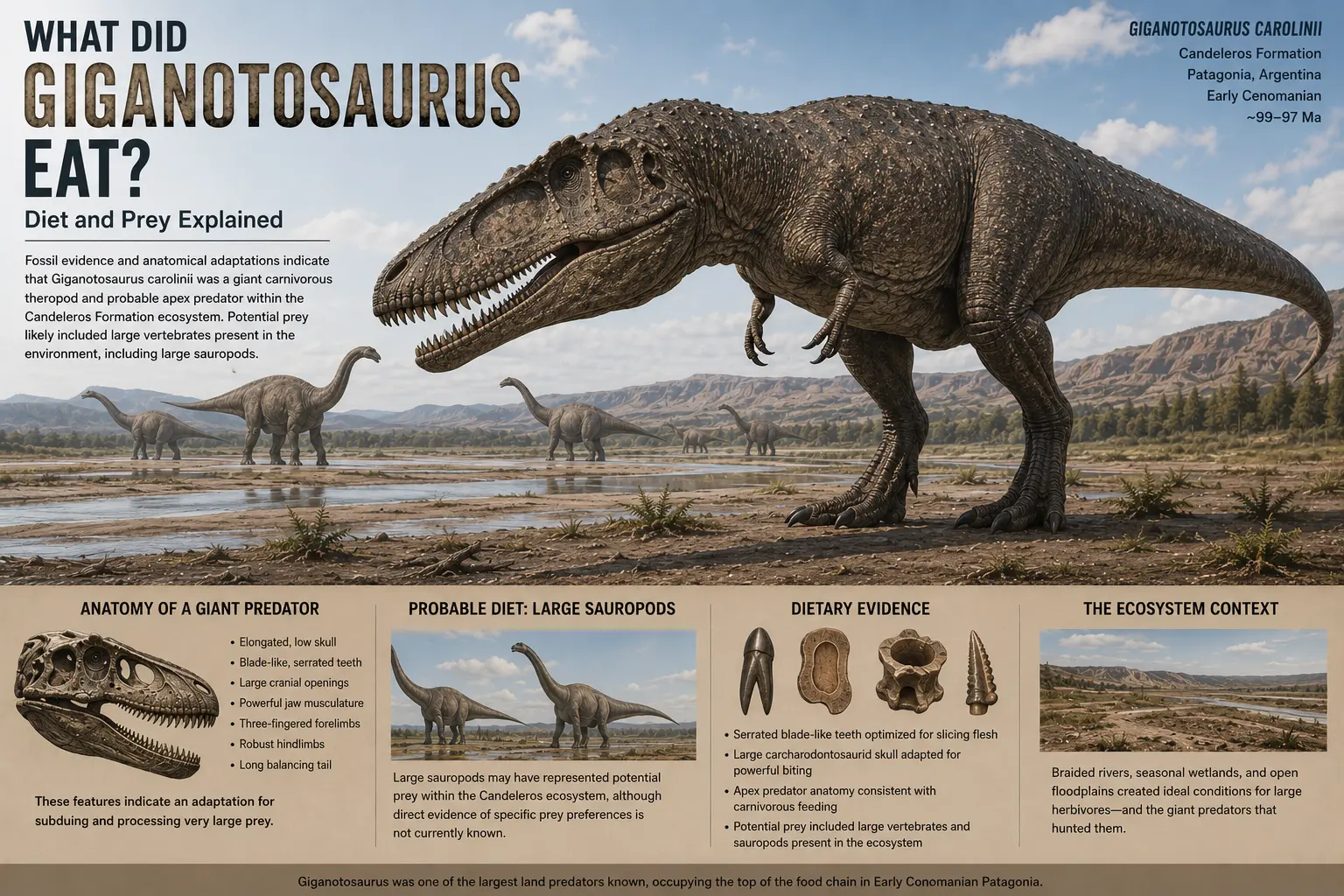
Quick Info
| Field | Information |
|---|---|
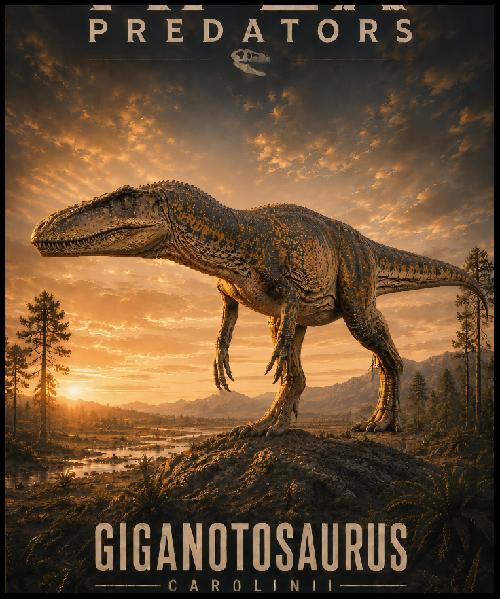
| Species | Giganotosaurus carolinii — Saurischia, Carcharodontosauridae |
| Period | Late Cretaceous (Cenomanian), approximately 99–97 million years ago |
| Diet Category | Carnivore (large-prey specialist, inferred) |
| Primary Prey Candidates | Large titanosaur sauropods, including Andesaurus delgadoi |
| Feeding Evidence | Serrated slicing teeth and ecological context; no confirmed Giganotosaurus-attributed bite marks on sauropod bones have been reported from the Candeleros Formation |
| Evidence Level | Strong ecological and anatomical inference; no direct fossil evidence of specific prey species |
Quick Answer
Giganotosaurus carolinii was a carnivorous theropod whose diet was likely dominated by large herbivorous dinosaurs, particularly the giant titanosaur sauropods that shared its ecosystem in the Candeleros Formation of Patagonia. This interpretation is supported by its enormous body size, specialized flesh-slicing teeth, and the composition of the local fauna. However, no direct fossil evidence—such as confirmed bite marks on sauropod bones or preserved stomach contents—has yet been discovered, meaning specific prey identifications remain inferential rather than directly documented.

Living alongside herbivores that weighed many tonnes, Giganotosaurus occupied the role of an apex predator in its ecosystem. Large sauropods represent the most plausible primary prey category based on available evidence, but the fossil record does not currently reveal exactly which species were hunted, scavenged, or consumed most frequently. As a result, the diet of Giganotosaurus is best understood through a combination of anatomical evidence, paleoecological context, and comparisons with other large predatory dinosaurs rather than direct records of feeding behaviour.
What Did Giganotosaurus Eat?
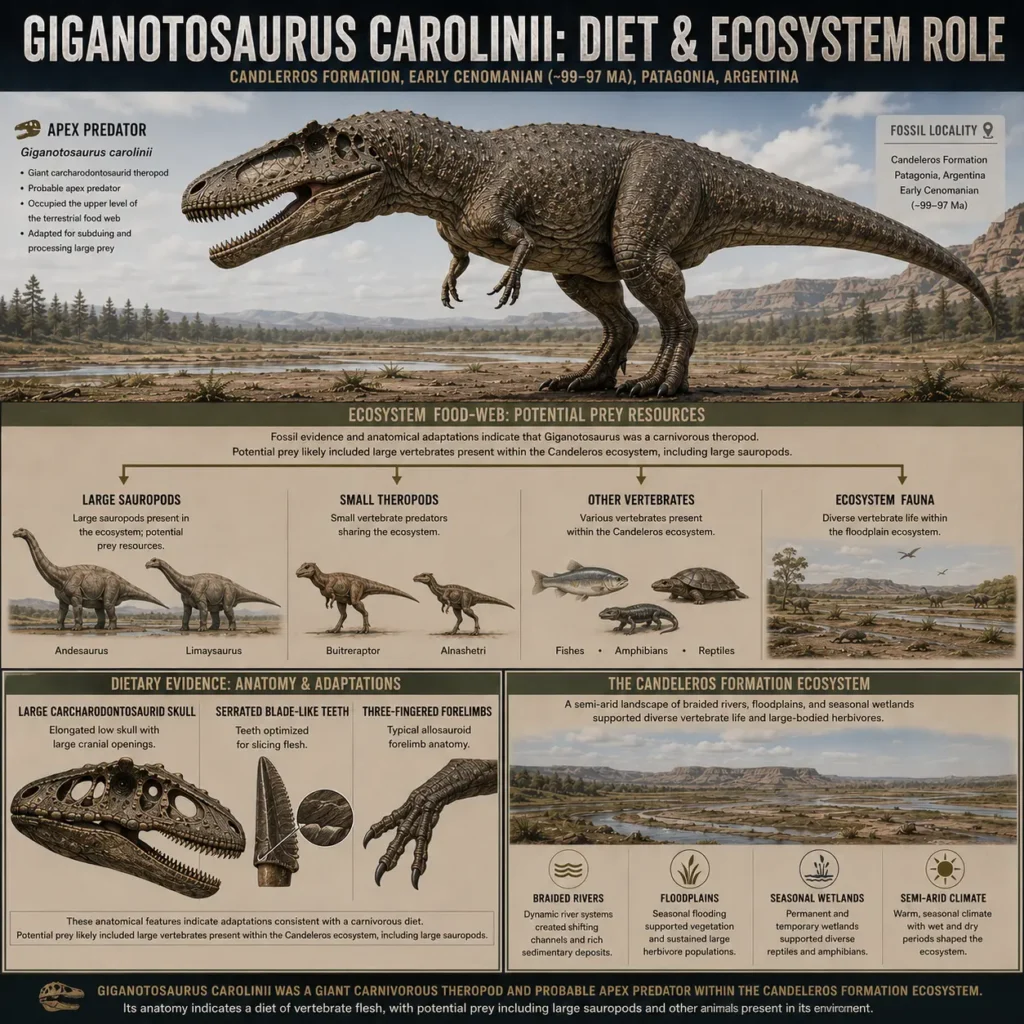
Giganotosaurus carolinii was an obligate carnivore. Its blade-like, serrated ziphodont teeth were specialized for slicing flesh and inflicting deep wounds rather than processing plant material. These dental adaptations are directly documented from fossil specimens and are characteristic of large predatory theropods. The laterally compressed teeth, combined with powerful jaws and a massive body size, indicate a feeding strategy focused on consuming large vertebrate prey.
The fauna of the Candeleros Formation provides the best evidence for identifying potential prey. This ecosystem contained large titanosaur sauropods, including Andesaurus delgadoi, as well as smaller herbivorous dinosaurs and other vertebrates. Given the enormous size of Giganotosaurus and the abundance of large-bodied herbivores in its environment, titanosaurs are widely regarded as the most plausible primary prey category. However, no direct fossil evidence currently demonstrates that Giganotosaurus hunted or consumed any particular sauropod species. This interpretation is therefore based on anatomical and ecological inference rather than documented predation events.
Was Argentinosaurus Prey?
Argentinosaurus huinculensis is often portrayed in popular media as a primary prey animal of Giganotosaurus. While this predator-prey pairing is plausible, the available evidence does not confirm a direct ecological relationship between the two species.
Argentinosaurus is known from the Huincul Formation, whereas Giganotosaurus is known from the older Candeleros Formation. The Huincul Formation overlies the Candeleros Formation stratigraphically, indicating that the two taxa are not currently known from the same geological formation. As a result, direct contemporaneity between Giganotosaurus carolinii and Argentinosaurus huinculensis has not been established by the fossil record.
The association persists because both animals lived in roughly the same region of Patagonia during the early Late Cretaceous and because their sizes suggest a potentially realistic predator-prey relationship. Nevertheless, the connection remains a regional paleoecological inference rather than a documented interaction supported by direct fossil evidence. Until additional discoveries clarify the temporal and ecological overlap between these taxa, Andesaurus and other herbivores from the Candeleros Formation remain the most directly supported prey candidates for Giganotosaurus.
Feeding Evidence: What Do the Fossils Show?
Direct evidence of what Giganotosaurus carolinii ate remains limited. At present, no confirmed bite marks attributable to Giganotosaurus have been reported on sauropod bones from the Candeleros Formation. This absence should not be interpreted as evidence that the dinosaur did not feed on sauropods, as bite-marked fossils require exceptional preservation and are relatively uncommon in the fossil record. However, it does mean that the diet of Giganotosaurus is reconstructed primarily through anatomical and paleoecological evidence rather than direct records of feeding behaviour.
The strongest evidence comes from tooth morphology. Giganotosaurus possessed large, laterally compressed teeth with finely serrated cutting edges, a tooth form known as ziphodont dentition. Similar teeth are characteristic of many large predatory theropods and are well suited for slicing flesh and inflicting deep wounds. Unlike the robust, thick-bodied teeth of some predators adapted for heavy bone processing, the teeth of Giganotosaurus appear optimized for cutting soft tissue rather than crushing bone. This suggests a feeding strategy focused on removing large portions of flesh from prey or carcasses.
Functional comparisons with other large theropod dinosaurs indicate that Giganotosaurus likely relied on powerful bites combined with repeated slashing motions to damage prey and remove tissue. While comparisons with modern animals can provide useful context, they remain analogies rather than direct evidence and should be interpreted cautiously.
Carcass Utilisation and Opportunistic Feeding
Although direct evidence is lacking, Giganotosaurus almost certainly scavenged carcasses when opportunities arose. Among modern ecosystems, large carnivores rarely rely exclusively on either hunting or scavenging; instead, they exploit both strategies when advantageous. The energetic demands of a predator weighing several tonnes would have made the consumption of available carcasses an efficient source of food.
Large sauropods would have represented an especially valuable resource. Whether killed by predators, weakened by disease, or dead from natural causes, a single giant sauropod carcass could have provided food for multiple carnivores and scavengers over an extended period. This interpretation is consistent with general ecological principles and observations from modern large-predator communities, although direct fossil evidence documenting scavenging behaviour in Giganotosaurus has not been discovered.
Because the fossil record preserves only a small fraction of past ecological interactions, it remains impossible to determine how frequently Giganotosaurus hunted live prey compared with scavenging carcasses. Both behaviours were likely part of its feeding ecology.
Food-Web Position
Available evidence indicates that Giganotosaurus occupied the apex predator role within the Candeleros Formation ecosystem. No larger terrestrial carnivore is currently known from the formation, and its immense size placed it among the dominant predators of Late Cretaceous Patagonia.
The ecosystem included giant titanosaur sauropods, smaller herbivorous dinosaurs, and a range of other vertebrates that collectively supported a complex food web. Large sauropods likely represented one of the most significant sources of biomass within this environment, making them an important ecological resource for top predators and scavengers alike.
As the largest known predator in its ecosystem, Giganotosaurus would have occupied the highest trophic level. However, the fossil record cannot currently determine the precise balance between active predation, opportunistic feeding, and scavenging in its lifestyle. Consequently, its role is best interpreted as that of a large apex carnivore capable of exploiting a variety of food resources within a sauropod-dominated ecosystem.
Related and Contemporary Species
Andesaurus delgadoi
A large titanosaur sauropod known from the Candeleros Formation, Andesaurus delgadoi, is one of the best-documented large herbivores that shared its environment with Giganotosaurus carolinii. Because it is confirmed from the same formation and represents a substantial source of biomass, it is widely regarded as one of the most plausible prey candidates for Giganotosaurus, although no direct evidence of predation has been discovered.
Mapusaurus roseae
Mapusaurus roseae was a closely related carcharodontosaurid that lived during the slightly younger Late Cretaceous and is known from the Huincul Formation of Patagonia. Its association with a multi-individual bone bed has generated discussion about possible social behaviour in large carcharodontosaurids and has contributed to hypotheses regarding how these predators may have interacted with very large sauropods. However, direct behavioural evidence remains limited.
Argentinosaurus huinculensis
One of the largest dinosaurs known, Argentinosaurus huinculensis, is frequently mentioned as a potential prey animal of Giganotosaurus. However, Argentinosaurus is known from the Huincul Formation rather than the Candeleros Formation, and direct contemporaneity between the two species has not been established. As a result, their predator-prey relationship remains a plausible regional inference rather than a documented ecological interaction.
Carcharodontosaurus saharicus
An African relative of Giganotosaurus, Carcharodontosaurus saharicus, occupied a comparable apex-predator role in North African ecosystems during the Late Cretaceous. Similarities in anatomy, body size, and ecological position make it a useful comparative taxon when reconstructing the feeding ecology and predatory adaptations of giant carcharodontosaurids.
Frequently Asked Questions
Did Giganotosaurus eat Argentinosaurus?
There is currently no direct fossil evidence showing that Giganotosaurus preyed upon Argentinosaurus. The two dinosaurs are known from different geological formations, with Giganotosaurus recorded from the Candeleros Formation and Argentinosaurus from the overlying Huincul Formation. Although the size relationship makes the pairing plausible and it is frequently depicted in popular media, the proposed predator-prey relationship remains speculative and is not supported by direct evidence.
Was Giganotosaurus a scavenger or an active hunter?
The available evidence suggests that Giganotosaurus was capable of both active predation and opportunistic scavenging. Its anatomy, including powerful jaws and flesh-slicing teeth, is consistent with a large predatory lifestyle. At the same time, ecological principles indicate that a predator of its size would likely have exploited carcasses whenever they were available. Because no fossil evidence directly documents its feeding behaviour, the relative importance of hunting versus scavenging remains unknown.
Scientific Note:The identity of specific prey species consumed by
Giganotosaurus caroliniiremains uncertain. Current reconstructions are based on anatomical evidence, paleoecological context, and the known fauna of the Candeleros Formation. Future fossil discoveries may refine or alter these interpretations.
Conclusion
Giganotosaurus carolinii was one of the largest terrestrial predators of the Late Cretaceous and occupied the apex carnivore role within the Candeleros Formation ecosystem. Anatomical evidence, ecological context, and the abundance of large herbivorous dinosaurs strongly suggest that giant titanosaur sauropods formed an important component of their diet. However, no direct fossil evidence currently links Giganotosaurus to any specific prey species.
As a result, the diet of Giganotosaurus is best understood as a well-supported paleoecological reconstruction rather than a directly documented record of feeding behaviour. The available evidence points most strongly toward large sauropods as primary prey, but the details of how this giant predator hunted, scavenged, and interacted with its ecosystem remain subjects of ongoing scientific investigation.
References
A. Primary Taxonomic Sources
Coria, R.A. & Salgado, L. (1995). A new giant carnivorous dinosaur from the Cretaceous of Patagonia. Nature, 377, 224–226. https://doi.org/10.1038/377224a0
B. Peer-Reviewed Literature
Calvo, J.O. & Bonaparte, J.F. (1991). Andesaurus delgadoi gen. et sp. nov. (Saurischia: Sauropoda), dinosaurio Titanosauridae de la Formación Río Limay (Albiano–Cenomaniano), Neuquén, Argentina. Ameghiniana, 28, 303–310.
Coria, R.A. & Currie, P.J. (2006). A new carcharodontosaurid (Dinosauria, Theropoda) from the Upper Cretaceous of Argentina. Geodiversitas, 28(1), 71–118.
C. Books and Monographs
Novas, F.E. (2009). The Age of Dinosaurs in South America. Bloomington, Indiana: Indiana University Press.
D. Databases and Online Resources
Paleobiology Database. Accessed July 2026.
Featured Museum Collections
Museum-quality paleoart and educational poster
collections based on evidence-informed prehistoric
Life reconstructions.