At a Glance
| Field | Information |
|---|---|
| Species | Mosasaurus hoffmannii — Squamata, Mosasauridae |
| Period | Late Cretaceous, 82–66 Ma |
| Primary habitat | Warm epicontinental seas — open marine |
| Known fossil locations | Netherlands, Belgium, Morocco, Russia, North America |
| Water type | Marine (saltwater) — freshwater capability debated |
| Terrestrial capability | None — fully aquatic |
Quick Answer: Mosasaurus habitat was the warm, shallow epicontinental seas of the Late Cretaceous, spanning what is now Europe, North Africa, North America, and Russia. It was a fully marine animal, incapable of terrestrial movement, that occupied open-water environments as an apex predator. Whether it ever entered freshwater is an active area of scientific debate.
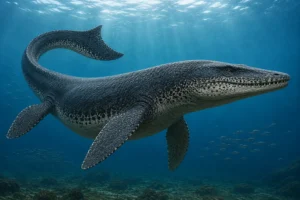
Sixty-six million years ago, a shallow sea covered much of what is now western Europe — warm, rich, and patrolled at its apex by one of the largest marine predators that has ever lived. The chalk cliffs of the Netherlands and Belgium are its gravestone and its record.
Where Did Mosasaurus hoffmannii Live?
This is an active area of research. Details here reflect current best-supported current estimate but may be revised as new fossil evidence or analysis emerges.
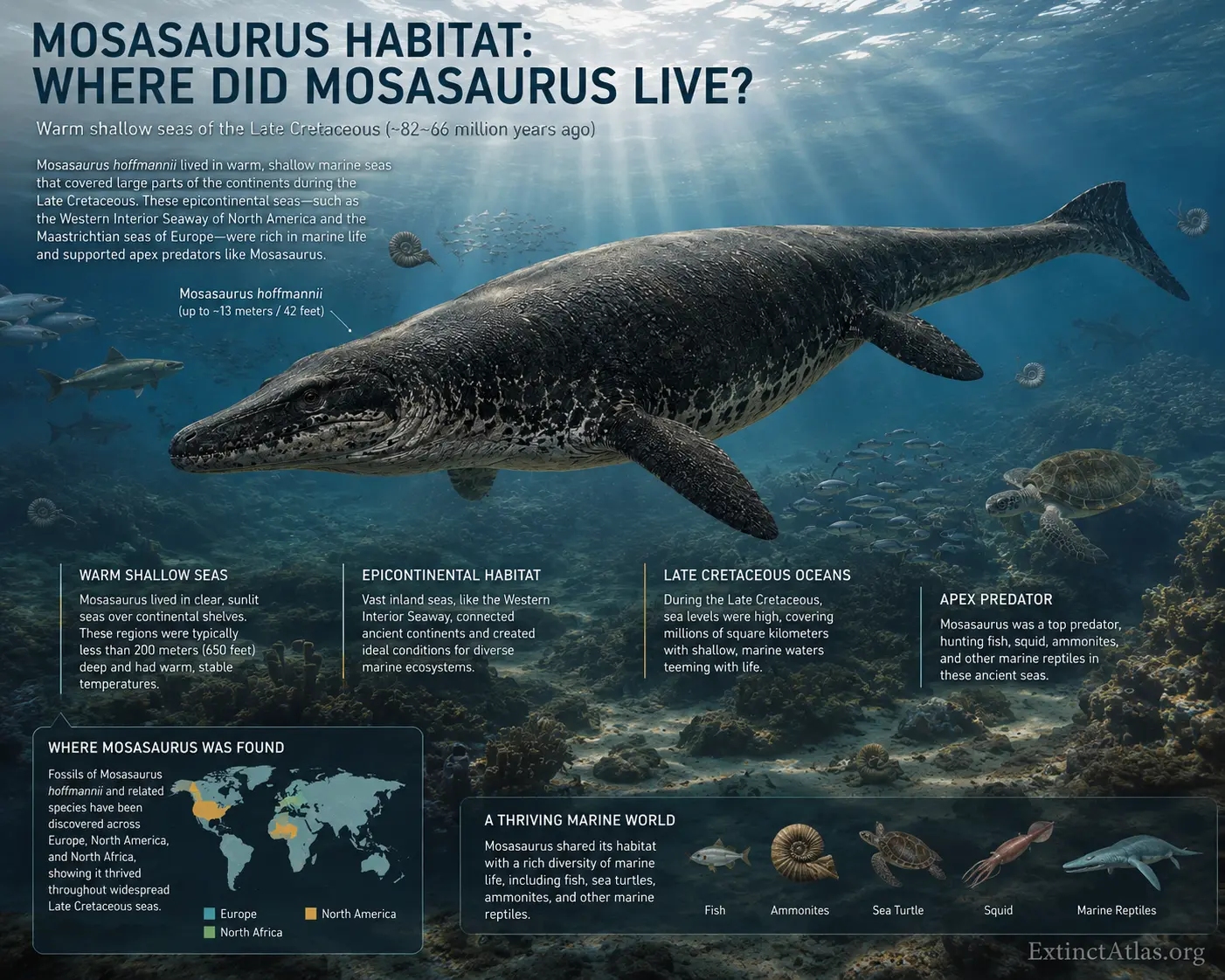
Mosasaurus inhabited the warm epicontinental seas of the Late Cretaceous period. Fossil evidence places M. hoffmannii within marine chalk and phosphate deposits across a broad geographic range:
- Western Europe — including the type specimen from Maastricht (Netherlands), with additional material from Belgium and the United Kingdom
- North Africa — well-documented specimens from Moroccan phosphate basins, indicating distribution across the southern margin of the Tethys Sea
- Eastern Europe and Russia — material described from regions such as Penza, extending its range into the eastern Tethyan margin
- North America — mosasaurine material from Late Cretaceous marine deposits of the Western Interior Seaway is broadly comparable, although species-level attribution to M. hoffmannii remains uncertain in some cases
Across all confirmed occurrences, the depositional context is consistently marine—primarily chalk or phosphate sediments representing warm, shallow to moderately deep open seas. No confirmed M. hoffmannii specimens are known from freshwater or terrestrial deposits.
Water Depth and Open-Ocean Range
Fossil evidence from the depositional environments of M. hoffmannii specimens indicates predominantly shallow to mid-depth epicontinental seas — inland extensions of the ocean that covered large portions of continental landmasses during the Late Cretaceous sea-level high stand. These were not deep oceanic trenches but relatively shallow, warm-water environments with abundant prey.
Comparison with living large marine predators suggests Mosasaurus was likely capable of deeper dives than its typical depositional context implies — modern monitor lizards and large marine reptiles regularly exploit depth ranges beyond their preferred habitat. This is comparative inference, not direct fossil evidence. No trackway or direct behavioural evidence for depth preference exists for M. hoffmannii.
Can a Mosasaurus Go on Land?
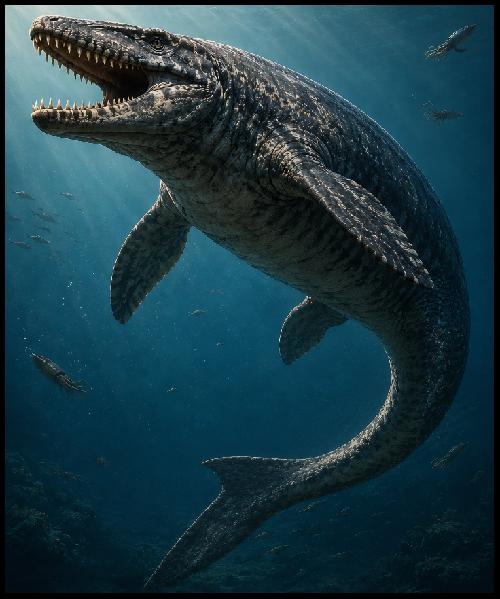
A Mosasaurus cannot go on land — it was fully aquatic and anatomically incapable of terrestrial locomotion. Fossil evidence directly shows that the limbs of M. hoffmannii were modified into paddle-like flippers, with reduced and fused limb bones that provided hydrodynamic efficiency in water but no weight-bearing capability on land. This is in contrast to animals like seals or sea turtles, which retain some terrestrial or semi-terrestrial capacity. Mosasaurus was committed to the marine environment in every aspect of its anatomy.
Speculatively, like sea turtles, females may have needed to come ashore to lay eggs — though viviparous (live birth) reproduction has been suggested for some mosasaurids based on fossil evidence from other taxa. Whether M. hoffmannii was viviparous or oviparous is not confirmed from direct fossil evidence. This question is addressed more fully in our full post on Mosasaurus behaviour.
Could Mosasaurus hoffmannii Live in Freshwater?
Whether Mosasaurus could tolerate freshwater remains an open question in the scientific literature.
Some mosasaurid taxa—notably Pannoniasaurus inexpectus from Upper Cretaceous deposits in Hungary—are confirmed freshwater inhabitants, demonstrating that the broader mosasaurid lineage included species capable of living outside marine environments.
However, there is no direct evidence that M. hoffmannii shared this capability. All confirmed specimens of this species come from marine deposits, primarily chalk and phosphate sediments associated with open-sea environments. Isotopic analyses conducted on mosasaurid material have not conclusively demonstrated freshwater use in M. hoffmannii specifically.
While comparison with related taxa suggests that some degree of ecological flexibility may have been possible within Mosasauridae, attributing freshwater tolerance to Mosasaurus itself would go beyond the available evidence. At present, freshwater habitation in M. hoffmannii should be considered unconfirmed and unsupported by direct fossil data.
The Late Cretaceous Seas: Environmental Context
The epicontinental seas Mosasaurus inhabited were warmer than modern oceans — global temperatures during the Late Cretaceous were substantially higher than today, and polar ice caps were minimal or absent. Sea levels were among the highest in Earth’s Phanerozoic history, flooding large areas of continental interiors. The Western Interior Seaway divided North America into two landmasses; the Tethys Sea covered much of what is now the Middle East and southern Europe.
These warm, shallow seas were biologically productive — supporting diverse fish, cephalopod, marine bird, and reptile faunas that provided Mosasaurus with its prey base. The chalk deposited in these seas preserved the fossil record that documents M. hoffmannii across its range. For details on what it ate within these environments, see our full post on Mosasaurus diet.
Related and Contemporary Species
Pannoniasaurus inexpectus is a confirmed freshwater mosasaurid from Hungary, demonstrating habitat flexibility within the broader mosasaurid group. Platecarpus tympaniticus inhabited similar North American epicontinental seas and is among the best-studied mosasaurids for soft-tissue evidence. Tylosaurus proriger was a dominant large mosasaurid of the Western Interior Seaway — a comparable marine environment to that which M. hoffmannii occupied in Europe. Hainosaurus bernardi was a large European mosasaurid from the same chalk sea deposits as M. hoffmannii. Prognathodon saturator is known from similar Maastrichtian marine deposits across Europe and North Africa.
Frequently Asked Questions
Can a Mosasaurus go on land?
A Mosasaurus cannot go on land. Fossil evidence directly shows that its limbs were modified into non-weight-bearing paddle-like flippers, making terrestrial locomotion anatomically impossible. Unlike sea turtles or seals, Mosasaurus had no capacity for movement outside the water. Whether it gave birth in the water or came ashore to lay eggs is not confirmed from direct fossil evidence for this species.
Where in the world did Mosasaurus live?
Mosasaurus lived across the warm epicontinental seas of the Late Cretaceous, with fossil specimens directly evidenced from the Netherlands, Belgium, Morocco, Russia, and North America. These localities all represent shallow to moderately deep marine environments — the warm chalk seas and phosphate basins that covered large areas of Europe, North Africa, and the margins of North America during the Late Cretaceous sea-level highstand.
Did Mosasaurus live in freshwater?
Whether Mosasaurus lived in freshwater is not confirmed by current fossil evidence. All known M. hoffmannii specimens come from marine deposits. Some other mosasaurid species — notably Pannoniasaurus from Hungary — are confirmed freshwater inhabitants, demonstrating the group had habitat flexibility, but this cannot be directly attributed to M. hoffmannii without supporting fossil evidence from freshwater localities.
Conclusion
Mosasaurus hoffmannii was a creature of warm, shallow epicontinental seas — fully committed to the marine environment, anatomically incapable of life on land, and distributed across a range stretching from western Europe to North Africa, Russia, and North America. Its habitat was the Late Cretaceous ocean at its most productive — and its most dangerous.
References
- Makádi et al. 2012 freshwater mosasauroid study
Makádi, L., Caldwell, M.W., & Ősi, A. (2012). The first freshwater mosasauroid (Upper Cretaceous, Hungary) and a new clade of basal mosasauroids. PLOS ONE, 7(12), e51781. https://doi.org/10.1371/journal.pone.0051781 - Lingham-Soliar 1995 Mosasaurus hoffmannii anatomy study
Lingham-Soliar, T. (1995). Anatomy and functional morphology of the largest marine reptile known, Mosasaurus hoffmannii (Mosasauridae, Reptilia) from the Upper Cretaceous, Upper Maastrichtian of the Netherlands. Philosophical Transactions of the Royal Society B, 347(1320), 155–180. https://doi.org/10.1098/rstb.1995.0019 - Polcyn et al. 2014 mosasaur evolution drivers
Polcyn, M.J., Lindgren, J., Bardet, N., Cornelissen, D., & Verding, L. (2014). Physical drivers of mosasaur evolution. Palaeogeography, Palaeoclimatology, Palaeoecology, 400, 17–27. https://doi.org/10.1016/j.palaeo.2013.05.018
Featured Museum Collections
Museum-quality paleoart and educational poster
collections based on evidence-informed prehistoric
Life reconstructions.