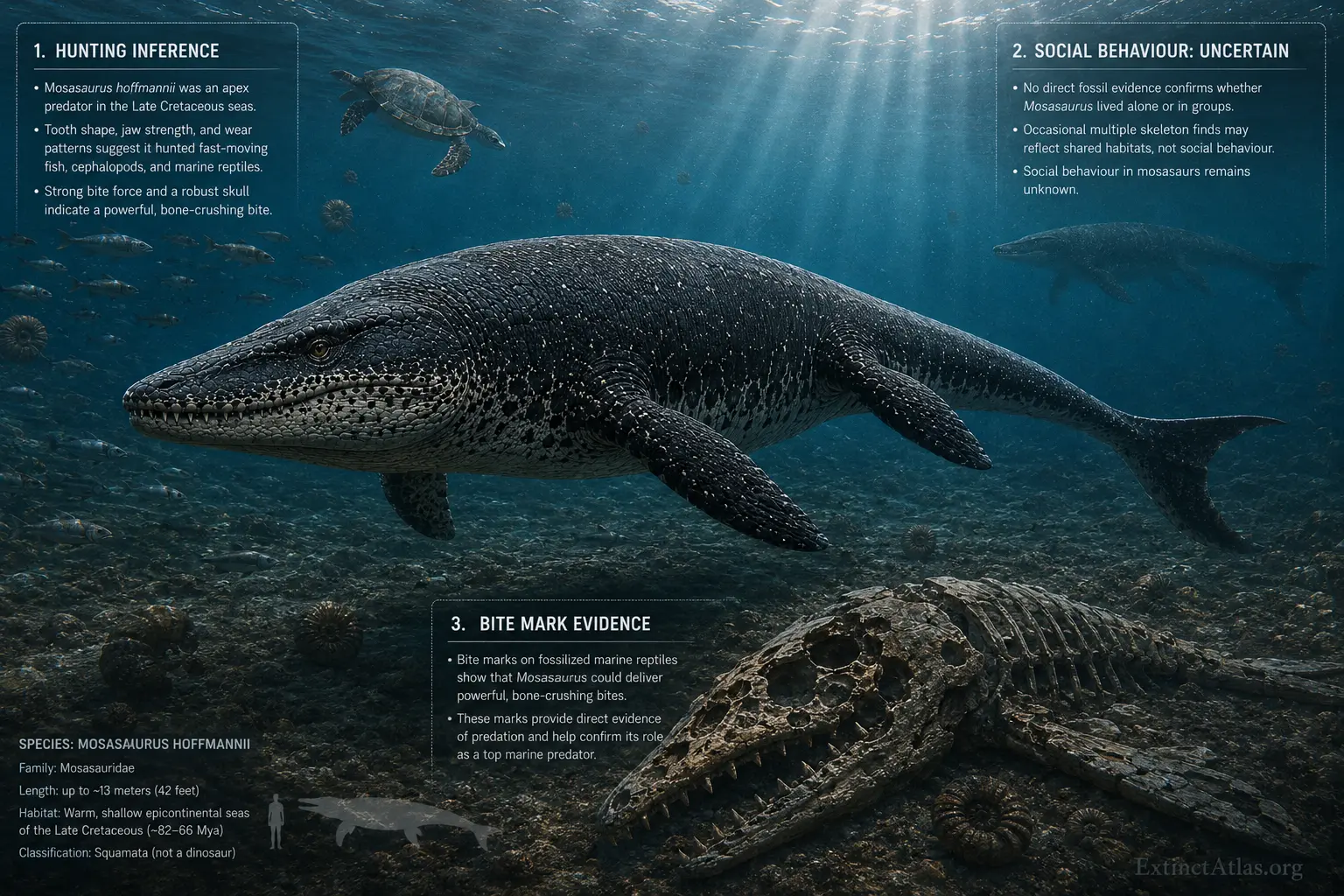
At a Glance
| Field | Information |
|---|---|
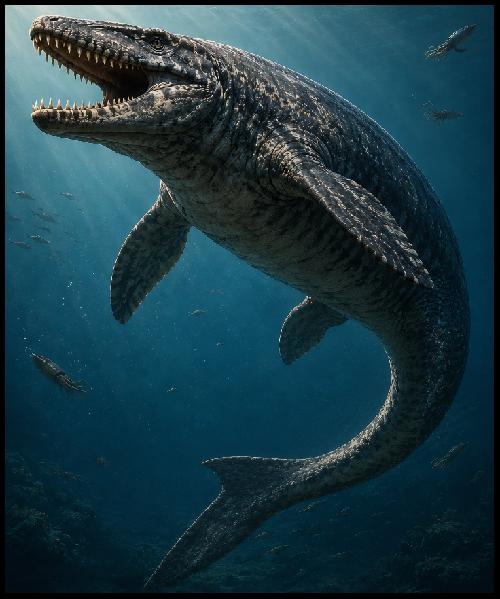
| Species | Mosasaurus hoffmannii — Squamata, Mosasauridae |
| Period | Late Cretaceous, 82–66 Ma |
| Trophic role | Apex marine predator |
| Reproductive mode | Viviparous probable — directly evidenced in other mosasaurids; M. hoffmannii not confirmed |
| Social behaviour | Unknown — no direct fossil evidence |
| Pop culture depiction | Jurassic World — significantly exaggerated in size and behaviour |
Quick Answer: Mosasaurus behaviour, as directly evidenced by fossils, was that of a solitary apex marine predator feeding on a wide range of prey. Social behaviour, parental care, and specific hunting tactics are not confirmed from fossil evidence for Mosasaurus hoffmannii. Much of what popular media presents as Mosasaurus behaviour is fictional extrapolation rather than scientific reconstruction.
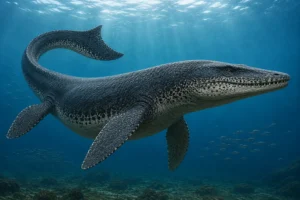
Almost everything most people think they know about how Mosasaurus behaved comes from Jurassic World, not from the fossil record. The two accounts differ substantially — and knowing which is which is the starting point for understanding the real animal.
What Was Mosasaurus’ Behaviour Actually Like?
Behaviour leaves almost no direct trace in the fossil record. What can be established for Mosasaurus hoffmannii with confidence is limited to what its anatomy and associated fossil material directly imply:
- Feeding behaviour — directly evidenced by tooth-marked bones, gut content fossils, and dentition form. Mosasaurus was a generalist carnivore taking fish, cephalopods, marine birds, and other marine reptiles. For full details on prey, see our full post on Mosasaurus diet.
- Locomotion — tail-driven lateral undulation confirmed by skeletal proportions and hypocercal tail fluke evidence. Sustained cruising with burst capacity inferred. For speed estimates, see our full post on Mosasaurus speed.
- Fully aquatic lifestyle — directly evidenced by flipper anatomy. No terrestrial behaviour was possible.
- Reproductive behaviour — live birth (viviparity) is directly evidenced in other mosasaurid taxa, including Carsosaurus marchesetti and Prognathodon sp., making it the most parsimonious inference for M. hoffmannii, though not directly confirmed for this species specifically.
What is not evidenced:
- Social grouping or pack behaviour — no fossil evidence exists
- Parental care — no fossil evidence exists
- Territorial behaviour — not assessable from fossil material
- Vocalisation — not assessable from fossil material
Real Behaviour vs. Jurassic World
The Jurassic World depiction of Mosasaurus differs from scientific evidence in several specific ways:
| Feature | Jurassic World depiction | Scientific evidence |
|---|---|---|
| Size | ~22 m (72 ft) | ~13–14 m (43–46 ft) — fossil evidence |
| Hunting method | Leaping from water to take prey | Not evidenced — Tier 4 speculation |
| Habitat | Pool / tank | Open epicontinental seas |
| Behaviour toward humans | Actively pursuing, intelligent predation | No basis for assessment. No evidence — humans did not coexist with mosasaurids |
| Appearance | Smooth-skinned, grey | Skin texture not fully confirmed for M. hoffmannii |
The size discrepancy is the most precisely quantifiable difference, roughly double the real animal’s maximum estimated length. The leaping behaviour depicted in the films is biomechanically possible in principle for a large aquatic predator, but is not supported by any fossil evidence and should be understood as a creative invention. Speculatively, large mosasaurids may have made explosive surface lunges when prey was available near the water surface — behaviour seen in large modern crocodilians — but this is extrapolation, not direct evidence.
Reproductive Behaviour
The most parsimonious inference for Mosasaurus hoffmannii reproductive behaviour is viviparity — giving birth to live young in the water rather than coming ashore to lay eggs. This inference is supported by direct fossil evidence from other mosasaurid taxa: embryonic specimens preserved within adult body cavities have been described for Carsosaurus marchesetti and Prognathodon sp., demonstrating that live birth occurred within the mosasaurid group.
No embryonic material directly associated with M. hoffmannii has been confirmed in the peer-reviewed literature. The viviparity inference is therefore Tier 3 comparative — not Tier 1 direct evidence for this species. If Mosasaurus was viviparous, it would not have needed to come ashore at any point in its life cycle, reinforcing its fully marine lifestyle.
Sensory Behaviour and Prey Detection
How Mosasaurus detected prey is not directly evidenced from fossil material for this species. Comparison with living monitor lizards — its closest living relatives — suggests chemosensory detection using a Jacobson’s organ system and forked tongue may have been present, as this feature is shared widely across squamates. This is Tier 3 comparative inference.
The large orbits (eye sockets) preserved in M. hoffmannii skulls are consistent with good visual acuity, though functional vision capability cannot be directly measured from bone dimensions alone. Comparison with living large marine predators suggests that a combination of vision and chemosensory detection would have been the primary prey-location strategy — but this remains inference, not direct evidence.
Social Behaviour
Social behaviour in Mosasaurus is unknown and cannot be assessed from current fossil evidence. No bonebed material suggesting aggregation behaviour has been confirmed for M. hoffmannii, and no other proxy evidence for sociality exists in the fossil record for this species. Comparison with large living squamates — which are generally solitary — supports a solitary lifestyle as the baseline inference, but this is Tier 3 comparative inference only. The absence of evidence for social behaviour is not confirmation of its absence.
Related and Contemporary Species
- Carsosaurus marchesetti is the mosasaurid for which some of the clearest embryonic evidence supporting mosasaurid viviparity has been described.
- Prognathodon sp. provides additional embryonic fossil evidence for live birth in large mosasaurids.
- Tylosaurus proriger is a well-studied large mosasaurid whose behaviour provides the closest large-bodied comparator for M. hoffmannii behavioural inference.
- Varanus komodoensis, the Komodo dragon, is the best living analogue for chemosensory and general predatory behaviour inference in mosasaurids.
- Platecarpus tympaniticus provides soft-tissue and locomotor evidence that informs mosasaurid behavioural reconstructions broadly.
Frequently Asked Questions
How did Mosasaurus hunt?
Mosasaurus hunting behaviour is not directly evidenced in the fossil record for M. hoffmannii specifically. Fossil evidence establishes what it ate — fish, cephalopods, marine birds, other reptiles — but not the specific method of capture. Comparison with large living aquatic predators of similar body plan suggests opportunistic ambush or slow pursuit rather than high-speed open-water chasing, though this is Tier 3 comparative inference, not confirmed behaviour.
Did Mosasaurus live in groups?
Mosasaurus social behaviour, including whether it lived or hunted in groups, is unknown. No fossil evidence — such as bonebed aggregations or direct interaction evidence — confirms group behaviour in M. hoffmannii. Comparison with living large squamates, which are generally solitary, supports a solitary lifestyle as the most parsimonious baseline inference, but the fossil record cannot confirm this directly.
Did Mosasaurus have live young?
Mosasaurus most likely had live young, based on fossil evidence of viviparity in closely related mosasaurid taxa, including Carsosaurus marchesetti and Prognathodon sp., where embryonic specimens have been preserved within adult body cavities. This inference has not been directly confirmed for M. hoffmannii itself — no embryonic material associated with this species has been described in peer-reviewed literature. It remains the most parsimonious reproductive inference.
Conclusion
What fossil evidence establishes about Mosasaurus behaviour is selective but solid: it was a generalist apex predator, fully aquatic, almost certainly viviparous, and probably solitary. Everything beyond that — social structure, precise hunting tactics, sensory capability — is inference or speculation. The real animal is compelling enough without the embellishments Jurassic World added.
References (Publication Version)
- Caldwell and Lee 2001) Mosasaur live birth study
Caldwell, M.W., & Lee, M.S.Y. (2001). Live birth in Cretaceous marine lizards (mosasauroids). Proceedings of the Royal Society B: Biological Sciences, 268(1484), 2397–2401. https://doi.org/10.1098/rspb.2001.1796 - Lingham-Soliar 1995 Mosasaurus functional morphology
Lingham-Soliar, T. (1995). Anatomy and functional morphology of the largest marine reptile known, Mosasaurus hoffmannii (Mosasauridae, Reptilia) from the Upper Cretaceous, Upper Maastrichtian of the Netherlands. Philosophical Transactions of the Royal Society B, 347(1320), 155–180. https://doi.org/10.1098/rstb.1995.0019 - Street and Caldwell 2017 Mosasaurus redescription
Street, H.P., & Caldwell, M.W. (2017). Rediagnosis and redescription of Mosasaurus hoffmannii (Squamata: Mosasauridae) and an assessment of species assigned to the genus Mosasaurus. Geological Magazine, 154(3), 521–557. https://doi.org/10.1017/S0016756815001090
Featured Museum Collections
Museum-quality paleoart and educational poster
collections based on evidence-informed prehistoric
Life reconstructions.