At a Glance
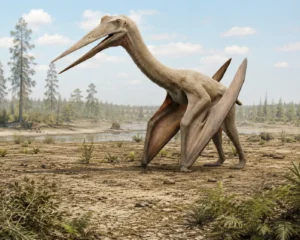
| Field | Information |
|---|---|
| Species | Quetzalcoatlus northropi / Q. lawsoni — Pterosauria, Azhdarchidae |
| Period | Late Cretaceous, 68–66 Ma |
| Estimated wingspan | 10–11 m (33–36 ft) — Q. northropi |
| Launch method | Quadrupedal vault — all four limbs used simultaneously |
| Flight speed estimate | 100–130 km/h (62–81 mph) — biomechanical modelling only |
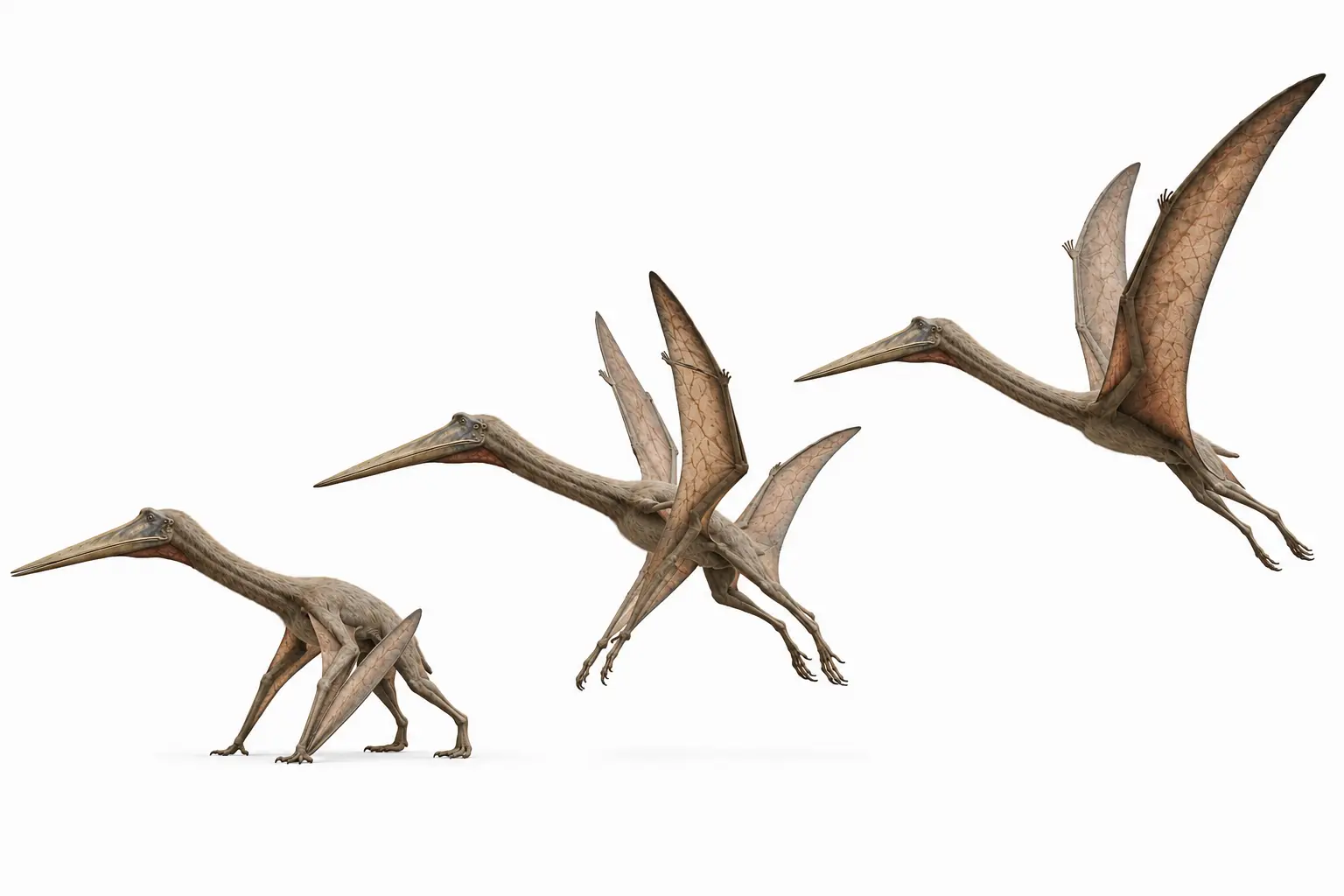
Quick Answer: How Quetzalcoatlus took off is explained by the quadrupedal vault model: it planted all four limbs and exploded upward in a single powerful launch rather than running first. Biomechanical estimates suggest this launched an animal of up to 250 kg (550 lb) airborne, though the exact mechanics remain an active area of study.
Introduction
Picture a creature the height of a giraffe folding its enormous wings, planting its knuckles into the earth, and vaulting skyward in a single explosive motion — no runway, no running start. The launch mechanics of Quetzalcoatlus are among the most debated questions in vertebrate palaeontology, and recent biomechanical modelling has produced a surprisingly coherent picture of how an animal this large ever got airborne at all.
How Did Quetzalcoatlus Take Off?
Biomechanical modelling indicates that Quetzalcoatlus used a quadrupedal vault to launch: all four limbs pushed simultaneously against the ground, propelling the body upward before the wings extended into a powered downstroke. This differs fundamentally from the bipedal run-up used by birds. Estimates suggest the initial vault could have achieved sufficient ground clearance for wingbeats to begin within one or two strokes.
The quadrupedal vault model is supported by comparison with other large azhdarchid pterosaurs and by skeletal analysis showing the forelimbs of Quetzalcoatlus were substantially more robust than the hindlimbs — the reverse of a running-launch body plan. Computer modelling by Habib (2008) and subsequent studies estimate that the forelimb musculature alone could generate the explosive force needed for liftoff, even at the upper mass estimates for Q. northropi.
This is an active area of research. Details here reflect current scientific consensus but may be revised as new fossil evidence or analysis emerges.
Could Quetzalcoatlus Fly at All?
Yes — the current scientific consensus is that Quetzalcoatlus was a capable powered flyer, not a glider. Early scepticism about whether an animal of this mass could sustain flight has been addressed by successive biomechanical studies. Modelling by Witton and Habib (2010) demonstrated that azhdarchid skeletal proportions are consistent with powered flight up to and including the size range of Q. northropi, with mass estimates in the range of 200–250 kg (440–550 lb) considered compatible with the vault-and-flap launch model. Uncertainty remains at the upper end of mass estimates; if Q. northropi reached 270 kg (595 lb) or above, the flight capacity question becomes less settled.
Flight Speed and Altitude
Biomechanical estimates suggest Quetzalcoatlus cruised at speeds of approximately 100–130 km/h (62–81 mph) at altitude, though these figures are derived from aerodynamic modelling rather than direct fossil evidence and should be treated as indicative ranges rather than established values. Comparison with modern large soaring birds suggests Quetzalcoatlus likely exploited thermals and ridge lift for long-distance travel, minimising powered flapping — an energy budget constraint imposed by its enormous size. Estimated cruising altitude models place it at several thousand metres, though this remains speculative.
How Did Quetzalcoatlus Walk on the Ground?
Fossil trackway evidence from azhdarchid pterosaurs — though not attributed directly to Quetzalcoatlus — documents a quadrupedal walking gait in which the folded wing-finger knuckle contacted the ground ahead of the hindfoot. Biomechanical modelling suggests Quetzalcoatlus held its body roughly horizontal when walking, with the neck elevated and head above shoulder height. At full standing height, this placed the head of Q. northropi approximately 5–6 m (16–20 ft) above the ground, comparable to a modern giraffe. Diet specifics are covered in full on the diet page.
Related and Contemporary Species
- Hatzegopteryx thambema — fellow giant azhdarchid from Romania; similar wingspan but a notably more robust skull, suggesting a divergent ecological role to Quetzalcoatlus.
- Arambourgiania philadelphiae — large azhdarchid from Jordan; estimated wingspan comparable to Q. northropi, though known from fragmentary material.
- Cryodrakon boreas — Canadian azhdarchid closely related to Quetzalcoatlus; described in 2019 and important for understanding North American azhdarchid diversity.
- Pteranodon longiceps — contemporaneous North American pterosaur; substantially smaller, with a very different skull shape and likely different ecology.
- Mosasaurus hoffmannii — a large marine reptile sharing the Late Cretaceous of North America; ecological context only, not a flying relative.
Frequently Asked Questions
How did Quetzalcoatlus take off?
How Quetzalcoatlus took off is best explained by the quadrupedal vault model: all four limbs fired simultaneously to push the body skyward, with the powerful forelimbs providing most of the force. Biomechanical estimates suggest this was sufficient to launch an animal of 200–250 kg (440–550 lb) without a running start. Direct fossil evidence of the launch itself does not exist.
Could Quetzalcoatlus fly despite its size?
Biomechanical modelling indicates Quetzalcoatlus was a capable powered flyer. Studies demonstrate that azhdarchid skeletal proportions support powered flight at the size range of Q. northropi, and the quadrupedal vault provides a plausible launch mechanism. Uncertainty increases at the upper end of mass estimates, and this remains an area of active research rather than fully settled science.
How fast could Quetzalcoatlus fly?
Biomechanical estimates suggest a cruising speed in the range of 100–130 km/h (62–81 mph), though these figures come from aerodynamic modelling rather than direct fossil evidence. A single definitive speed cannot be stated — the range reflects genuine uncertainty in the underlying mass and wing-loading estimates used in different studies.
Conclusion
The takeoff and flight of Quetzalcoatlus were made possible by a quadrupedal vault — an explosive, four-limbed launch unique to large pterosaurs. Biomechanical modelling supports powered flight at its estimated mass, though exact figures remain model-dependent.
References
Habib, M. B. (2008). Comparative evidence for quadrupedal launch in pterosaurs. Zitteliana B, 28, 161–168.
Habib, M. B. (2010). The structural mechanics and evolution of aquaflying birds. Biological Journal of the Linnean Society, 99(4), 687–698. (Referenced for comparative launch biomechanics methodology.)
Witton, M. P., & Habib, M. B. (2010). On the size and flight diversity of giant pterosaurs, the use of birds as pterosaur analogues, and comments on pterosaur flightlessness. PLoS ONE, 5(11), e13982. https://doi.org/10.1371/journal.pone.0013982
Witton, M. P. (2013). Pterosaurs: Natural History, Evolution, Anatomy. Princeton University Press.
Hone, D. W. E., & Witton, M. P. (2017). Azhdarchid pterosaurs: water-trawling pelican mimics or “terrestrial stalkers”? Acta Palaeontologica Polonica, 62(4), 651–660. https://doi.org/10.4202/app.00320.2017
Henderson, D. M. (2010). Pterosaur body mass estimates from three-dimensional mathematical slicing. Journal of Vertebrate Paleontology, 30(3), 768–785. https://doi.org/10.1080/02724631003758334
Cunningham, J. A., Unwin, D. M., Dececchi, T. A., et al. (2022). The rise of pterosaurs: flight origins in vertebrates and the evolution of aerial locomotion. Annual Review of Earth and Planetary Sciences, 50, 355–384. https://doi.org/10.1146/annurev-earth-032320-084509
Langston, W. Jr. (1981). Pterosaurs. Scientific American, 244(2), 122–136. (Historical context for giant pterosaur interpretation.)
Featured Museum Collections
Museum-quality paleoart and educational poster
collections based on evidence-informed prehistoric
Life reconstructions.