At a Glance
| Field | Information |
|---|---|
| Genus | Quetzalcoatlus |
| Recognized species | Quetzalcoatlus northropi, Quetzalcoatlus lawsoni |
| Clade | Pterosauria |
| Family | Azhdarchidae |
| Geological age | Late Cretaceous (Maastrichtian), approximately 68–66 million years ago |
| Dinosaur? | No — Quetzalcoatlus was a pterosaur, not a dinosaur |
| Bird? | No — pterosaurs were a separate flying archosaur lineage |
| Relationship to dinosaurs | Both were archosaurs but belonged to separate evolutionary lineages |
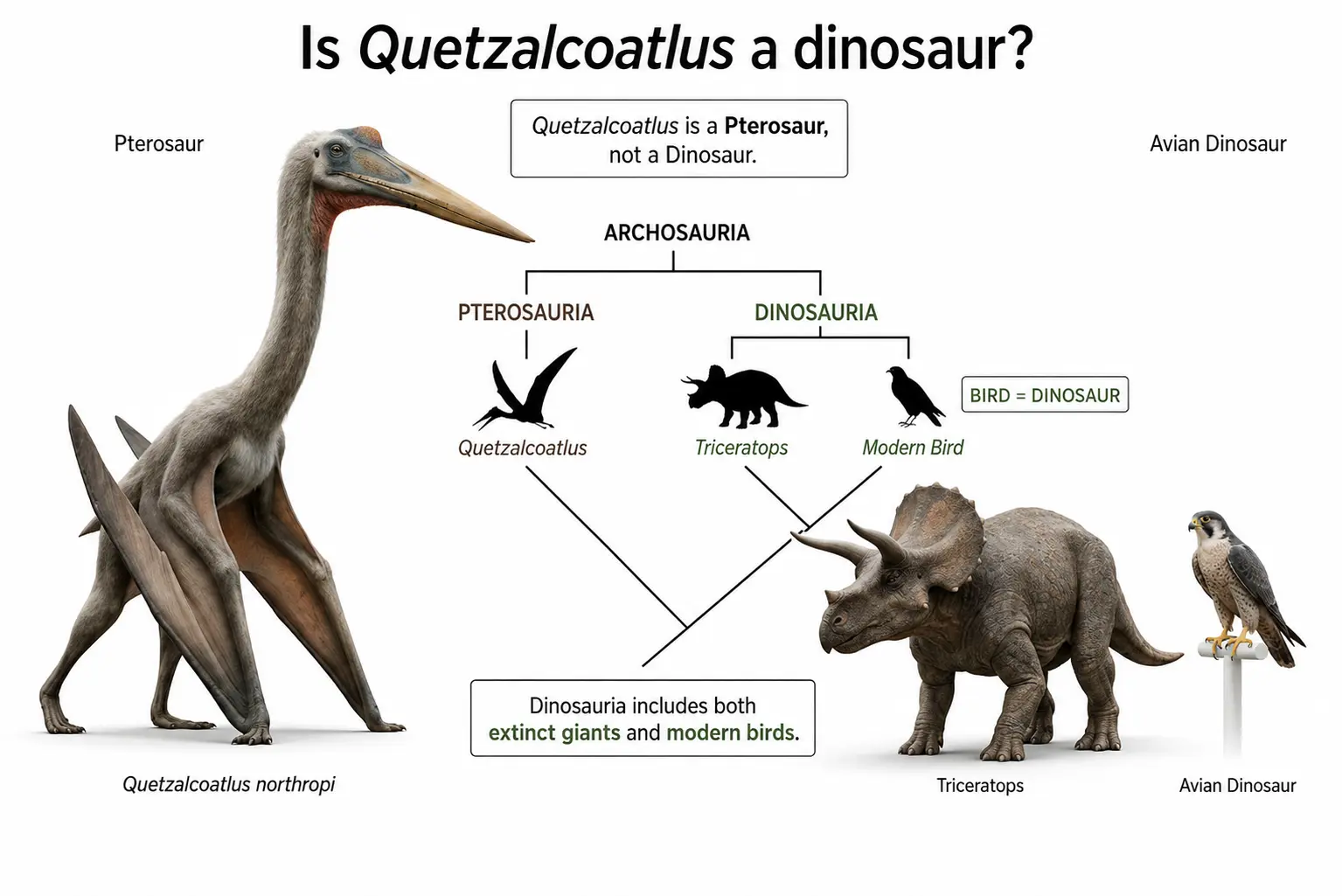
Quick Answer: Quetzalcoatlus was not a dinosaur. It was a pterosaur — a member of the clade Pterosauria — a distinct lineage of flying reptiles that evolved powered flight independently of birds and separately from dinosaurs. Although pterosaurs and dinosaurs shared a broader archosaur ancestry, Quetzalcoatlus was no more a dinosaur than a crocodilian is.
Introduction
The confusion is understandable: Quetzalcoatlus lived alongside dinosaurs, disappeared in the same end-Cretaceous mass extinction event, and has frequently been grouped with dinosaurs in popular media, museum exhibits, and documentary portrayals. However, its classification is clear: Quetzalcoatlus was a pterosaur, and pterosaurs were not dinosaurs.
Understanding that distinction is scientifically important because it highlights a remarkable evolutionary reality: multiple major archosaur lineages coexisted during the Mesozoic, each following very different anatomical and ecological pathways.
Is Quetzalcoatlus a Dinosaur?
Quetzalcoatlus was not a dinosaur. It belonged to Pterosauria, a separate lineage of flying reptiles that evolved powered flight independently long before birds appeared. Although pterosaurs and dinosaurs both belong to the broader archosaur lineage and share a distant common ancestor, they represent distinct evolutionary branches.
Calling Quetzalcoatlus a dinosaur is taxonomically incorrect in the same way that calling a crocodilian a dinosaur would be incorrect: both belong to Archosauria, but neither belongs to Dinosauria.
The distinction is more than a technical classification. Pterosaurs evolved flight through a fundamentally different anatomical design from birds. Their wings were formed primarily by a flight membrane supported by a dramatically elongated fourth finger, whereas bird wings are modified feathered forelimbs. Although Quetzalcoatlus itself preserves no direct feather evidence, related pterosaurs show pycnofibres—hair-like integumentary structures covering the body—indicating a very different external anatomy from either birds or dinosaurs.
Why Is Quetzalcoatlus So Often Called a Dinosaur?
The frequent confusion between pterosaurs and dinosaurs largely stems from popular culture, museum presentation, and the fact that both groups are commonly discussed together in Mesozoic contexts. Pterosaurs, dinosaurs, and marine reptiles such as mosasaurs and plesiosaurs all disappeared during the end-Cretaceous mass extinction event approximately 66 million years ago, leading to their frequent cultural grouping as “prehistoric reptiles” despite belonging to distinct evolutionary lineages.
Films, documentaries, toys, and general media have often reinforced this confusion by presenting pterosaurs alongside dinosaurs without clearly explaining the taxonomic distinction. As a result, many people incorrectly use “dinosaur” as a catch-all term for large extinct reptiles, even though the term has a much more specific scientific meaning.
What Is a Pterosaur?
A pterosaur was a member of the clade Pterosauria, the first known vertebrate group to evolve powered flight. Pterosaurs first appeared in the Late Triassic, approximately 228 million years ago, and persisted until the end of the Cretaceous Period.
This group ranged dramatically in size, from small early forms with wingspans comparable to modern birds to giant azhdarchids such as Quetzalcoatlus, which approached the upper biological limits of powered vertebrate flight.
Pterosaurs were archosaurs, placing them within the same broader evolutionary group as dinosaurs, crocodilians, and modern birds. However, they were not dinosaurs themselves, but a separate archosaur lineage that evolved its own specialized anatomy for flight.
How Are Pterosaurs and Dinosaurs Different?
Pterosaurs and dinosaurs were distinct archosaur lineages defined by different skeletal anatomy and evolutionary history. Dinosaurs are classified within Dinosauria based on a suite of anatomical characteristics, including specific pelvic structure, limb posture, and skeletal arrangements not present in pterosaurs.
Pterosaurs evolved a very different body plan adapted for powered flight, including lightweight hollow bones, elongated wing-supporting forelimbs, and membranous wings anchored primarily by an enormously extended fourth finger. Dinosaurs, by contrast, evolved a wide range of terrestrial body plans, with only one branch—the theropod lineage leading to birds—later developing flight.
The distinction is therefore based on evolutionary anatomy, not an arbitrary naming convention.
Are Birds Dinosaurs?
Yes. Modern birds are living theropod dinosaurs, a conclusion firmly established in modern vertebrate paleontology through extensive anatomical and evolutionary evidence.
This means birds are the only surviving members of Dinosauria. Pterosaurs, despite also achieving powered flight, were not dinosaurs and represent a completely separate extinct archosaur lineage with no living descendants.
What Did Quetzalcoatlus Have in Common with Dinosaurs?
Quetzalcoatlus inhabited the same Late Cretaceous terrestrial ecosystems as dinosaurs and shared the broader archosaur evolutionary heritage that links pterosaurs, dinosaurs, birds, and crocodilians.
Within the Javelina Formation of Texas, Quetzalcoatlus existed alongside dinosaurs, including the giant titanosaur Alamosaurus, as well as hadrosaur and ceratopsian taxa. It also lived during the same broader Maastrichtian interval as Tyrannosaurus rex in other North American ecosystems.
However, ecological coexistence does not imply taxonomic relationship. Sharing time and habitat with dinosaurs does not make Quetzalcoatlus a dinosaur any more than sharing a modern ecosystem with birds makes a crocodile a bird.
Related and Comparative Species
- Pteranodon longiceps — A well-known North American pterosaur from the earlier Late Cretaceous, often confused with Quetzalcoatlus in popular media despite being significantly smaller and belonging to a different pterosaur lineage.
- Dimorphodon macronyx — An early Jurassic pterosaur that illustrates the much deeper evolutionary history of Pterosauria, demonstrating that pterosaurs had already diversified long before the rise of giant Late Cretaceous forms such as Quetzalcoatlus.
- Tyrannosaurus rex — A large theropod dinosaur from Late Cretaceous North America, included here as a useful comparison for understanding the distinction between true dinosaurs and contemporaneous non-dinosaur archosaurs such as pterosaurs.
- Alamosaurus sanjuanensis — A giant titanosaur sauropod known from the same Javelina Formation ecosystem as Quetzalcoatlus, providing a direct example of dinosaur faunal associates within its habitat.
- Archaeopteryx lithographica — An early avialan frequently used to illustrate the evolutionary origin of birds within Dinosauria, offering useful contrast with the entirely separate evolutionary history of pterosaurs.
Frequently Asked Questions
Is Quetzalcoatlus a dinosaur?
No. Quetzalcoatlus was not a dinosaur; it was a pterosaur belonging to the clade Pterosauria. Although both pterosaurs and dinosaurs were archosaurs and shared a distant common ancestor, they were separate evolutionary lineages. The confusion largely arises because both groups coexisted during the Mesozoic and disappeared in the same end-Cretaceous extinction event.
Is Quetzalcoatlus a dinosaur or a bird?
Neither. Quetzalcoatlus was a pterosaur—a flying reptile that evolved powered flight independently of birds. Birds are living theropod dinosaurs with feathered wings derived from modified forelimbs, whereas pterosaur wings consisted of membranous flight structures supported primarily by an elongated fourth finger.
What is the difference between a pterosaur and a dinosaur?
The difference is both anatomical and evolutionary. Dinosaurs belong to Dinosauria, a clade defined by specific skeletal and evolutionary characteristics. Pterosaurs were a separate archosaur lineage with distinct anatomy adapted for powered flight. Although both groups share deep evolutionary ancestry within Archosauria, pterosaurs were never members of Dinosauria.
Conclusion
Quetzalcoatlus was not a dinosaur, but a pterosaur—a member of a separate flying reptile lineage that evolved alongside dinosaurs for much of the Mesozoic Era. While the two groups shared ecosystems, a broad archosaur ancestry, and ultimately the same extinction event, they remained taxonomically and evolutionarily distinct.
Recognizing that distinction makes Quetzalcoatlus more scientifically remarkable, not less: it represents a completely independent solution to powered flight and giant body size within vertebrate evolutionary history.
Featured Museum Collections
Museum-quality paleoart and educational poster
collections based on evidence-informed prehistoric
Life reconstructions.