
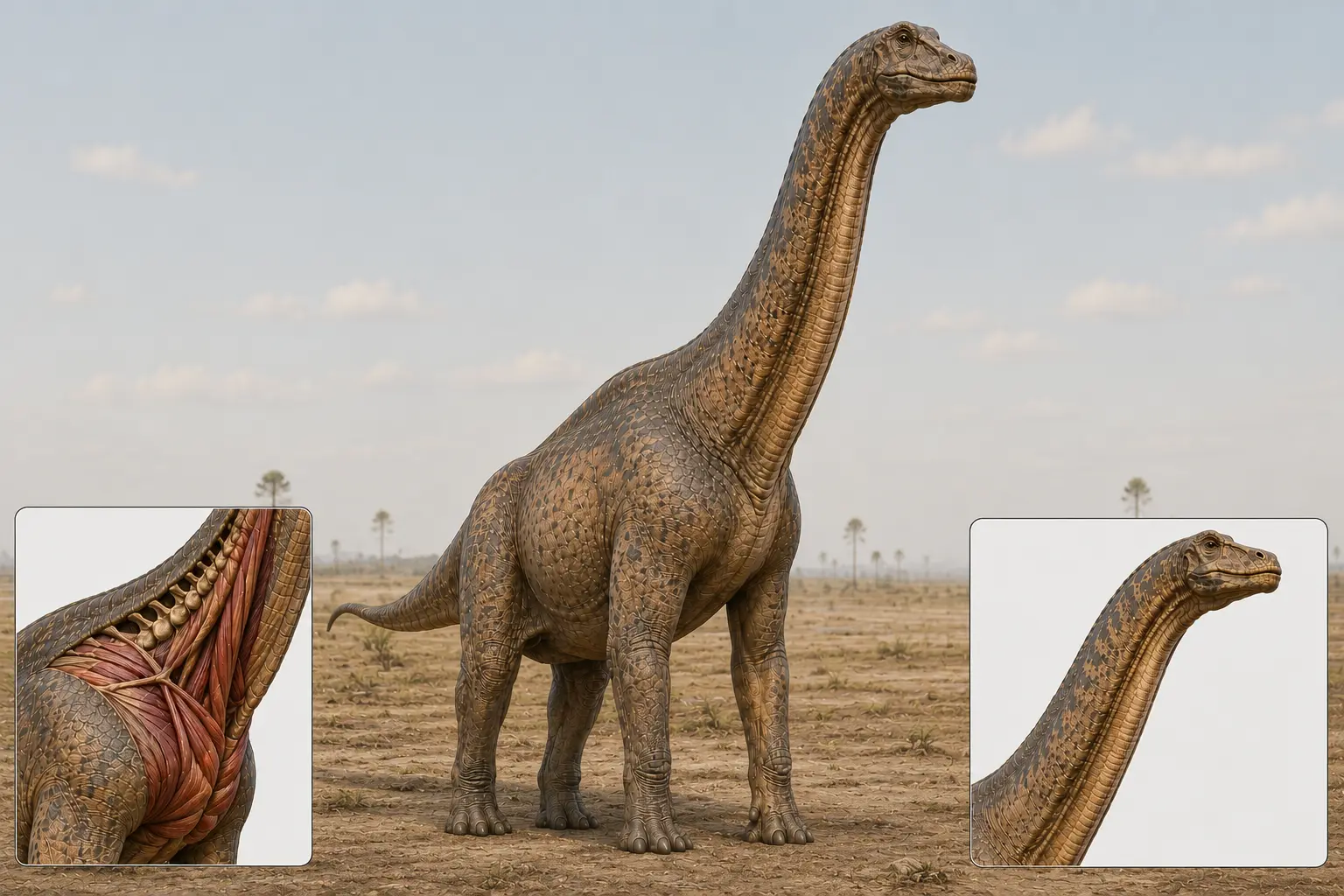
At a Glance
| Field | Information |
|---|---|
| Species | Brachiosaurus altithorax — Sauropoda, Brachiosauridae |
| Period | Late Jurassic, 154–150 Ma |
| Estimated neck length | Approximately 8.5–9 m (28–30 ft) — based on scaled Giraffatitan material |
| Forelimb to hindlimb ratio | Forelimbs longer than hindlimbs — unusual among dinosaurs |
| Estimated maximum feeding height | Approximately 9–13 m (30–43 ft) — posture-dependent |
Quick Answer: The Brachiosaurus neck was approximately 8.5–9 metres (28–30 ft) long, supported by thirteen elongated cervical vertebrae and held at an elevated angle by the animal’s unusually long forelimbs. Biomechanical modelling suggests a habitually raised neck posture, though the precise resting angle remains debated. Combined with its elevated shoulder height, this gave Brachiosaurus an estimated feeding reach of 9–13 metres (30–43 ft).

Introduction
No other Morrison Formation dinosaur was built quite like Brachiosaurus. Where most large sauropods held their bodies roughly horizontal, the elongated forelimbs of Brachiosaurus raised the shoulders above the hips, tilting the entire torso upward and directing the long neck toward the upper canopy. That body plan — front-heavy, high-shouldered, reaching — is the defining characteristic of the brachiosaurid lineage.
How Long Was the Brachiosaurus Neck?
The Brachiosaurus neck was approximately 8.5–9 metres (28–30 ft) long, comprising thirteen cervical vertebrae that were individually elongated compared to those of most other sauropods. These figures are derived by scaling from Giraffatitan brancai material — the African taxon covered in detail in our full post on the Brachiosaurus vs Giraffatitan taxonomic split — since no complete cervical series has been recovered for B. altithorax itself. Each cervical vertebra was heavily pneumatised: fossil evidence shows extensive air-sac invasion of the bone, reducing skeletal mass considerably relative to what solid bone of similar dimensions would weigh. This pneumatisation is now understood to be a key structural adaptation enabling very long necks in sauropods without prohibitive increases in neck mass.
Cervical Vertebra Structure
Fossil evidence from brachiosaurid material shows that the cervical vertebrae were not simply elongated versions of standard vertebrae. They featured deep lateral excavations — termed pleurocoels — that indicate extensive pneumatisation by diverticula of the respiratory system. Biomechanical modelling of the cervical column suggests the vertebrae were also structured to resist vertical bending loads efficiently, consistent with a habitually elevated neck posture. The neural spines and zygapophyseal joints of the cervical series constrain the range of neck motion and have been the subject of ongoing biomechanical analysis; the precise range of lateral and vertical movement available to the neck in life remains an active area of research.
Forelimb Proportions and Their Structural Significance
Brachiosaurus had forelimbs that were proportionally longer than its hindlimbs — a feature that distinguishes brachiosaurids from most other sauropod families and gives the group its characteristic forward-tilted body posture. Fossil evidence from the holotype of B. altithorax includes a humerus measuring approximately 2.03 m (6.7 ft), which is among the longest sauropod forelimb bones known from North American material. The radius and ulna are correspondingly elongated. This forelimb elongation raises the shoulder above the hip, directing the neck upward rather than forward and significantly increasing the vertical reach available to the animal without requiring any active elevation of the neck above its resting angle.
Why Were the Front Legs Longer?
The longer front legs of Brachiosaurus reflect an evolutionary body plan specialised for high browsing rather than horizontal reach. Comparison with related brachiosaurids confirms that elevated forelimbs are a consistent feature of the lineage, not an individual variation. Biomechanical modelling suggests that the combination of elevated shoulders and a long neck directed upward gave Brachiosaurus access to a feeding tier — the upper canopy of tall conifers — that was structurally unavailable to diplodocid sauropods with lower, more horizontal body plans. The ecological significance of this specialisation is discussed in our full post on Brachiosaurus diet and browsing ecology.
Neck Posture: The Debate
Whether Brachiosaurus held its neck habitually raised at a steep angle or carried it more horizontally has been one of the more actively debated questions in sauropod biomechanics. Biomechanical estimates based on the neutral pose of the cervical vertebral column — the angle at which the zygapophyses are fully engaged — suggest a naturally elevated neck posture for brachiosaurids, with some models producing angles of 45–60 degrees above horizontal. Other analyses, applying osteological neutral pose methodology more strictly, have produced lower habitual angles. The disagreement partly reflects different assumptions about cartilage thickness at intervertebral joints, which is not preserved in fossils and must be estimated. The current weight of evidence from biomechanical modelling supports an elevated resting posture for the brachiosaurid neck, but a single settled figure for the habitual angle has not been established.
Speculatively, a habitually near-vertical neck posture would have placed the head of Brachiosaurus at heights approaching or exceeding 13 metres (43 ft) — equivalent to a four-storey building. This is an extrapolation from the upper end of modelled posture ranges and should not be treated as a confirmed figure.
Skull and Sensory Anatomy
No confirmed skull material has been recovered for Brachiosaurus altithorax. Skull reconstructions associated with Brachiosaurus in popular media are based on Giraffatitan brancai material, which preserves a tall, boxy skull with large nasal openings positioned high on the snout. Whether B. altithorax shared this cranial morphology cannot be confirmed from current fossil evidence. Inferences about sensory capabilities — vision, hearing, olfaction — depend entirely on Giraffatitan material and comparative inference from related taxa, and should be understood as approximate.
Related and Contemporary Species
Giraffatitan brancai — the African brachiosaurid providing the most complete cervical series used in neck posture reconstructions for the broader brachiosaurid body plan. Camarasaurus supremus — a Morrison Formation contemporary with a shorter, more robust neck and a distinctly different browsing profile. Diplodocus carnegii — a Morrison contemporary with a very long but horizontally oriented neck, illustrating an alternative sauropod high-volume browsing strategy. Apatosaurus ajax — a Morrison sauropod with a heavily built, shorter neck suited to lower browsing or ground-level feeding. Abydosaurus mcintoshi — a North American brachiosaurid known from skull material, providing rare cranial data for the broader brachiosaurid lineage.
Frequently Asked Questions
How did Brachiosaurus hold its neck?
How Brachiosaurus held its neck is estimated through biomechanical modelling of the cervical vertebral column. Current evidence supports a habitually elevated posture, with most models placing the neck at an angle well above horizontal — consistent with the animal’s elevated shoulder height and long-bone proportions. The precise habitual angle has not been settled, as it depends on assumptions about intervertebral cartilage that are not preserved in the fossil record.
How many neck bones did Brachiosaurus have?
Brachiosaurus had thirteen cervical vertebrae, based on comparison with Giraffatitan brancai material. No complete cervical series has been confirmed for Brachiosaurus altithorax specifically, so this figure is inferred from the closely related African taxon. Each cervical vertebra was elongated and heavily pneumatised, reducing neck mass relative to overall dimensions.
Was the Brachiosaurus’ neck flexible or rigid?
The Brachiosaurus neck was neither fully flexible nor rigid, but fell between those extremes. Biomechanical analysis of the zygapophyseal joints and vertebral morphology suggests the cervical column was capable of lateral movement and vertical adjustment, but was constrained from extreme poses. Comparison with modern long-necked animals suggests the neck was most efficiently operated within a relatively limited arc around its resting posture, with full extension in any direction requiring muscular effort.
Note: Brachiosaurus neck posture, the range of cervical motion, and the role of intervertebral cartilage in sauropod neck biomechanics are active areas of research. Details reflect current scientific consensus but may be revised as new evidence emerges.
References
B. Peer-Reviewed Literature
Taylor, M.P., Wedel, M.J. and Naish, D., 2009. Head and neck posture in sauropod dinosaurs inferred from extant animals. Acta Palaeontologica Polonica, 54(2), pp.213–220. https://doi.org/10.4202/app.2009.0007
Wedel, M.J., 2003. Vertebral pneumaticity, air sacs, and the physiology of sauropod dinosaurs. Paleobiology, 29(2), pp.243–255. https://doi.org/10.1666/0094-8373(2003)029<0243:VPASAT>2.0.CO;2
Stevens, K.A. and Parrish, J.M., 1999. Neck posture and feeding habits of two Jurassic sauropod dinosaurs. Science, 284(5415), pp.798–800. https://doi.org/10.1126/science.284.5415.798
Christian, A. and Dzemski, G., 2007. Reconstruction of the cervical skeleton posture of Brachiosaurus brancai Janensch, 1914, by an analysis of the intervertebral stress along the neck and a comparison with the results of different approaches. Fossil Record, 10(1), pp.38–49. https://doi.org/10.1002/mmng.200600017
C. Monographs, Books, and Technical Reports
Klein, N., Remes, K., Gee, C.T. and Sander, P.M. (eds.), 2011. Biology of the Sauropod Dinosaurs: Understanding the Life of Giants. Indiana University Press, Bloomington.
D. Databases and Online Resources
Paleobiology Database — Brachiosaurus altithorax specimen data. https://paleobiodb.org
Conclusion
The neck of Brachiosaurus was approximately 8.5–9 metres (28–30 ft) long, built from thirteen elongated, air-filled vertebrae, and directed upward by a body plan in which the forelimbs exceeded the hindlimbs in length. Combined, these features gave the animal a feeding reach no contemporary Morrison Formation herbivore could match. Precise neck posture in life remains an open question in sauropod biomechanics.
Recommended Paleontology & Natural History Books
As an Amazon Associate, Extinct Atlas may earn from qualifying purchases.
The Rise and Fall of the Dinosaurs
A compelling history of dinosaurs, tracing their origins, diversification, 200-million-year reign, extinction, and enduring legacy.
Dinosaurs and Prehistoric Life
A richly illustrated visual reference exploring dinosaurs, fossils, evolution, and prehistoric life across geological time.
Encyclopedia Prehistorica: Dinosaurs
An interactive dinosaur book featuring spectacular three-dimensional pop-ups, particularly suited to young readers and families.
The Rise and Reign of the Mammals
A sweeping history of mammalian evolution, from their origins alongside dinosaurs through the Cenozoic and the emergence of humans.