

At a Glance
| Attribute | Detail |
|---|---|
| Scientific name | Brachiosaurus altithorax |
| Pronunciation | BRAK-ee-oh-SORE-us al-tih-THOR-aks |
| Name meaning | “Arm lizard” + “deep/high chest” |
| Classification | Sauropoda > Brachiosauridae > Brachiosaurus > B. altithorax |
| Period | Late Jurassic, ~154–150 Ma |
| Found in | Morrison Formation, western North America (USA) |
| Diet | Herbivore — high-browsing specialist on conifers, cycads, and tree ferns |
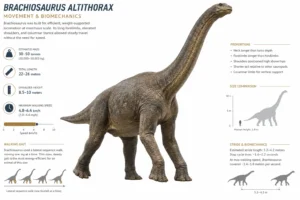
| Length | ~20–26 m (66–85 ft) |
| Weight | ~28,000–62,000 kg (62,000–137,000 lb) |
| Status | Extinct |
Quick Answer: Brachiosaurus was a plant-eating sauropod dinosaur from the Late Jurassic period, roughly 154–150 million years ago, that ranks among the largest land animals known from reasonably complete fossil material. It reached lengths of approximately 20–26 metres (66–85 ft) and could browse vegetation at heights of up to 9–13 metres (30–43 ft) using its long neck and elevated forelimbs.
Introduction
Brachiosaurus facts place this sauropod among the most remarkable animals ever to walk the Earth. Known from the Morrison Formation of western North America, Brachiosaurus altithorax stood taller at the shoulder than a double-decker bus and could reach vegetation higher than most other dinosaurs in its ecosystem. It lived approximately 154–150 million years ago, so far before the end-Cretaceous extinction that the gap between Brachiosaurus and Tyrannosaurus rex exceeds the gap between T. rex and the present day.
What makes Brachiosaurus genuinely distinctive among sauropods is its body plan: forelimbs longer than hindlimbs, a steeply inclined back, and a neck capable of elevated browsing posture — a combination that gave it exclusive access to the highest feeding tiers in its environment. The posts below cover every major aspect of the animal in detail.
How Big Was Brachiosaurus?
| Measurement | Estimate |
|---|---|
| Body length | ~20–26 m (66–85 ft) |
| Shoulder height | ~5.8–6 m (19–20 ft) |
| Mass | ~28,000–62,000 kg (62,000–137,000 lb) |
| Holotype humerus | ~2.03 m (6.7 ft) |
Mass estimates for large sauropods carry substantial uncertainty and have been revised repeatedly as volumetric modelling methodology has evolved; earlier figures exceeded 70,000 kg and were later revised downward. Size figures for Brachiosaurus are partially dependent on scaling from the closely related Giraffatitan because the B. altithorax holotype is incomplete.
For more details, see our full post on Brachiosaurus size.
What Did Brachiosaurus Eat?
| Feature | Detail |
|---|---|
| Diet | Herbivore |
| Primary food sources | Conifers, cycads, ginkgoes, tree ferns |
| Browsing height | ~9–13 m (30–43 ft) |
| Estimated daily intake | ~120–260 kg (265–575 lb) — wide metabolic uncertainty |
| Tooth type | Spatula-shaped cropping teeth |
Gut fermentation was likely essential for processing tough plant material, though the association of gastroliths with sauropod digestion remains unconfirmed for Brachiosaurus specifically.
For more details, see our full post on what Brachiosaurus ate.
Brachiosaurus vs Giraffatitan: What Is the Difference?
| Feature | Brachiosaurus altithorax | Giraffatitan brancai |
|---|---|---|
| Formation | Morrison Formation, North America | Tendaguru Formation, Tanzania |
| Separated as distinct genera | Taylor (2009) | Taylor (2009) |
| Skull material | None confirmed | Known |
| Famous mounted skeleton | No | Yes — Berlin Natural History Museum |
For most of the twentieth century, both animals were classified as a single genus. Anatomical differences in torso shape, dorsal vertebra proportions, and skull structure support their separation. Most popular reconstructions labelled as Brachiosaurus — including the Berlin museum mount — are based on Giraffatitan material.
For more details, see our full post on Brachiosaurus vs Giraffatitan.
Brachiosaurus Neck: Length, Structure, and Function
| Feature | Detail |
|---|---|
| Neck length | ~8.5–9 m (28–30 ft) |
| Cervical vertebrae | 13, heavily pneumatised |
| Forelimb proportions | Longer than hindlimbs — unusual among dinosaurs |
| Feeding reach | ~9–13 m (30–43 ft) |
Some biomechanical studies support elevated feeding postures, though resting neck posture remains debated., though the precise resting angle remains debated. Pneumatisation of the cervical vertebrae was essential for reducing neck mass to manageable levels.
For more details, see our full post on Brachiosaurus neck anatomy.
Brachiosaurus Discovery: Who Found It and When?
| Detail | Value |
|---|---|
| Discoverer | Elmer S. Riggs |
| Discovery year | 1900 |
| Discovery site | Grand River Valley, Mesa County, Colorado, USA |
| Formal description | 1903 |
| Holotype specimen | FMNH P25107 |
| Material present | Forelimbs, dorsal and sacral vertebrae, pelvis, ribs |
| Material absent | Skull; most hindlimb material |
No additional specimens have been unambiguously referred to B. altithorax, making the holotype the primary — and largely sole — direct evidence for the species.
For more details, see our full post on Brachiosaurus discovery.
When Did Brachiosaurus Live?
| Detail | Value |
|---|---|
| Geological period | Late Jurassic |
| Stages | Kimmeridgian to Tithonian |
| Temporal range | ~154–150 Ma |
| Formation | Morrison Formation (~156–148 Ma) |
| Time before end-Cretaceous extinction | ~84 million years |
Brachiosaurus disappeared from the fossil record approximately 84 million years before the asteroid impact that ended the non-avian dinosaurs — it did not survive into the Cretaceous and had no connection to the end-Cretaceous extinction event.
For more details, see our full post on when Brachiosaurus lived.
How Fast Was Brachiosaurus?
| Metric | Estimate |
|---|---|
| Comfortable walking pace | ~2–4 km/h (1.2–2.5 mph) |
| Theoretical maximum | likely slow-moving; exact maximum speed uncertain |
| Running gait | Biomechanically implausible for fully grown adults |
Biomechanical estimates suggest that slow, steady locomotion was the norm. Trackway evidence from large Morrison Formation sauropods supports this interpretation. Herding behaviour has been inferred from multi-individual sauropod assemblages, though it is not confirmed for B. altithorax specifically.
For more details, see our full post on Brachiosaurus speed.
Where Did Brachiosaurus Live?
| Feature | Detail |
|---|---|
| Formation | Morrison Formation, western North America |
| Environment | Seasonal floodplains, river channels, open woodland |
| Climate | Warm, seasonally variable — pronounced wet and dry periods |
| Vegetation | Conifers, cycads, tree ferns, ginkgoes — no grasses or flowering plants |
| Key predator | Allosaurus — tooth-marked sauropod bones documented |
The Morrison Formation supported one of the most diverse large-dinosaur faunas known from the Jurassic. Brachiosaurus shared this environment with Allosaurus, Camarasaurus, Diplodocus, Stegosaurus, Apatosaurus, and Torvosaurus, among others.
For more details, see our full post on Brachiosaurus habitat.
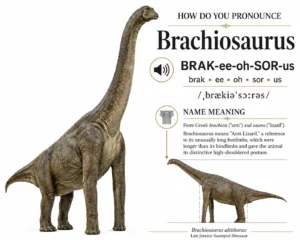
How Do You Pronounce Brachiosaurus?
| Element | Detail |
|---|---|
| Pronunciation | BRAK-ee-oh-SORE-us |
| Primary stress | BRAK |
| Secondary stress | SORE |
| Syllable count | Four |
| Name origin | Greek brachion (arm) + sauros (lizard) |
| Species name meaning | altithorax — “deep/high chest” |
The name was chosen by Riggs in 1903 to reflect the animal’s defining anatomical feature: forelimbs longer than its hindlimbs — a proportion rare among dinosaurs.
For more details, see our full post on Brachiosaurus pronunciation and name meaning.
Brachiosaurus vs Apatosaurus: Key Differences
| Feature | Brachiosaurus altithorax | Apatosaurus |
|---|---|---|
| Family | Brachiosauridae | Diplodocidae |
| Mass estimate | ~28,000–62,000 kg | ~17,000–36,000 kg |
| Body plan | Forelimbs longer than hindlimbs; inclined back | Horizontal body plan; hindlimbs longer |
| Browsing height | ~9–13 m (30–43 ft) | ~3–4 m (10–13 ft) |
| Tail | Moderate | Long, whip-like |
| Did they meet? | Yes — confirmed Morrison Formation coexistence |
These two sauropods occupied different feeding tiers within the same ecosystem, reducing direct competition. They are not closely related — Brachiosauridae and Diplodocidae are distinct lineages.
For more details, see our full post on Brachiosaurus vs Apatosaurus.
Related and Contemporary Species
Giraffatitan brancai — the African relative long classified as Brachiosaurus, now recognised as a separate genus; the Berlin museum mount is the best-known specimen of the brachiosaurid body plan.
Apatosaurus ajax and A. louisae — diplodocid sauropods that shared the Morrison Formation with Brachiosaurus, browsing at much lower heights.
Camarasaurus supremus — the most abundant Morrison Formation sauropod, a mid-level browser and ecological intermediate between the high-browsing brachiosaurids and the low-browsing diplodocids.
Diplodocus carnegii — a long-bodied diplodocid coexisting with Brachiosaurus in the Morrison; among the longest dinosaurs known, with an estimated length of 24–26 m (79–85 ft).
Allosaurus fragilis — the dominant large theropod predator of the Morrison Formation and the primary predatory threat to adult Brachiosaurus; tooth-marked sauropod bones document predation attempts.
Common Questions About Brachiosaurus
Is Brachiosaurus the biggest dinosaur ever?
Brachiosaurus is not the largest dinosaur ever discovered, though it ranks among the largest known from reasonably complete material. Several titanosaur sauropods from South America — including Patagotitan mayorum and Argentinosaurus huinculensis — have produced mass estimates that exceed those of Brachiosaurus, though size comparisons between large sauropods carry substantial uncertainty given the incompleteness of many specimens.
Did Brachiosaurus live at the same time as T. rex?
Brachiosaurus and Tyrannosaurus rex did not coexist. Brachiosaurus lived approximately 154–150 million years ago, while T. rex appeared around 68–66 Ma. The gap between them — roughly 84 million years — is greater than the gap between T. rex and the present day.
How many species of Brachiosaurus are there?
The number of valid species within Brachiosaurus is currently regarded as one: Brachiosaurus altithorax, described by Riggs in 1903. Various specimens once assigned to Brachiosaurus — including all Tendaguru material — have been reclassified into other genera, most significantly Giraffatitan. Species-level assignments within Brachiosauridae remain an active area of research subject to ongoing revision.
Could Brachiosaurus swim or hold its head above water like a snorkel?
The snorkel hypothesis — that sauropods like Brachiosaurus lived semi-aquatically and breathed through their elevated necks — has been rejected by modern palaeontology. Hydrostatic pressure at the depths required would have prevented effective lung ventilation. Current evidence supports Brachiosaurus as a fully terrestrial animal, though it would have visited water sources as any large land animal does.
What killed Brachiosaurus?
No single cause of Brachiosaurus extinction is established. The species disappears from the fossil record by the end of the Tithonian stage, approximately 150 Ma, consistent with broader faunal turnover documented within the Morrison Formation. It was not affected by the end-Cretaceous mass extinction, which occurred roughly 84 million years later.
Note: Mass estimates for large sauropods, taxonomic placement within Brachiosauridae, Morrison Formation palaeoenvironmental reconstruction, and sauropod locomotion mechanics are active areas of research. Details reflect current scientific consensus but may be revised as new evidence emerges.
References
A. Primary Taxonomic Sources
Riggs, E.S., 1903. Brachiosaurus altithorax, the largest known dinosaur. American Journal of Science, Series 4, Vol. 15, No. 88, pp. 299–306.
Taylor, M.P., 2009. A re-evaluation of Brachiosaurus altithorax Riggs 1903 (Dinosauria, Sauropoda) and its generic separation from Giraffatitan brancai (Janensch 1914). Journal of Vertebrate Paleontology, 29(3), pp.787–806.
Janensch, W., 1914. Übersicht über die Wirbeltierfauna der Tendaguru-Schichten. Archiv für Biontologie, 3, pp.81–110.
B. Peer-Reviewed Literature
Wedel, M.J., 2003. Vertebral pneumaticity, air sacs, and the physiology of sauropod dinosaurs. Paleobiology, 29(2), pp.243–255.
Christiansen, P., 1997. Locomotion in sauropod dinosaurs. Gaia, 14, pp.45–75.
C. Monographs, Books, and Technical Reports
Paul, G.S., 2016. The Princeton Field Guide to Dinosaurs (2nd Edition). Princeton University Press.
Curry Rogers, K. and Wilson, J.A. (eds.), 2005. The Sauropods: Evolution and Paleobiology. University of California Press, Berkeley.
D. Databases and Online Resources
Paleobiology Database. Brachiosaurus altithorax occurrence data. https://paleobiodb.org/
📘 Related Species
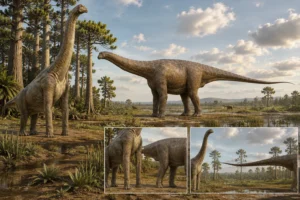

🦴 Fossil History
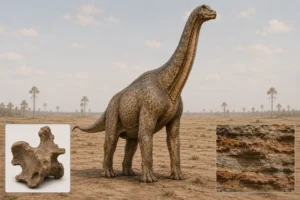
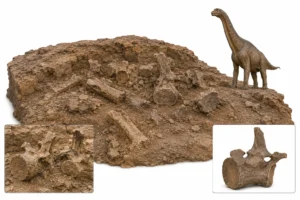

🦷 Anatomy


Recommended Paleontology & Natural History Books
As an Amazon Associate, Extinct Atlas may earn from qualifying purchases.
The Rise and Fall of the Dinosaurs
A compelling history of dinosaurs, tracing their origins, diversification, 200-million-year reign, extinction, and enduring legacy.
Dinosaurs and Prehistoric Life
A richly illustrated visual reference exploring dinosaurs, fossils, evolution, and prehistoric life across geological time.
Encyclopedia Prehistorica: Dinosaurs
An interactive dinosaur book featuring spectacular three-dimensional pop-ups, particularly suited to young readers and families.
The Rise and Reign of the Mammals
A sweeping history of mammalian evolution, from their origins alongside dinosaurs through the Cenozoic and the emergence of humans.