Quick Info
| Field | Information |
|---|---|
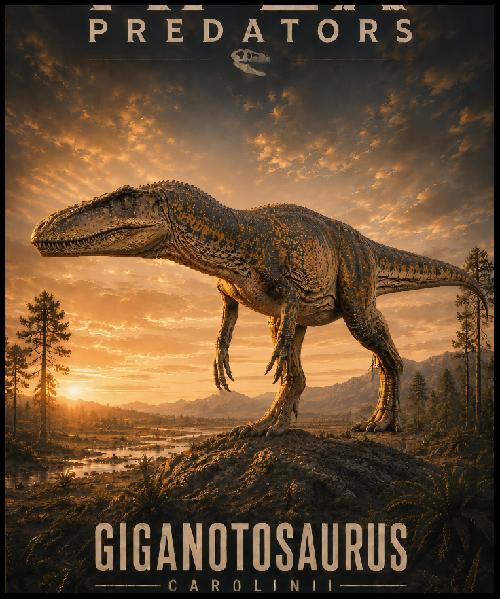
| Species | Giganotosaurus carolinii — Saurischia, Carcharodontosauridae |
| Period | Late Cretaceous (Cenomanian), approximately 99–97 Ma |
| Evidence for sociality | Indirect only — no direct fossil evidence of cooperative hunting confirmed |
| Relevant related taxon | Mapusaurus roseae — associated bone bed cited in sociality discussion |
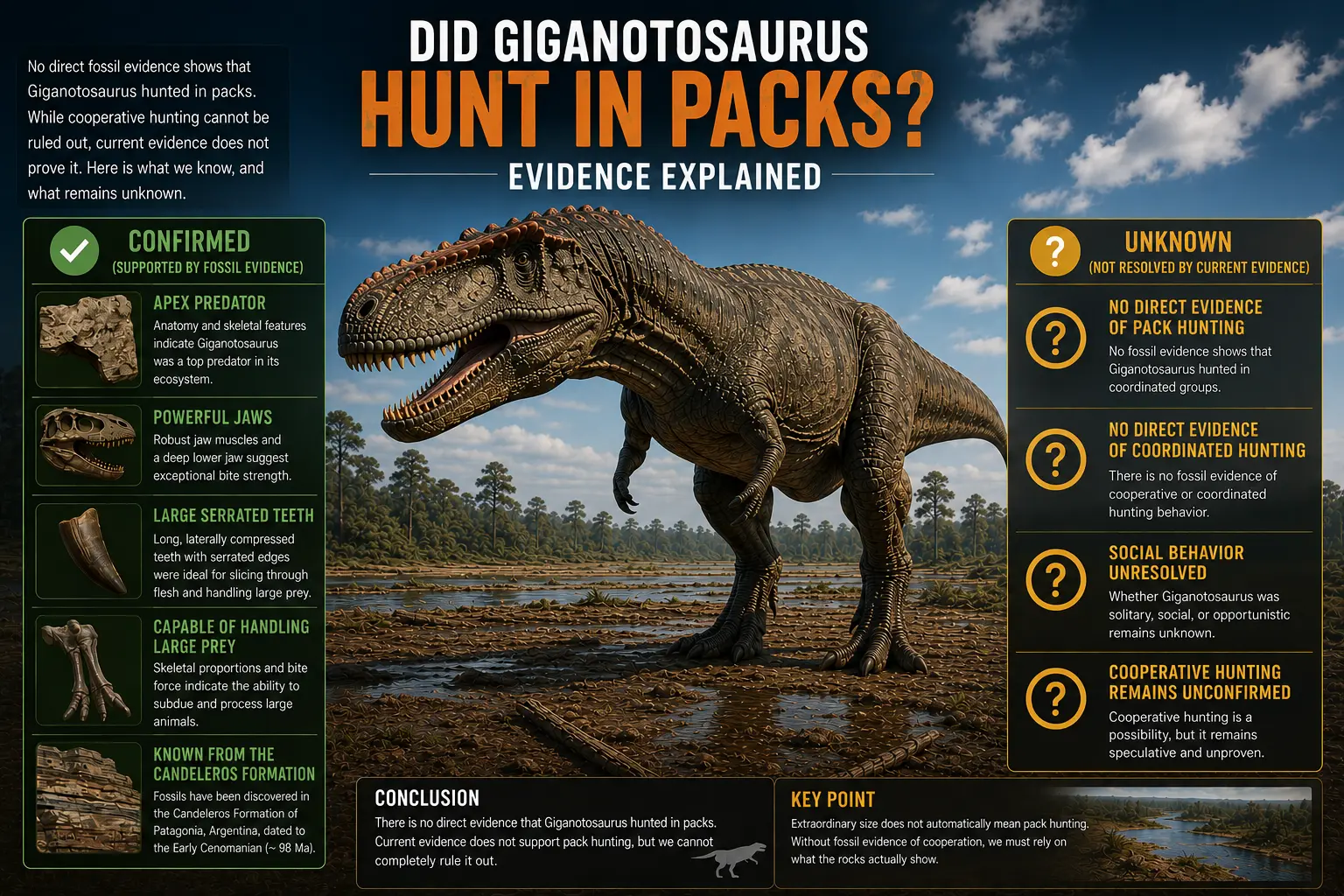
Quick Answer: Direct fossil evidence for pack hunting in Giganotosaurus does not exist. The hypothesis is based primarily on a bone bed containing multiple individuals of the closely related Mapusaurus roseae, which some researchers interpret as evidence of group behaviour in carcharodontosaurids. This interpretation remains contested, and alternative explanations exist.

No Giganotosaurus tooth marks have been found on sauropod bone in a pattern that confirms a coordinated group attack. The pack-hunting idea is compelling, and it cannot be ruled out — but the evidence supporting it is indirect, comparative, and genuinely disputed. Understanding what the fossils actually show is the most interesting part of this question.
Did Giganotosaurus Hunt in Packs?
The short answer is that there is currently no direct fossil evidence demonstrating pack hunting in Giganotosaurus. The species is known from relatively limited fossil material, and none of the known remains preserve behavioural evidence. As a result, any discussion of social hunting in Giganotosaurus relies on indirect evidence and comparisons with closely related carcharodontosaurid theropods rather than observations from Giganotosaurus fossils themselves.
The Mapusaurus Bone Bed
The principal evidence frequently cited in discussions of carcharodontosaurid social behaviour comes from a fossil bone bed in the Huincul Formation of Neuquén Province, Argentina. Described by Coria and Currie (2006), the site contains the remains of multiple individuals of Mapusaurus roseae, a large carcharodontosaurid that was closely related to Giganotosaurus.
The discovery of several individuals preserved within the same deposit has been interpreted by some researchers as potentially consistent with group behaviour. If these animals were associated in life, the find could suggest some degree of social interaction among large carcharodontosaurids. Because Mapusaurus and Giganotosaurus were closely related, this possibility has occasionally been extended to Giganotosaurus as well.
However, the evidence does not demonstrate cooperative hunting. Fossil bone beds can form through a variety of processes that do not require social behaviour. Seasonal droughts may concentrate animals around limited water sources, flood events can transport and accumulate remains from different locations, and carcasses may collect at frequently used feeding areas over extended periods of time. Based on the available evidence, these alternative explanations cannot be ruled out.
Consequently, the Mapusaurus bone bed provides evidence that multiple large carcharodontosaurids were preserved together, but it does not conclusively show that they lived, travelled, or hunted as coordinated groups. Any inference of pack hunting in Giganotosaurus, therefore, remains speculative and indirect rather than a demonstrated fact.
What the Evidence Actually Supports
The Mapusaurus bone bed supports the conclusion that multiple individuals of a large carcharodontosaurid died or were deposited in the same location. It is consistent with, but does not confirm, social behaviour. Applying this inference to Giganotosaurus requires an additional assumption — that behaviours inferred for Mapusaurus also applied to the closely related but temporally and geographically separated Giganotosaurus. This is a reasonable comparative inference but not a direct fossil finding.
Comparison with modern large predators is informative but inconclusive. Among living theropod descendants — birds — both solitary and cooperative hunting strategies occur. Among large non-avian archosaurs such as Nile crocodiles, opportunistic group feeding is observed without requiring permanent social structures. Inferred from comparison with modern analogues, a loose or opportunistic form of group behaviour in Giganotosaurus is plausible but speculative.
How Did Giganotosaurus Hunt?
Predation Mechanics
Giganotosaurus possessed large, laterally compressed, serrated teeth that were well suited for slicing flesh. Unlike the thick, robust teeth of tyrannosaurids, which were capable of withstanding extremely high bite forces and frequent bone contact, the teeth of Giganotosaurus were adapted primarily for cutting soft tissue and inflicting deep wounds.
Studies of carcharodontosaurid skull anatomy suggest that these predators relied on a different feeding strategy from later tyrannosaurids. Rather than delivering a single crushing bite, Giganotosaurus likely used powerful bites combined with pulling and tearing motions to remove flesh and inflict substantial tissue damage. Its elongated skull and blade-like teeth were well suited for this style of predation.
Based on tooth morphology, skull structure, and comparisons with other carcharodontosaurids, many researchers infer that Giganotosaurus employed repeated slashing bites against large prey. Such a strategy would have been effective when attacking massive herbivorous dinosaurs, including titanosaurs, by causing significant blood loss and tissue damage over time rather than relying on a single immediately fatal bite.
Although this hunting model is widely considered plausible, direct evidence of specific hunting behaviour is not preserved in the fossil record. Consequently, details of how Giganotosaurus subdued prey remain partly inferential.
Bite Force
The exact bite force of Giganotosaurus remains uncertain because estimates depend on biomechanical modelling and assumptions about muscle size and skull function. Published studies generally indicate that its bite force was substantially lower than that of Tyrannosaurus rex, which possessed one of the most powerful bites known among terrestrial animals.
This difference reflects contrasting skull designs rather than differences in predatory effectiveness. Tyrannosaurids evolved exceptionally robust skulls and teeth capable of generating enormous bite forces and crushing bone. In contrast, carcharodontosaurids such as Giganotosaurus evolved narrower skulls and blade-like teeth adapted for slicing and tearing flesh.
As a result, Giganotosaurus is generally interpreted as a predator that relied on repeated cutting bites and tissue damage, whereas Tyrannosaurus rex relied more heavily on overwhelming bite force. Both strategies were successful adaptations for hunting large prey, but they achieved this through different anatomical specialisations.
Was Giganotosaurus a Social Animal?
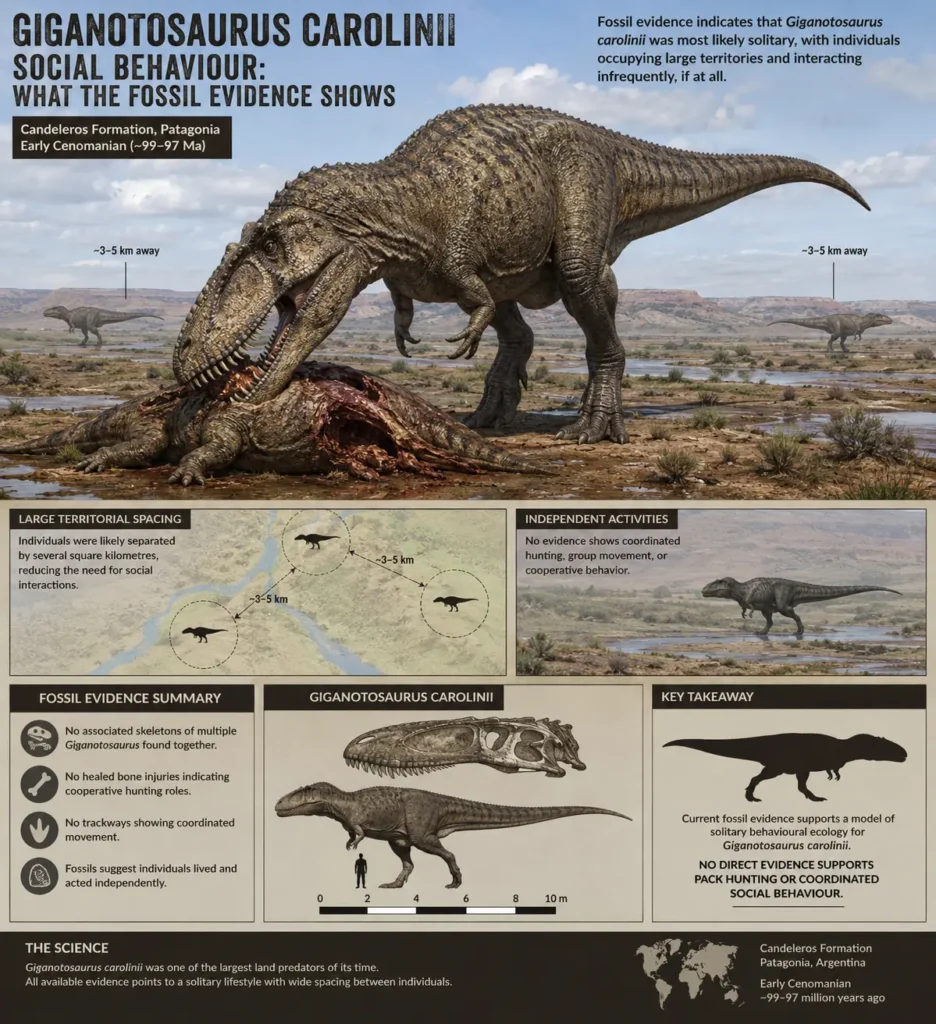
No direct evidence addresses the social structure of Giganotosaurus. Based on comparison with the Mapusaurus bone bed and broader inference from large theropod ecology, three interpretations are possible.
The first is solitary ambush or pursuit predation, consistent with the behaviour of most large living predators and requiring no social organisation. The second is opportunistic aggregation — individuals attracted to the same large carcass or prey animal without coordinated hunting. The third is active cooperative hunting involving coordinated group attack on large prey. The available evidence cannot distinguish between these possibilities for Giganotosaurus specifically.
Speculatively, coordinated hunting of giant titanosaur sauropods by groups of carcharodontosaurids would offer a plausible selective advantage, as prey of that size would be difficult or impossible to subdue quickly by a single predator. This is extrapolation, not direct evidence, and should not be presented as established behaviour.
Related and Contemporary Species
- Mapusaurus roseae — a closely related carcharodontosaurid and the source of the bone-bed evidence central to discussions of possible group behaviour in giant carcharodontosaurids.
- Carcharodontosaurus saharicus — a contemporary North African carcharodontosaurid representing convergent ecological evolution; no evidence of group behaviour reported from its fossil record.
- Tyrannosaurus rex — a distantly related large theropod from North America showing no confirmed evidence of pack hunting- is used as a comparative reference point for large theropod predatory behaviour.
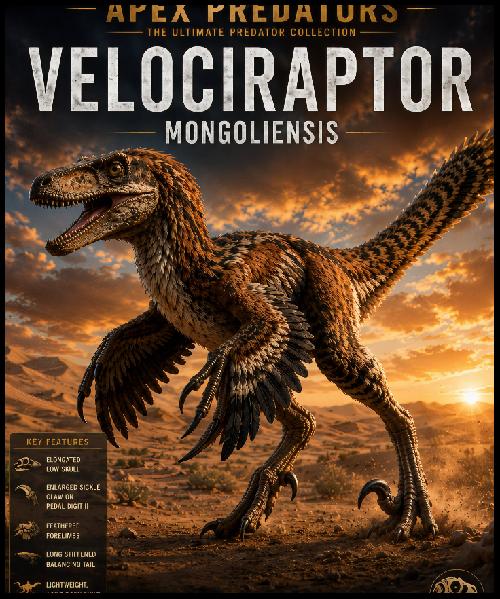
- Velociraptor mongoliensis — a much smaller dromaeosaurid sometimes cited in popular discussions of dinosaur pack hunting; its own sociality evidence is also debated, and it is not closely related to Giganotosaurus.
Frequently Asked Questions
What was the bite force of a Giganotosaurus?
The exact bite force of Giganotosaurus remains uncertain because estimates depend on biomechanical modelling and assumptions about muscle size and skull anatomy. Most studies suggest that its bite force was substantially lower than that of Tyrannosaurus rex, but the species likely compensated through repeated slashing bites and powerful tearing motions. As a result, Giganotosaurus is generally interpreted as a predator adapted for slicing flesh rather than crushing bone.
Note: The interpretation of the Mapusaurus bone bed as evidence of social behaviour and biomechanical bite-force estimates for carcharodontosaurids are active areas of research. Details reflect current scientific consensus but may be revised as new evidence emerges.
Conclusion
The hypothesis that Giganotosaurus hunted in coordinated groups remains unproven. The primary evidence comes from a bone bed of the related carcharodontosaurid Mapusaurus, which demonstrates the association of multiple individuals but does not conclusively establish cooperative hunting. Current evidence supports the interpretation of Giganotosaurus as a large predator capable of attacking enormous prey, but whether it hunted alone, gathered opportunistically, or occasionally cooperated with other individuals remains unknown.
References
A. Primary Taxonomic Sources
Coria, R.A. & Salgado, L. (1995). A new giant carnivorous dinosaur from the Cretaceous of Patagonia. Nature, 377, 224–226. https://doi.org/10.1038/377224a0
B. Peer-Reviewed Literature
Coria, R.A. & Currie, P.J. (2006). A new carcharodontosaurid (Dinosauria, Theropoda) from the Upper Cretaceous of Argentina. Geodiversitas, 28(1), 71–118.
Novas, F.E., de Valais, S., Vickers-Rich, P. & Rich, T.H. (2005). A large Cretaceous theropod from Patagonia and the evolution of carcharodontosaurids. Journal of Vertebrate Paleontology, 25(4), 966–970.
Sereno, P.C., Dutheil, D.B., Iarochene, M., Larsson, H.C.E., Lyon, G.H., Magwene, P.M., Sidor, C.A., Varricchio, D.J. & Wilson, J.A. (1996). Predatory dinosaurs from the Sahara and Late Cretaceous faunal differentiation. Science, 272(5264), 986–991.
Varricchio, D.J., Sereno, P.C., Xijin, Z., Lin, T., Wilson, J.A. & Lyon, G.H. (2008). Avian paternal care had a dinosaur origin. Science, 322(5909), 1826–1828.
C. Books and Reference Works
The Princeton Field Guide to Dinosaurs. Princeton University Press.
Dinosaurs: The Most Complete, Up-to-Date Encyclopedia for Dinosaur Lovers of All Ages. Random House.
D. Museums and Scientific Databases
Natural History Museum — Giganotosaurus profile and educational resources.
Natural History Museum Website
Paleobiology Database
Featured Museum Collections
Museum-quality paleoart and educational poster
collections based on evidence-informed prehistoric
Life reconstructions.