
At a Glance
| Field | Information |
|---|---|
| Species | Brachiosaurus altithorax — Sauropoda, Brachiosauridae |
| Period | Late Jurassic, 154–150 Ma |
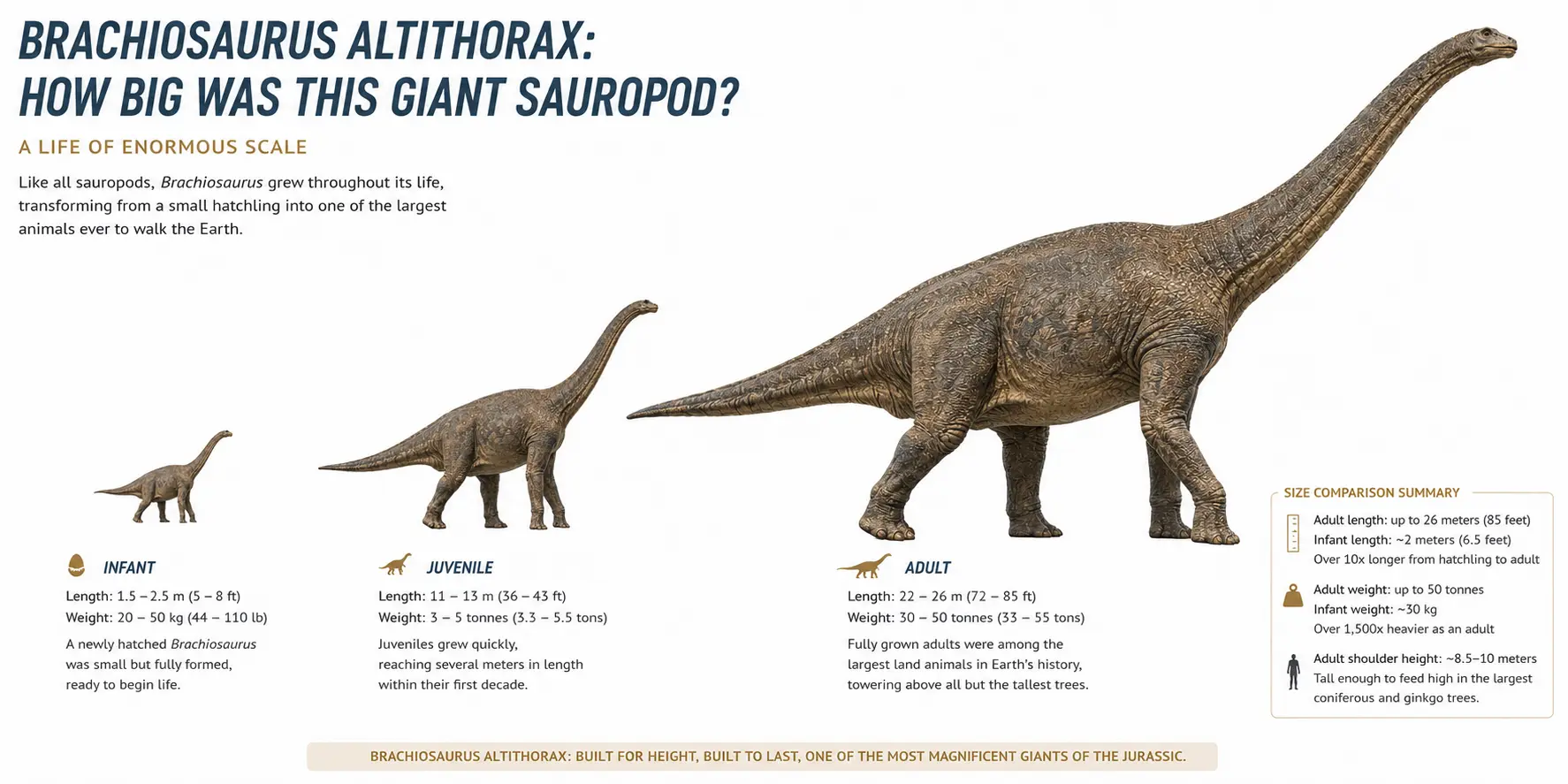
| Body length | Estimated 20–26 m (66–85 ft) |
| Shoulder height | Approximately 5.8–6 m (19–20 ft) |
| Mass estimate | 28,000–62,000 kg (62,000–137,000 lb) — estimates vary significantly |
Quick Answer: Brachiosaurus size estimates place it among the largest dinosaurs known from reasonably complete material. Current figures suggest a body length of roughly 20–26 metres (66–85 ft) and a mass somewhere between 28,000 and 62,000 kilograms (62,000–137,000 lb), though mass estimates for large sauropods carry substantial uncertainty and have been revised repeatedly.

Introduction
At its shoulder alone, Brachiosaurus stood nearly as tall as a double-decker bus. The forelimbs were longer than the hindlimbs — an unusual body plan among dinosaurs — giving the animal a forward-sloping torso and elevating the base of its neck well above the ground. That combination of height and mass made it one of the most immediately recognisable animals in the Jurassic fossil record.
How Big Was Brachiosaurus?
Brachiosaurus reached an estimated body length of 20–26 metres (66–85 ft) and a shoulder height of approximately 5.8–6 metres (19–20 ft). Fossil evidence from the holotype specimen — recovered in Colorado — indicates a massive but incomplete skeleton, and all size figures depend partly on scaling from related material.
Biomechanical estimates suggest total body mass fell somewhere between 28,000 and 62,000 kilograms (62,000–137,000 lb), with more recent volumetric modelling tending toward the lower end of earlier published ranges. The wide spread in mass figures reflects genuine scientific disagreement about soft-tissue volume, posture assumptions, and how well the known bones represent the full animal.
Length and Proportions
Fossil evidence from the holotype includes forelimb bones, vertebrae, and pelvic elements, but the specimen is not complete. Length estimates are therefore constructed by scaling from Giraffatitan brancai — the African taxon long assigned to Brachiosaurus — which is known from more complete material.
Comparison with related taxa suggests North American B. altithorax may have been somewhat larger than the Berlin Giraffatitan mount, but the evidence for this remains provisional, and species-level size differences within brachiosaurids are an active area of research.
Mass Estimates and Their Revision History
Biomechanical estimates of Brachiosaurus body mass have shifted substantially over the past four decades. Earlier figures, based on scaled physical models, regularly exceeded 70,000–80,000 kg (154,000–176,000 lb).
Computer modelling using three-dimensional volumetric reconstructions has since produced lower figures, with several studies arriving at values closer to 28,000–58,000 kg (62,000–128,000 lb). The difference is not trivial: it affects everything from metabolic rate reconstructions to inferred habitat requirements.
No single mass figure should be treated as definitive, given the incomplete nature of the fossil material and the sensitivity of volumetric models to body-shape assumptions.
How Tall Was Brachiosaurus?
Fossil evidence indicates the forelimbs of B. altithorax were proportionally longer than those of most other sauropods — the humerus alone measures approximately 2.03 m (6.7 ft) in the holotype. This elevation of the shoulder, combined with a long neck, means total vertical reach from the ground to the tip of the raised head is estimated at 9–13 metres (30–43 ft), depending on posture assumptions. Biomechanical modelling of neck angle produces a range of plausible head-height figures rather than a single settled value.
Is Brachiosaurus Bigger Than T. Rex?
Brachiosaurus was substantially larger than Tyrannosaurus rex by almost every physical measure. T. rex reached approximately 12–13 metres (39–43 ft) in length and an estimated mass of 8,000–14,000 kg (17,600–30,900 lb) — well below even the most conservative Brachiosaurus mass estimates.
In terms of shoulder height, T. rex stood roughly 3.7–4 m (12–13 ft) at the hip, compared to Brachiosaurus’s shoulder height of approximately 5.8–6 m (19–20 ft). The two species did not coexist: Brachiosaurus lived during the Late Jurassic, approximately 150–154 Ma, while T. rex lived during the Late Cretaceous, approximately 68–66 Ma — a gap of roughly 80–85 million years. Any size comparison is therefore a cross-temporal exercise rather than an ecological one.
Related and Contemporary Species
Giraffatitan brancai — the African taxon long classified within Brachiosaurus and now the basis for the most detailed size reconstructions of the brachiosaurid body plan. Apatosaurus ajax — a contemporary Morrison Formation sauropod with a heavier, lower-slung build and significantly different neck proportions. Diplodocus carnegii — another Morrison Formation contemporary; longer in body than Brachiosaurus but considerably lighter in estimated mass. Camarasaurus supremus — a common Morrison sauropod and close ecological neighbour; shorter and stockier, with a blunter skull. Supersaurus vivianae — a diplodocid from the same formation; potentially matching or exceeding Brachiosaurus in length but differing substantially in body plan.
Frequently Asked Questions
Is Brachiosaurus bigger than T. rex?
Brachiosaurus was considerably larger than Tyrannosaurus rex in mass, shoulder height, and body length. T. rex is estimated at 8,000–14,000 kg (17,600–30,900 lb) and roughly 12–13 metres (39–43 ft) long, while Brachiosaurus mass estimates reach 28,000–62,000 kg (62,000–137,000 lb). The two species lived approximately 80–85 million years apart and never shared an environment.
How has the weight estimate for Brachiosaurus changed over time?
Weight estimates for Brachiosaurus have been revised downward significantly since the late twentieth century. Earlier scaled-model approaches produced figures above 70,000 kg (154,000 lb), while more recent three-dimensional volumetric modelling has yielded estimates closer to 28,000–58,000 kg (62,000–128,000 lb). The revision reflects improved modelling methodology and a reassessment of how much soft tissue large sauropods likely carried.
What is the largest known individual Brachiosaurus?
The largest confirmed Brachiosaurus altithorax material is the holotype specimen housed at the Field Museum of Natural History in Chicago, recovered from the Morrison Formation in Colorado. Because the skeleton is incomplete, precise size reconstruction depends on scaling from more complete brachiosaurid material. Whether larger individuals of B. altithorax existed cannot be confirmed from current fossil evidence.
Note: Mass estimates for large sauropods and species-level size differences within Brachiosauridae are active areas of research. Details reflect current scientific consensus but may be revised as new evidence emerges.
References
A. Primary Taxonomic Sources
Riggs, E.S., 1903. Brachiosaurus altithorax, the largest known dinosaur. American Journal of Science, 15, pp.299–306. [verify reference before publishing]
B. Peer-Reviewed Literature
Campione, N.E. and Evans, D.C., 2012. A universal scaling relationship between body mass and proximal limb bone dimensions in quadrupedal terrestrial tetrapods. BMC Biology, 10(1), p.60. https://doi.org/10.1186/1741-7007-10-60
Paul, G.S., 1988. The brachiosaur giants of the Morrison and Tendaguru with a description of a new subgenus, Giraffatitan, and a comparison of the world’s largest dinosaurs. Hunteria, 2(3), pp.1–14. [verify reference before publishing]
Benson, R.B.J., Campione, N.E., Carrano, M.T., Mannion, P.D., Sullivan, C., Upchurch, P., and Evans, D.C., 2014. Rates of dinosaur body mass evolution indicate 170 million years of sustained ecological innovation on the avian stem lineage. PLOS Biology, 12(5), e1001853. https://doi.org/10.1371/journal.pbio.1001853
C. Monographs, Books, and Technical Reports
Paul, G.S., 2016. The Princeton Field Guide to Dinosaurs, 2nd edition. Princeton University Press, Princeton.
D. Databases and Online Resources
Paleobiology Database — Brachiosaurus altithorax occurrence data. https://paleobiodb.org
Conclusion
Brachiosaurus was one of the largest animals ever to walk the Earth, with body length estimates of 20–26 metres (66–85 ft) and mass estimates ranging from 28,000 to 62,000 kilograms (62,000–137,000 lb). Those figures carry real uncertainty — the fossil material is incomplete, and mass modelling methods continue to be refined — but the animal’s extraordinary scale is not in doubt.
Recommended Paleontology & Natural History Books
As an Amazon Associate, Extinct Atlas may earn from qualifying purchases.
The Rise and Fall of the Dinosaurs
A compelling history of dinosaurs, tracing their origins, diversification, 200-million-year reign, extinction, and enduring legacy.
Dinosaurs and Prehistoric Life
A richly illustrated visual reference exploring dinosaurs, fossils, evolution, and prehistoric life across geological time.
Encyclopedia Prehistorica: Dinosaurs
An interactive dinosaur book featuring spectacular three-dimensional pop-ups, particularly suited to young readers and families.
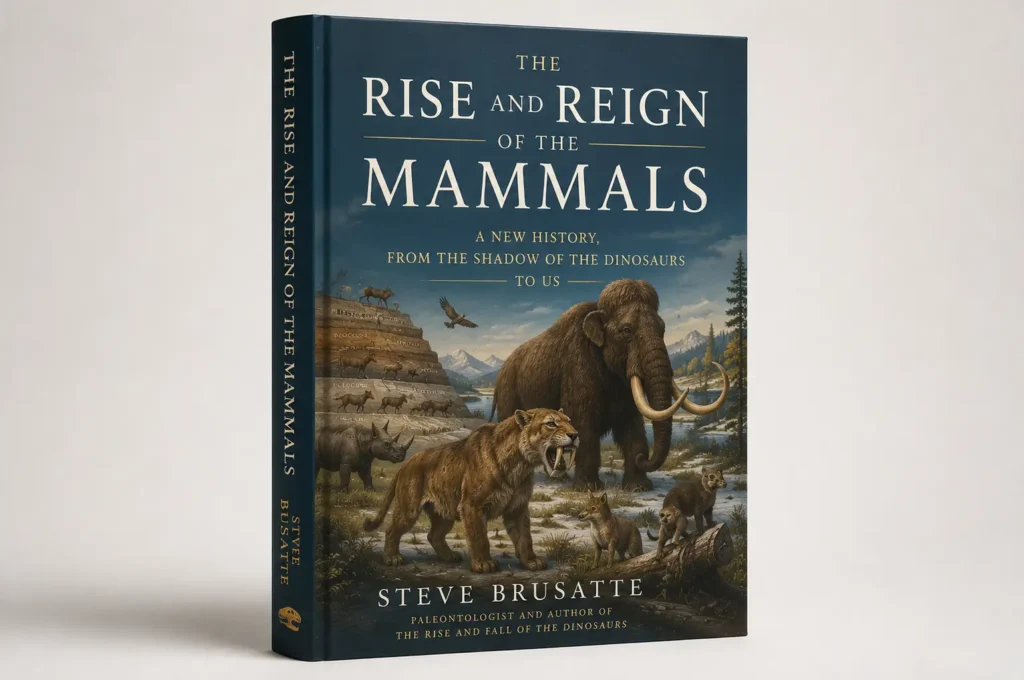
The Rise and Reign of the Mammals
A sweeping history of mammalian evolution, from their origins alongside dinosaurs through the Cenozoic and the emergence of humans.