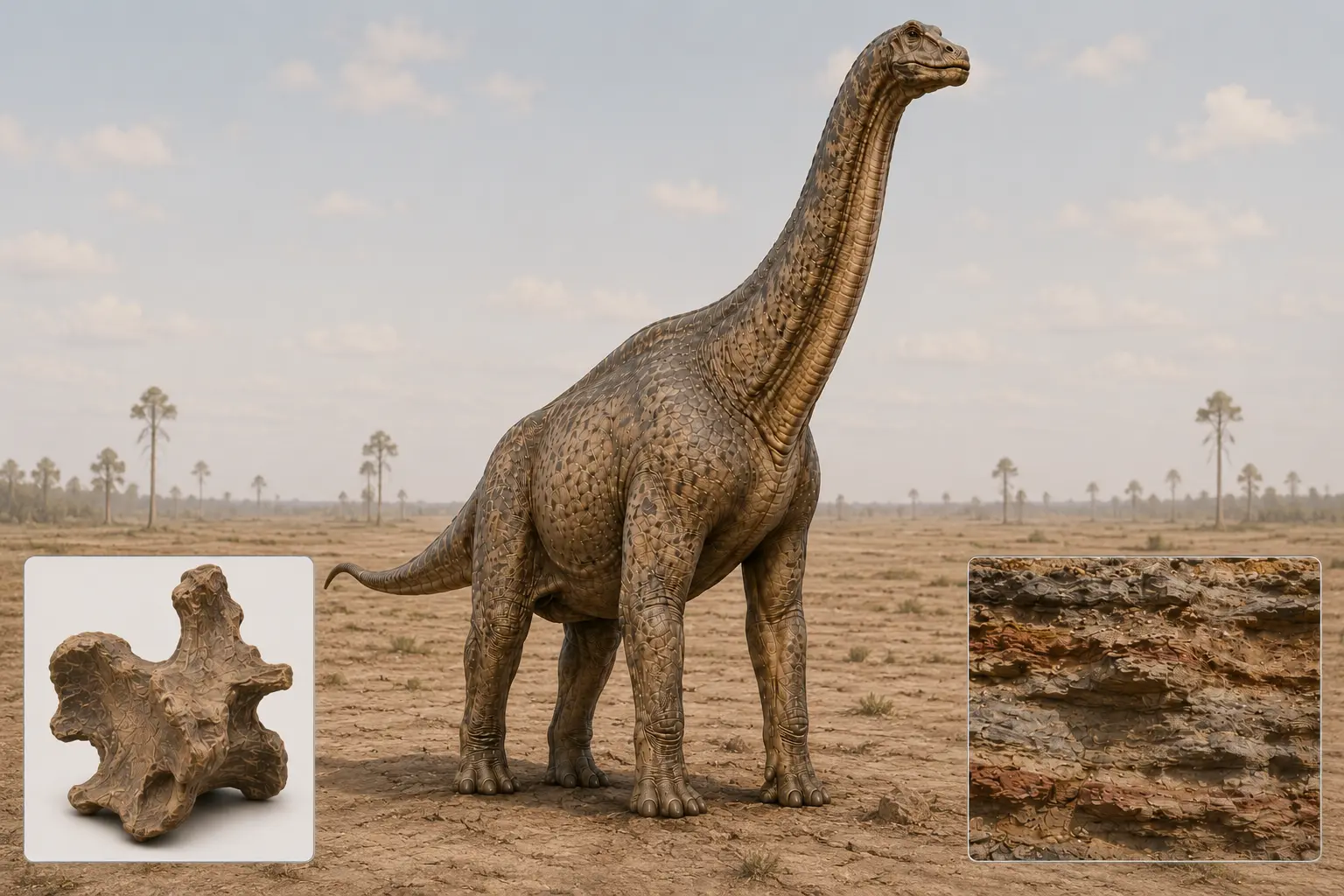
At a Glance
| Field | Information |
|---|---|
| Species | Brachiosaurus altithorax — Sauropoda, Brachiosauridae |
| Period | Late Jurassic — Kimmeridgian to Tithonian |
| Temporal range | Approximately 154–150 Ma |
| Formation | Morrison Formation, western North America |
| Extinction timing | Disappeared from the fossil record well before the end-Cretaceous mass extinction at 66 Ma |
Quick Answer: Brachiosaurus lived during the Late Jurassic period, approximately 154–150 million years ago, during the Kimmeridgian to Tithonian stages. It is known from the Morrison Formation of western North America. Brachiosaurus did not survive to the end-Cretaceous mass extinction — it disappeared from the fossil record roughly 84 million years before the asteroid impact that ended the age of non-avian dinosaurs.

Introduction
Brachiosaurus belongs to a world that preceded the most famous chapter of dinosaur history by a vast margin. The Late Jurassic Morrison Formation fauna — Allosaurus, Stegosaurus, Diplodocus, Camarasaurus, and Brachiosaurus among them — lived and disappeared tens of millions of years before Tyrannosaurus rex first appeared. Understanding when Brachiosaurus lived means stepping back not just from the present but from the Cretaceous entirely.
When Did Brachiosaurus Live?
Brachiosaurus lived approximately 154–150 million years ago, during the Kimmeridgian to Tithonian stages of the Late Jurassic period. This temporal range is established from the stratigraphic position of the Morrison Formation layers in which B. altithorax material has been recovered. Radiometric dating of volcanic ash beds interbedded with Morrison Formation sediments has provided calibration points for the formation’s depositional timeline, constraining the ages of the fossil-bearing layers with increasing precision. The Late Jurassic was characterised globally by warm climates, elevated sea levels relative to the present, and the dominance of sauropod dinosaurs across multiple continents.
The Morrison Formation Timeline
The Morrison Formation is a sequence of Late Jurassic sedimentary rocks deposited across a large area of western North America, extending through parts of present-day Colorado, Utah, Wyoming, Montana, South Dakota, New Mexico, and Oklahoma. Fossil evidence from the formation documents one of the richest and most diverse Late Jurassic dinosaur assemblages known anywhere in the world. The formation was deposited over an extended period — current estimates place its total depositional span at roughly 6–7 million years, from approximately 156 to 148 Ma, though the precise bounds are subject to ongoing refinement as new radiometric data are published. Brachiosaurus altithorax material comes from the middle portion of this sequence.
Geological Context
The Late Jurassic world in which Brachiosaurus lived differed substantially from the present. North America and Europe were closer together, separated by a narrowing seaway rather than the full Atlantic Ocean. The interior of western North America was a seasonally variable floodplain environment — the Morrison Formation preserves evidence of both wet and dry seasons, river systems, and periods of drought. The full habitat and ecosystem context is covered in our dedicated post on Brachiosaurus habitat and the Morrison Formation environment.
When Did Brachiosaurus Go Extinct?
Brachiosaurus went extinct approximately 150 million years ago — or, more precisely, it ceased to appear in the fossil record at the end of the Morrison Formation’s brachiosaurid-bearing layers. This is far earlier than the end-Cretaceous mass extinction at 66 Ma, which eliminated the non-avian dinosaurs, including T. rex, Triceratops, and the other Cretaceous forms familiar from popular culture. The disappearance of Brachiosaurus was not a global extinction event but a regional and temporal turnover — the replacement of one dinosaur fauna by another over geological time. What specifically drove the loss of North American brachiosaurids from the Morrison Formation record is not fully understood; possible factors include habitat change, faunal turnover, and the gradual shift in vegetation and climate that characterised the Jurassic–Cretaceous transition. These remain areas of active research rather than settled explanation.
Is Brachiosaurus Still Alive?
Brachiosaurus is not still alive. The species Brachiosaurus altithorax is known only from the Late Jurassic fossil record, approximately 150–154 million years ago, and there is no credible scientific evidence for the survival of any non-avian sauropod dinosaur into the modern era. Claims of living large dinosaur-like animals in remote regions — most often associated with central African folklore — have no support in the palaeontological or zoological literature and are not consistent with what is known about large-animal ecology, island biogeography, or the completeness of the modern faunal record.
How Does Brachiosaurus Fit Into Dinosaur History?
Brachiosaurus represents one point in a very long arc. The first dinosaurs appeared approximately 230–240 Ma, during the Triassic. The Late Jurassic Morrison Formation fauna lived roughly 80 million years into dinosaur history. The end-Cretaceous extinction occurred approximately 66 Ma — meaning the gap between Brachiosaurus and T. rex (approximately 84 million years) is larger than the gap between T. rex and the present day (66 million years). Brachiosaurus is, therefore, in temporal terms, considerably more ancient than the Cretaceous dinosaurs that dominate popular culture.
Related and Contemporary Species
Stegosaurus stenops — a Morrison Formation contemporary, living at the same time and in the same environments as Brachiosaurus; approximately 155–150 Ma. Allosaurus fragilis — the dominant large predator of the Morrison Formation; temporal range overlapping substantially with Brachiosaurus. Diplodocus carnegii — a Morrison sauropod with a temporal range closely aligned with B. altithorax; one of the best-documented Morrison Formation dinosaurs. Camarasaurus supremus — the most abundant Morrison Formation sauropod; co-occurring in the same stratigraphic layers as Brachiosaurus material. Giraffatitan brancai — a contemporary African brachiosaurid from the Tendaguru Formation; living at approximately the same time on a different continent.
Frequently Asked Questions
Is Brachiosaurus still alive?
Brachiosaurus is not still alive. Brachiosaurus altithorax is known only from Late Jurassic fossil material approximately 150–154 million years old, and no credible scientific evidence supports the survival of any non-avian sauropod into the modern era. The species disappeared from the fossil record approximately 84 million years before the end-Cretaceous mass extinction, and no living population has ever been documented.
Did Brachiosaurus live at the same time as T. rex?
Brachiosaurus did not live at the same time as Tyrannosaurus rex. Brachiosaurus lived approximately 154–150 million years ago during the Late Jurassic, while T. rex lived approximately 68–66 million years ago during the Late Cretaceous. The two species were separated by roughly 84 million years — a gap greater than the time elapsed between T. rex and the present day.
What period did Brachiosaurus live in?
Brachiosaurus lived during the Late Jurassic period, specifically the Kimmeridgian to Tithonian stages, approximately 154–150 million years ago. It is found in the Morrison Formation of western North America, one of the world’s richest Late Jurassic dinosaur-bearing rock sequences. This places it among the large sauropod-dominated faunas that characterised much of the Jurassic globally.
Note: The precise depositional timeline of the Morrison Formation and the stratigraphic ranges of individual species within it are active areas of research as new radiometric dating is applied to formation sections. Details reflect current scientific consensus but may be revised as new evidence emerges.
References
B. Peer-Reviewed Literature
Trujillo, K.C. y Kowallis, B.J., 2015. Recalibrated legacy radiometric ages for the Upper Jurassic Morrison Formation, western interior, USA. Geology of the Intermountain West, 2, pp.1–8. [verify reference before publishing]
Turner, C.E. and Peterson, F., 1999. Biostratigraphy of dinosaurs in the Upper Jurassic Morrison Formation of the Western Interior, U.S.A. Utah Geological Survey Miscellaneous Publication, 99-1, pp.77–114. [verify reference before publishing]
Litwin, R.J., Turner, C.E., and Peterson, F., 1998. Palynological evidence on the age of the Morrison Formation, Colorado Plateau region. Modern Geology, 22, pp.297–319. [verify reference before publishing]
C. Monographs, Books, and Technical Reports
Foster, J., 2007. Jurassic West: The Dinosaurs of the Morrison Formation and Their World. Indiana University Press, Bloomington.
Weishampel, D.B., Dodson, P. and Osmólska, H. (eds.), 2004. The Dinosauria, 2nd edition. University of California Press, Berkeley.
D. Databases and Online Resources
Paleobiology Database — Morrison Formation stratigraphic and occurrence data. https://paleobiodb.org
Conclusion
Brachiosaurus lived approximately 154–150 million years ago during the Late Jurassic, vanishing from the fossil record long before the Cretaceous extinctions that ended non-avian dinosaur history. It shared its world with Stegosaurus, Allosaurus, and Diplodocus — a fauna separated from T. rex by a greater span of time than separates T. rex from the present day.
Featured Museum Collections
Museum-quality paleoart and educational poster
collections based on evidence-informed prehistoric
Life reconstructions.