
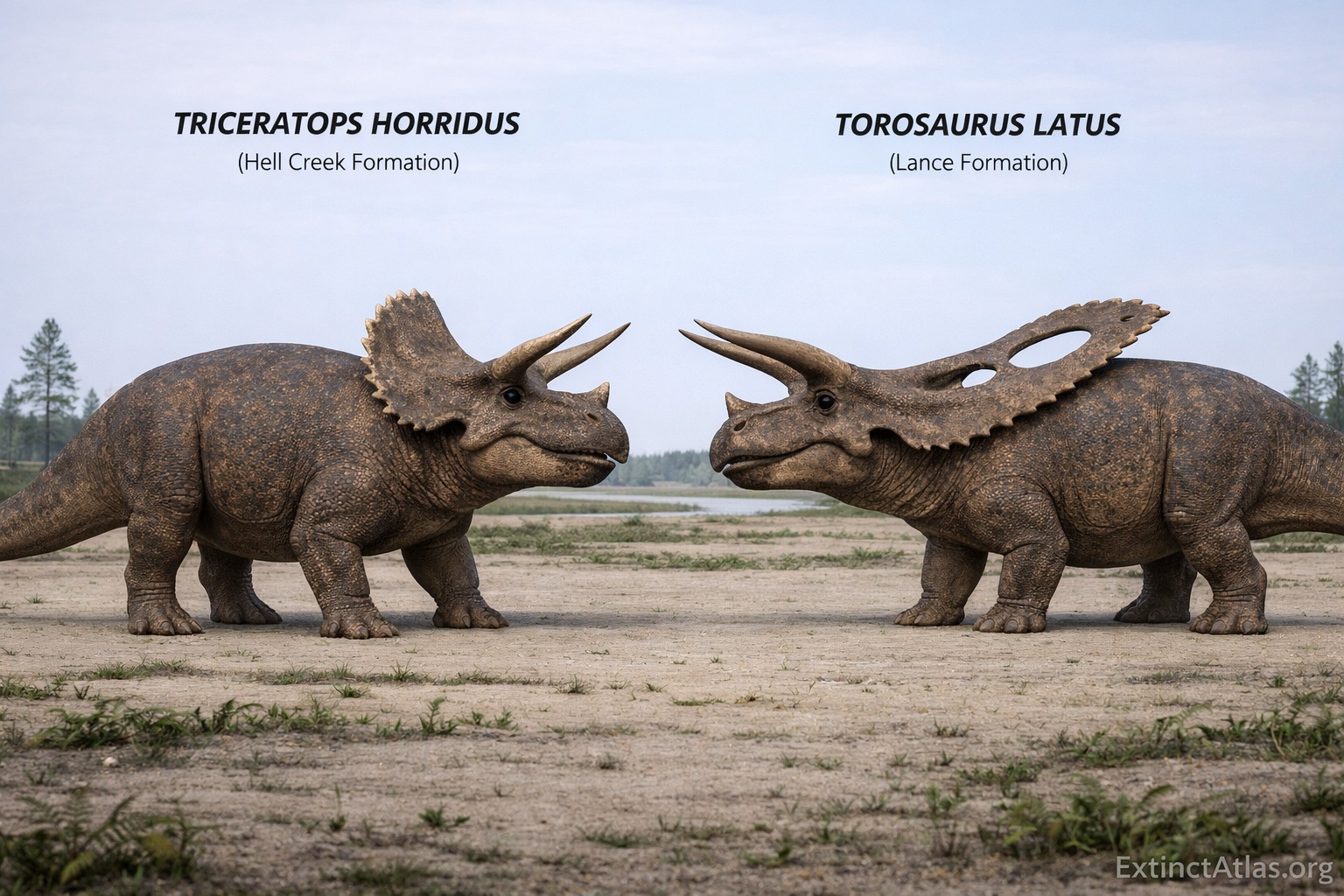
Quick Answer: As of current research, Triceratops and Torosaurus are most likely separate genera, though the debate remains open. A 2010 study proposed that Torosaurus was simply an old Triceratops that had grown large holes in its frill — but subsequent work found evidence of young Torosaurus individuals and major structural differences that are difficult to explain through growth alone.
For a moment in 2010, Triceratops was in danger of disappearing — not from the fossil record, but from the species list. The argument was elegant: Torosaurus, the related ceratopsian with a longer frill and two large oval holes through it, was not a separate dinosaur at all. It was just what Triceratops looked like when it was very old.
Is Triceratops the Same Animal as Torosaurus?
The short answer is: probably not, but the question is genuinely unresolved.
In 2010, palaeontologists John Scannella and Jack Horner published a study proposing that Torosaurus latus and Triceratops were synonymous — meaning Torosaurus should be absorbed into Triceratops rather than treated as a distinct genus. Since Triceratops was named first (1889 vs 1891), it would have priority, and “Torosaurus” would cease to exist as a valid name.
The proposal generated intense debate — and it has not been resolved.
The Case For Synonymy (Scannella & Horner’s Argument)
Scannella and Horner’s hypothesis rested on several observations:
- Triceratops bones showed signs of being metaplastic — capable of significant remodelling over the animal’s lifetime. Horn orientation changed from backward-pointing in juveniles to forward-pointing in adults.
- The thin areas on Triceratops frills in approximately 50% of subadult skulls corresponded in position to the large holes (fenestrae) in Torosaurus frills, suggesting the holes might open up in very old individuals.
- Bone microstructure analysis indicated that all identified Torosaurus specimens showed more heavily remodelled (mature) bone than any examined Triceratops — consistent with Torosaurus representing older animals.
- No juvenile Torosaurus had been found, while Triceratops specimens spanning hatchlings to large adults are well documented.
The Case Against Synonymy
Multiple researchers challenged the hypothesis, and by the mid-2010s, the consensus had shifted against it:
Longrich and Field (2012)
A detailed morphometric and comparative study by Nicholas R. Longrich and Daniel J. Field (2012) evaluated a sample of Triceratops and Torosaurus skulls and found no ontogenetic sequence linking the two genera.
Key findings include:
- Ontogenetic stage distribution: Both Triceratops and Torosaurus specimens exhibit a range of maturity levels. The presence of apparently subadult Torosaurus individuals contradicts the hypothesis that Torosaurus represents only the terminal growth stage of Triceratops.
- Epoccipital (epiossification) counts: The number of marginal frill ossifications differs consistently—typically 5–7 in Triceratops versus 10 or more in Torosaurus—indicating stable taxonomic distinction rather than developmental variation.
- Bone fusion patterns: Patterns of cranial suture closure and epiossification fusion do not support a single continuous growth trajectory between the two morphologies.
Farke (2011) and Nedoceratops
Andrew A. Farke (2011) re-examined the controversial specimen Nedoceratops hatcheri, which had been proposed as a transitional form in the Triceratops–Torosaurus ontogenetic hypothesis.
Farke concluded that:
- The specimen exhibits a distinct combination of cranial characters, not a transitional morphology.
- Features previously interpreted as intermediate are better explained as taxonomically diagnostic traits.
- Nedoceratops is best regarded as a valid, separate genus, not a growth stage of Triceratops.
The Fenestra Problem
The presence of large parietal fenestrae (openings) in Torosaurus remains the most structurally problematic feature for the synonymy hypothesis.
- Triceratops possesses a solid parietal frill with no fenestrae.
- Torosaurus exhibits large, well-defined parietal openings.
In other ceratopsian lineages, frill fenestrae are typically established early in ontogeny, not introduced late in life through extensive bone resorption. The transformation from a completely solid frill to one with large fenestrae would require a radical and unprecedented remodeling process, for which there is limited direct developmental evidence in ceratopsids.
Summary (Consensus Position)
By the mid-2010s, the prevailing interpretation in ceratopsian systematics had shifted toward treating Triceratops and Torosaurus as distinct genera, based on:
- Non-overlapping and consistent cranial morphology
- Independent ontogenetic trajectories
- Structural constraints on frill evolution
- Reinterpretation of purported transitional specimens
The synonymy hypothesis remains debated, but current evidence more strongly supports taxonomic separation rather than ontogenetic equivalence.
What about T. horridus vs T. prorsus?
Separately from the Torosaurus debate, the relationship between the two recognised Triceratops species is well established. A 2014 study of more than 50 Triceratops skulls from the Hell Creek Formation found that T. horridus skulls appear exclusively in the lower (older) rock layers, T. prorsus in the upper (younger) layers, and skulls with intermediate features in the middle layers. This stratigraphic pattern strongly supports the interpretation that T. horridus gradually evolved into T. prorsus over approximately one to two million years — a process called anagenesis.
T. horridus can be distinguished from T. prorsus by its shorter nasal horn, longer snout, and more horizontally oriented brow horns. T. prorsus had a taller nasal horn, shorter snout, and more upright brow horns.
Why Does the Torosaurus Debate Matter?
The Torosaurus question is not merely taxonomic housekeeping. It has implications for how palaeontologists understand:
- Dinosaur diversity at the end of the Cretaceous — if multiple apparent species are actually growth stages of fewer species, Late Cretaceous dinosaur diversity may have been much lower than the species list implies
- How dinosaur skulls change through life — ceratopsian skulls are already known to change dramatically as individuals age; the question is whether that plasticity could be extreme enough to explain the Triceratops-to-Torosaurus transformation
- How we name and classify fossil species — when most specimens are skulls and skulls change with age, species delimitation is genuinely hard
Related and Contemporary Species
Other ceratopsians that are central to understanding this debate:
- Torosaurus latus — the species at the centre of the synonymy argument; characterised by a very long frill with two large oval openings; rarer than Triceratops in the fossil record
- Nedoceratops hatcheri — a single-specimen ceratopsian whose valid status is itself disputed; proposed as a transitional form by Scannella and Horner, rejected as such by Farke.
- Centrosaurus — used as a comparison in ontogeny studies; its skulls also change through growth,h but in ways that do not produce comparable taxonomic confusion.
- T. prorsus — the second accepted Triceratops species; stratigraphically younger than T. horridus and likely its direct evolutionary descendant
Frequently Asked Questions
How many species of Triceratops are there?
Two species are currently accepted by the palaeontological community: Triceratops horridus (the older, type species) and Triceratops prorsus (younger and likely descended from T. horridus). Seventeen species were named historically, but these have been reduced to two through taxonomic revision over the twentieth century. The Torosaurus synonymy question, if ever resolved in Scannella and Horner’s favour, would not add a third species — it would absorb Torosaurus into Triceratops.
Did Triceratops evolve into another dinosaur?
Research suggests that Triceratops horridus evolved directly into Triceratops prorsus over approximately one to two million years — a process documented by the stratigraphic distribution of skull types in the Hell Creek Formation. Triceratops prorsus is the younger species, found only in the upper rock layers. Both species then went extinct in the mass extinction event 66 million years ago.
Why are there so few Torosaurus fossils compared to Triceratops?
Fewer than a dozen Torosaurus specimens have been identified, compared to hundreds of Triceratops. This rarity is itself one of the points in the synonymy debate: if Torosaurus is simply a very old Triceratops, the rarity of the “Torosaurus morph” could reflect the rarity of animals surviving to extreme old age, rather than a naturally scarce separate genus.
Conclusion: The Torosaurus debate is one of the liveliest open questions in ceratopsian palaeontology — and a useful reminder that naming and classifying fossil animals is genuinely difficult when most of what survives is skull material from animals of different ages. The current balance of evidence favours Triceratops and Torosaurus as distinct genera, but the case is not closed.
References
Primary Peer-Reviewed Literature
Scannella JB, Horner JR. 2010. Torosaurus Marsh, 1891, is Triceratops Marsh, 1889 (Ceratopsidae: Chasmosaurinae) synonymized by ontogeny. Journal of Vertebrate Paleontology. 30(4):1157–1168. https://doi.org/10.1080/02724634.2010.483632
Longrich NR, Field DJ. 2012. Torosaurus is not Triceratops: ontogeny in chasmosaurine ceratopsids as a case study in dinosaur taxonomy. PLoS ONE. 7(2):e32623. https://doi.org/10.1371/journal.pone.0032623
Farke AA. 2011. Anatomy and taxonomic status of Nedoceratops hatcheri (Dinosauria: Ceratopsidae). PLoS ONE. 6(1):e16196. https://doi.org/10.1371/journal.pone.0016196
Scannella JB, Fowler DW, Goodwin MB, Horner JR. 2014. Evolutionary trends in Triceratops from the Hell Creek Formation, Montana. Proceedings of the National Academy of Sciences. 111(28):10245–10250. https://doi.org/10.1073/pnas.1313334111
Foundational Taxonomic Sources
Marsh OC. 1889. Notice of new American Dinosauria. American Journal of Science. 38(224):173–175.
Marsh OC. 1891. Notice of new vertebrate fossils. American Journal of Science. 42(251):265–269.
High-Quality Reference Works / Databases
Weishampel DB, Dodson P, Osmólska H, editors. 2004. The Dinosauria. 2nd ed. Berkeley: University of California Press.
Dodson P, Forster CA, Sampson SD. 2004. Ceratopsidae. In: Weishampel DB, Dodson P, Osmólska H, editors. The Dinosauria. 2nd ed. Berkeley: University of California Press. p. 494–513.
Recommended Paleontology & Natural History Books
As an Amazon Associate, Extinct Atlas may earn from qualifying purchases.
The Rise and Fall of the Dinosaurs
A compelling history of dinosaurs, tracing their origins, diversification, 200-million-year reign, extinction, and enduring legacy.
Dinosaurs and Prehistoric Life
A richly illustrated visual reference exploring dinosaurs, fossils, evolution, and prehistoric life across geological time.
Encyclopedia Prehistorica: Dinosaurs
An interactive dinosaur book featuring spectacular three-dimensional pop-ups, particularly suited to young readers and families.
The Rise and Reign of the Mammals
A sweeping history of mammalian evolution, from their origins alongside dinosaurs through the Cenozoic and the emergence of humans.