Quick Info
| Field | Information |
|---|---|
| Species | Smilodon fatalis — Carnivora, Felidae |
| Period | Pleistocene, 2.5 Ma–10,000 years ago |
| Diet type | Hypercarnivore |
| Primary prey | Large-bodied Pleistocene megafauna |
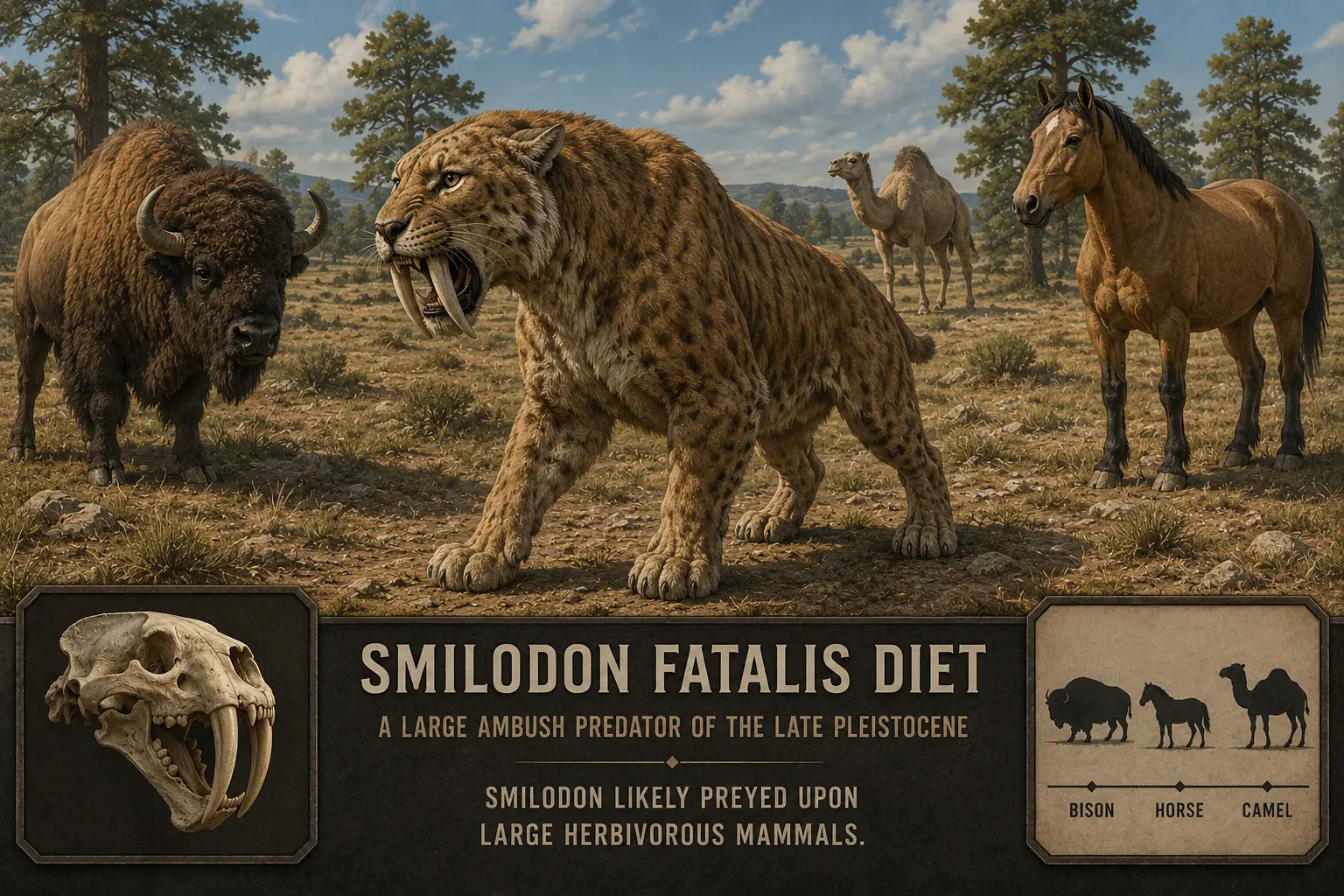
Quick Answer: Smilodon ate large herbivorous mammals, including horses, bison, camels, ground sloths, and young or weakened mammoths and mastodons. Isotopic evidence and dental microwear from fossil specimens confirm a diet dominated by megafauna. Smilodon was a hypercarnivore — its diet was almost entirely meat.

Forty thousand individual Smilodon fatalis bones have been recovered from the La Brea Tar Pits in Los Angeles — more than any other large carnivore at the site. The sheer number suggests this animal was a highly active predator in a landscape packed with large prey. The prey species it hunted can be reconstructed from multiple independent lines of evidence.
What Did Smilodon Eat?
Smilodon’s diet consisted primarily of large-bodied herbivorous mammals. Stable isotope studies, dental wear analyses, and the composition of Pleistocene fossil communities indicate that Smilodon fatalis specialised in hunting megafauna rather than small prey.
Likely prey included:
- Horses (Equus spp.)
- Bison (Bison spp.)
- Camels (Camelops hesternus)
- Other large herbivores available within local ecosystems
Ground sloths, juvenile proboscideans, and smaller ungulates may also have been taken opportunistically, although evidence for these prey types is less direct.
Prey Reconstruction Table
| Prey Group | Evidence Strength |
|---|---|
| Horses (Equus spp.) | Strong |
| Bison (Bison spp.) | Strong |
| Camels (Camelops hesternus) | Moderate |
| Ground Sloths | Moderate |
| Mammoths | Weak |
| Mastodons | Weak |
The strongest evidence supports horses and bison as major components of the diet. Larger prey such as mammoths and mastodons are generally regarded as possible opportunistic targets rather than primary food sources.
Dietary Evidence: What the Fossils Tell Us
Stable Isotope Analysis
Stable carbon and nitrogen isotopes preserved within Smilodon bone collagen provide one of the strongest lines of evidence for reconstructing its diet. By comparing isotope signatures in predator and prey fossils, researchers can identify the types of animals that contributed most strongly to the predator’s food intake.
Studies of Rancho La Brea specimens indicate that Smilodon fatalis relied heavily on large herbivorous mammals, particularly grazers and mixed-feeders. While isotope analysis cannot identify individual prey species with complete certainty, it consistently supports a diet dominated by megafauna.
Dental Microwear
Microscopic wear patterns on fossil teeth offer additional clues about feeding behaviour. Compared with specialised bone-cracking carnivores such as spotted hyenas, Smilodon exhibits relatively low frequencies of pits and fractures associated with heavy bone consumption.
This evidence suggests that Smilodon primarily consumed flesh and soft tissues rather than routinely processing carcasses down to the skeleton. Such wear patterns are consistent with an active predator that frequently had access to fresh kills.
Jaw Mechanics and Feeding Behaviour
The skull and dentition of Smilodon were highly specialised for killing and processing large prey. Biomechanical studies indicate that its elongated upper canines were adapted for delivering precise killing bites after prey had been restrained with the forelimbs.
Unlike bone-crushing carnivores, Smilodon lacked adaptations for routinely cracking large bones. Its feeding anatomy was therefore better suited to slicing and removing flesh than to extracting marrow from heavily processed carcasses.
Prey Availability and Ecological Context
Smilodon fatalis lived during the Pleistocene, a period when North America supported an exceptional diversity of large herbivorous mammals. Horses, camels, bison, mammoths, mastodons, and giant ground sloths were all present within portions of its range.
This abundance of megafauna provided a rich prey base for large predators. Isotopic and anatomical evidence suggest that Smilodon was particularly adapted to exploiting these large-bodied herbivores rather than smaller prey animals.
Many of these megafaunal species disappeared near the end of the Pleistocene. Because Smilodon appears to have been specialised for hunting large prey, the loss of this ecological foundation is widely considered an important factor in its eventual extinction.
Related and Contemporary Species
- Smilodon populator — the largest species of the genus, distributed across much of South America. Available evidence suggests a diet dominated by large herbivorous mammals, broadly comparable to that of Smilodon fatalis.
- Panthera atrox (American lion) — a contemporary apex predator that occupied many of the same ecosystems as Smilodon. Studies suggest some overlap in prey resources, although the two predators may have differed in hunting strategies and ecological roles.
- Canis dirus (dire wolf) — another major predator of Late Pleistocene North America. Differences in tooth wear patterns suggest that dire wolves may have processed carcasses more extensively than Smilodon.
- Homotherium serum — a contemporary sabre-toothed cat with a more cursorial body plan and a hunting strategy likely distinct from that of Smilodon.
- Arctodus simus (short-faced bear) — a large omnivorous to carnivorous mammal that shared portions of the same ecosystem and may have competed with other predators for access to carcasses.
Frequently Asked Questions
Did Smilodon eat mammoths?
Mammoths and mastodons were part of the ecosystems inhabited by Smilodon, but evidence that they formed a major component of its diet is limited. Juvenile, injured, or otherwise vulnerable individuals may occasionally have been targeted, but most dietary studies indicate that horses, bison, camels, and other large herbivores were more important prey resources.
Was Smilodon a scavenger or an active hunter?
Available evidence strongly supports Smilodon as an active predator. Its powerful forelimbs, specialised canine teeth, and feeding adaptations were well-suited for capturing and subduing large prey. However, like most modern large carnivores, it likely scavenged opportunistically when carcasses were available.
Scientific Note: Reconstructions of Smilodon diet are based primarily on stable isotope analysis, dental wear studies, biomechanical modelling, and comparisons with modern predators. While the general picture of a megafauna-specialist hypercarnivore is well supported, the relative importance of specific prey species remains an active area of research.
Conclusion
Smilodon fatalis was a hypercarnivorous predator that specialised in hunting large herbivorous mammals during the Pleistocene. Stable isotope analyses, dental wear studies, and anatomical evidence all indicate a diet centred on megafauna rather than small prey.
Its feeding adaptations were designed for capturing and consuming flesh from large animals rather than crushing bones, setting it apart from many contemporary carnivores. As the great herbivore communities of the Pleistocene declined and disappeared, the ecological foundation that supported Smilodon also vanished, contributing to the extinction of one of the most iconic predators in prehistoric North America.
References
Peer-Reviewed Literature
Coltrain, J.B., Harris, J.M., Cerling, T.E., Ehleringer, J.R., Dearing, M.D., Ward, J., & Allen, J. (2004). Rancho La Brea stable isotope biogeochemistry and its implications for the palaeoecology of late Pleistocene coastal southern California. Palaeogeography, Palaeoclimatology, Palaeoecology, 205(3–4), 199–219. https://doi.org/10.1016/j.palaeo.2003.12.008
DeSantis, L.R.G., Schubert, B.W., Scott, J.R., & Ungar, P.S. (2012). Implications of diet for the extinction of saber-toothed cats and American lions. PLOS ONE, 7(12), e52453. https://doi.org/10.1371/journal.pone.0052453
Feranec, R.S. (2004). Ecological specialization and the success of Smilodon fatalis during the Late Pleistocene of North America as revealed by stable isotope analysis. Palaeogeography, Palaeoclimatology, Palaeoecology, 213(3–4), 243–256.
Meachen-Samuels, J., & Van Valkenburgh, B. (2010). Radiographs reveal exceptional forelimb strength in the sabertooth cat, Smilodon fatalis. PLOS ONE, 5(7), e11412. https://doi.org/10.1371/journal.pone.0011412
Van Valkenburgh, B., & Hertel, F. (1993). Tough times at La Brea: tooth breakage in large carnivores of the Late Pleistocene. Science, 261(5120), 456–459. https://doi.org/10.1126/science.261.5120.456
Featured Museum Collections
Museum-quality paleoart and educational poster
collections based on evidence-informed prehistoric
Life reconstructions.