
Quick Answer
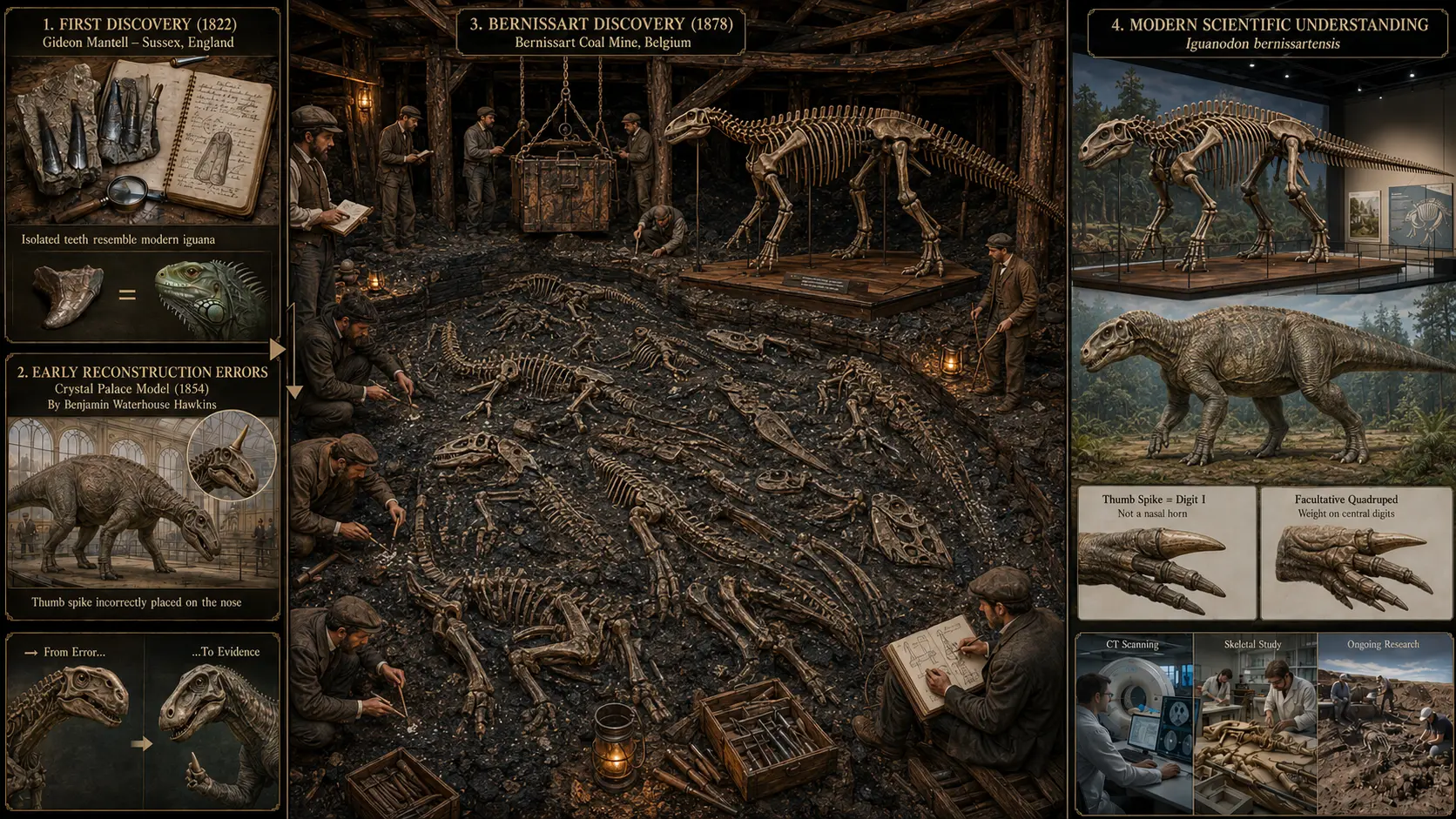
Iguanodon was the second dinosaur to receive a formal scientific name and one of the most influential discoveries in the history of palaeontology. The first fossils were discovered in southern England during the early 1820s and were scientifically described by Gideon Mantell in 1825. Initially known only from isolated teeth and bones, Iguanodon transformed scientific understanding of prehistoric reptiles. The later discovery of nearly complete skeletons at Bernissart, Belgium, in 1878 corrected many early misconceptions and established Iguanodon as one of the best-known dinosaurs in the world.

Discovery Summary
| Characteristic | Information |
|---|---|
| First Scientific Description | 1825 |
| Describing Scientist | Gideon Mantell |
| Country of First Discovery | England |
| Geological Formation | Wealden Group |
| Most Famous Discovery | Bernissart Skeletons (Belgium, 1878) |
| Scientific Importance | One of the first dinosaurs ever identified |
| Current Significance | Key genus in dinosaur history and ornithopod research |
Introduction
The discovery of Iguanodon marks one of the most important milestones in the history of palaeontology. At a time when dinosaurs had not yet been recognized as a distinct group of animals, isolated fossil bones and teeth from southern England challenged existing ideas about extinct reptiles and eventually helped establish the scientific study of dinosaurs.
Unlike many later dinosaur discoveries, the history of Iguanodon unfolded over decades. Early researchers worked with fragmentary fossils, leading to several incorrect interpretations. Only after the discovery of remarkably complete skeletons in Belgium were scientists able to reconstruct the animal accurately and appreciate its true anatomy.
Today, the discovery of Iguanodon is recognised not only for revealing a remarkable dinosaur but also for shaping the development of vertebrate palaeontology itself.
Who Discovered Iguanodon?
Discovery Timeline
| Year | Person | Event |
|---|---|---|
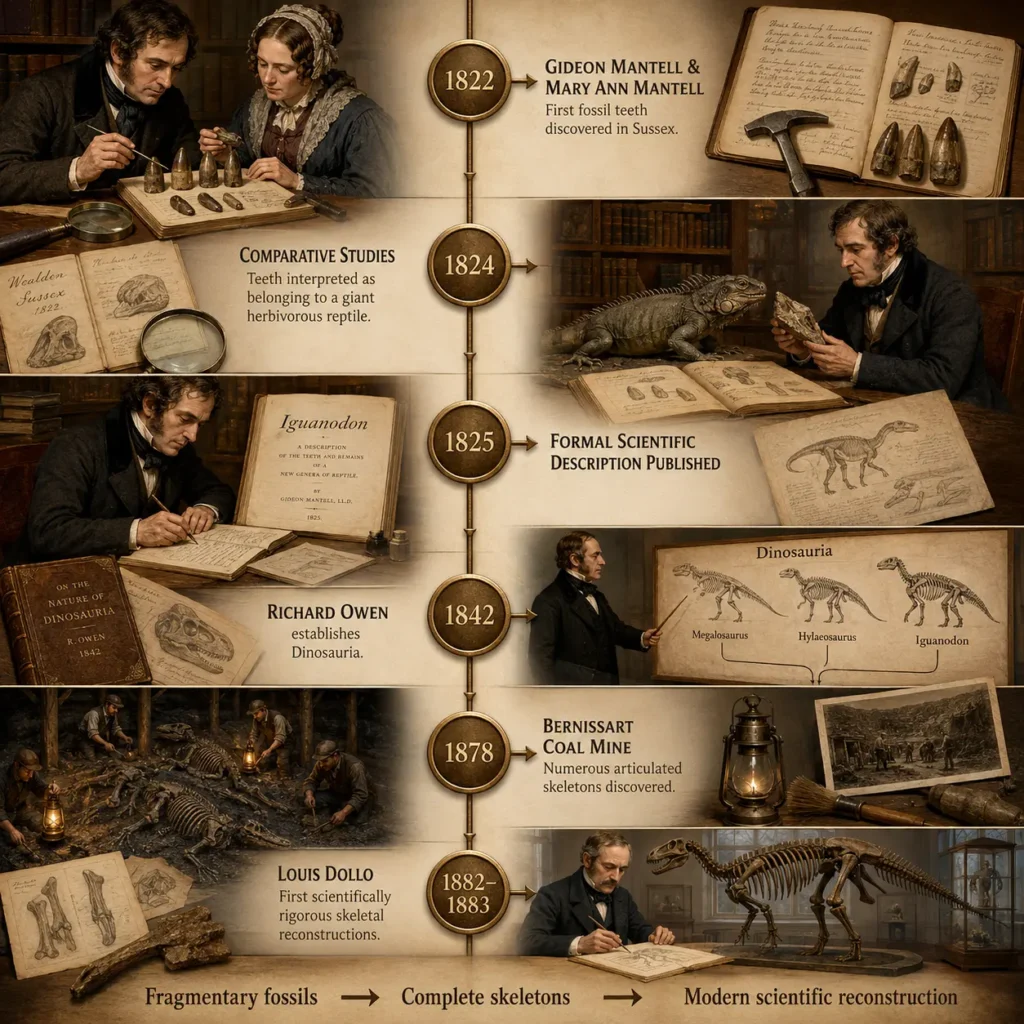
| 1822 | Gideon Mantell and Mary Ann Mantell | Fossil teeth discovered in the Wealden deposits of Sussex, England |
| 1824 | Gideon Mantell | Comparative studies suggested the teeth belonged to a giant herbivorous reptile |
| 1825 | Gideon Mantell | Formal scientific description of Iguanodon published |
| 1842 | Richard Owen | Included Iguanodon among the three genera used to establish Dinosauria |
| 1878 | Belgian miners | Discovery of numerous articulated skeletons at Bernissart |
| 1882–1883 | Louis Dollo | Produced the first scientifically accurate skeletal reconstructions |
Key People
| Scientist | Contribution | Historical Importance |
|---|---|---|
| Gideon Mantell | Described Iguanodon and recognised it as a giant herbivorous reptile | Pioneer of dinosaur palaeontology |
| Mary Ann Mantell | Traditionally credited with finding some of the first fossil teeth (although the details remain debated) | Associated with the earliest discovery history |
| Georges Cuvier | Initially questioned the interpretation of the fossils before later acknowledging their significance | Influential comparative anatomist whose opinions shaped early debates |
| Richard Owen | Included Iguanodon in the newly established Dinosauria | Helped define dinosaurs as a scientific group |
| Louis Dollo | Reconstructed the Bernissart skeletons and corrected earlier anatomical errors | Revolutionised understanding of Iguanodon anatomy |
Scientific Explanation
The discovery of Iguanodon was not the work of a single event but rather a series of scientific advances spanning more than half a century. During the early 1820s, Gideon Mantell collected unusual fossil teeth and bones from the Wealden deposits of Sussex. Their large size and distinctive shape suggested they belonged to an unknown reptile unlike any living species.
By comparing the fossil teeth with those of modern iguanas, Mantell concluded that the animal had been herbivorous, an unexpected finding at a time when large fossil reptiles were generally assumed to have been carnivorous. In 1825 he formally described the genus Iguanodon, naming it for the resemblance of its teeth to those of an iguana.
The discovery attracted considerable scientific interest and debate. Georges Cuvier initially questioned Mantell’s interpretation before later accepting that the fossils represented a previously unknown reptile. Richard Owen subsequently recognised the broader significance of Iguanodon by including it within Dinosauria in 1842.
The greatest breakthrough came with the Bernissart discoveries in 1878. These exceptionally preserved skeletons enabled Louis Dollo to reconstruct the animal with unprecedented accuracy, correcting numerous misconceptions that had arisen from the fragmentary English material.
Together, these discoveries transformed Iguanodon from a collection of isolated fossils into one of the best-understood dinosaurs of the nineteenth century.
Evidence Strength
Very High
Evidence Assessment
The discovery history of Iguanodon is exceptionally well documented through original scientific publications, museum collections, correspondence, and historical records. While some details—particularly the exact circumstances surrounding the earliest fossil discoveries and Mary Ann Mantell’s role—remain debated by historians, the principal events and scientific contributions are firmly established.
The First Fossil Discoveries
Early Fossils
| Fossil | Locality | Scientific Importance |
|---|---|---|
| Teeth | Cuckfield, Sussex, England | Allowed recognition of a giant herbivorous reptile |
| Limb Bones | Wealden Group, Sussex | Demonstrated the animal’s enormous size |
| Vertebrae | Southern England | Confirmed the reptilian nature of the fossils |
| Thumb Spike (isolated) | Sussex | Initially misidentified as a nasal horn |
| Additional Skeletal Fragments | Isle of Wight and Sussex | Expanded knowledge of anatomy before complete skeletons were discovered |
Original Specimens
| Specimen | Current Repository | Significance |
|---|---|---|
| Original Teeth Described by Mantell | Natural History Museum | Basis for the scientific description of Iguanodon |
| Early Wealden Fossils | Natural History Museum | Important historical reference material |
| Bernissart Skeletons | Royal Belgian Institute of Natural Sciences | Most complete and scientifically valuable Iguanodon specimens |
| Additional Historic Material | Various European museum collections | Supports continuing anatomical and taxonomic research |
Scientific Explanation
The first fossils of Iguanodon consisted of isolated teeth, bones, and fragments recovered from the Early Cretaceous rocks of southern England. Unlike modern discoveries that often include articulated skeletons, these early finds were incomplete and widely separated, making interpretation difficult.
The fossil teeth proved especially important because their distinctive leaf-shaped crowns closely resembled those of modern iguanas while being vastly larger. This comparison led Gideon Mantell to propose that the fossils belonged to an enormous herbivorous reptile, an idea that challenged prevailing scientific assumptions about fossil reptiles.
Other isolated bones gradually expanded knowledge of the animal, but the absence of complete skeletons resulted in several anatomical errors. Most famously, the isolated thumb spike was reconstructed as a horn positioned on the nose because its true anatomical location was unknown.
Despite these limitations, the original English fossils laid the foundation for all subsequent research on Iguanodon. They established the existence of a previously unknown giant herbivore and stimulated decades of investigation that ultimately culminated in the discovery of complete skeletons at Bernissart.
Evidence Strength
Very High
Evidence Assessment
The early discoveries are supported by surviving fossil specimens, historical collections, and the original scientific descriptions published by Mantell and his contemporaries. Although the fragmentary nature of the fossils initially led to incorrect anatomical reconstructions, the specimens themselves remain invaluable historical and scientific evidence and continue to be studied today.
Naming Iguanodon
Taxonomic History
| Year | Scientific Name | Author | Notes |
|---|---|---|---|
| 1825 | Iguanodon | Gideon Mantell | Genus formally established |
| 1825 | Iguanodon anglicum | Gideon Mantell | Original species based on fragmentary material; now regarded as dubious (nomen dubium) |
| 1881 | Iguanodon bernissartensis | George Albert Boulenger | Named from the exceptional Belgian skeletons; principal valid species |
| 1888 | Iguanodon atherfieldensis | Richard Lydekker | Later reassigned to Mantellisaurus in modern classifications |
| 21st Century | Various taxonomic revisions | Multiple authors | Improved understanding of iguanodontian diversity and relationships |
Name Origin
| Name Component | Meaning | Explanation |
|---|---|---|
| Iguana | Modern lizard genus | Refers to the similarity between the fossil teeth and those of living iguanas |
| -odon | Greek for “tooth” | Indicates the distinctive dentition used to identify the animal |
| Iguanodon | “Iguana tooth” | Reflects the feature that first allowed scientific recognition of the genus |
Scientific Explanation
Gideon Mantell named Iguanodon in 1825 after recognising that its fossil teeth closely resembled those of modern iguanas. By combining the word Iguana with the Greek suffix -odon, meaning “tooth,” he created a name that reflected the anatomical feature upon which the genus was first identified.
This naming strategy was typical of nineteenth-century palaeontology, when isolated teeth often provided the most informative fossils available. Although Mantell recognised the similarity in tooth shape, he understood that the animal itself was vastly larger than any living iguana and represented a previously unknown giant reptile.
The taxonomy of Iguanodon has changed considerably since its original description. Early species were often erected from incomplete material, and modern research has shown that several historically recognised species actually belong to different genera or are too fragmentary for reliable classification. Today, Iguanodon bernissartensis is regarded as the best-known and most securely established species because it is represented by numerous exceptionally preserved skeletons.
The history of the name Iguanodon reflects the development of dinosaur taxonomy itself, progressing from fragmentary nineteenth-century discoveries to modern classifications based on comprehensive anatomical and phylogenetic evidence.
Evidence Strength
Very High
Evidence Assessment
The naming history of Iguanodon is thoroughly documented through published taxonomic literature and preserved type specimens. While the validity of some historically named species has changed with modern revisions, the origin of the genus name and the sequence of major taxonomic developments are well established and supported by extensive scientific evidence.
The Bernissart Discovery
Bernissart Discovery
| Feature | Information |
|---|---|
| Discovery Year | 1878 |
| Location | Bernissart, Hainaut Province, Belgium |
| Number of Skeletons | At least 38 largely complete Iguanodon skeletons |
| Geological Age | Early Cretaceous (Barremian Stage, approximately 125–126 million years ago) |
| Scientific Importance | First discovery of numerous articulated Iguanodon skeletons, revolutionising dinosaur anatomy and reconstruction |
Bernissart Specimens
| Specimen Group | Preservation | Scientific Value |
|---|---|---|
| Nearly Complete Skeletons | Exceptional | Revealed overall anatomy and body proportions |
| Articulated Hands | Exceptional | Correctly identified the thumb spike as part of the hand |
| Skulls | Very Good | Improved understanding of feeding anatomy and dentition |
| Pelvic and Hind Limb Bones | Excellent | Clarified locomotion and posture |
| Juvenile and Adult Individuals | Good | Allowed study of growth and variation within the species |
Scientific Explanation
The discovery of Iguanodon skeletons at Bernissart is regarded as one of the greatest events in the history of vertebrate palaeontology. In 1878, coal miners working deep underground unexpectedly uncovered a deposit containing dozens of remarkably preserved dinosaur skeletons embedded within Early Cretaceous sediments.
Unlike the isolated fossils previously known from England, the Bernissart specimens were preserved as articulated skeletons, meaning that the bones remained largely in their original anatomical positions. This exceptional preservation provided scientists with the first opportunity to examine the complete skeleton of Iguanodon and resolve many long-standing anatomical uncertainties.
Louis Dollo led the scientific study of the fossils, carefully excavating, describing, and reconstructing the skeletons. His work demonstrated that the distinctive spike previously interpreted as a nasal horn was actually the enlarged thumb of the hand. The discoveries also revealed the proportions of the limbs, the structure of the pelvis, the arrangement of the vertebral column, and the overall body plan of the animal.
The Bernissart collection remains one of the largest concentrations of articulated dinosaur skeletons ever discovered. Beyond transforming knowledge of Iguanodon, it established new standards for fossil excavation, conservation, and anatomical reconstruction that continue to influence palaeontological research today.
Evidence Strength
Very High
Evidence Assessment
The Bernissart discoveries are supported by exceptionally preserved fossil material that remains available for scientific study. Numerous articulated skeletons provide direct evidence for skeletal anatomy, making this one of the most important dinosaur fossil assemblages ever discovered. Historical excavation records and subsequent anatomical studies further reinforce the reliability of these specimens.
How the Discovery Changed Science
Scientific Impact
| Area | Impact |
|---|---|
| Dinosaur Anatomy | Revealed the complete skeletal structure of Iguanodon |
| Dinosaur Posture | Corrected many anatomical interpretations and improved understanding of locomotion |
| Museum Displays | Led to the first mounted dinosaur skeletons displayed to the public |
| Evolutionary Studies | Provided crucial evidence for dinosaur diversity and ornithopod evolution |
| Public Interest | Increased worldwide fascination with dinosaurs and palaeontology |
Historical Reconstruction
| Reconstruction | Earlier Interpretation | Modern Understanding |
|---|---|---|
| Thumb Spike | Horn on the nose | Modified thumb (Digit I) |
| Body Shape | Heavy, lizard-like reptile | Large, dynamic ornithopod with balanced proportions |
| Forelimbs | Poorly understood | Specialized hands with differentiated digits |
| Posture | Kangaroo-like upright stance | Facultative biped capable of both bipedal and quadrupedal locomotion |
| Feeding Anatomy | Based largely on isolated teeth | Complete skulls revealed complex herbivorous adaptations |
Scientific Explanation
Before the Bernissart discovery, scientific understanding of Iguanodon was based almost entirely on isolated bones and teeth. As a result, many early reconstructions contained significant anatomical errors, including the famous placement of the thumb spike on the animal’s nose.
The articulated Belgian skeletons fundamentally changed this picture. For the first time, palaeontologists could examine an entire dinosaur skeleton preserved in anatomical order. This allowed Louis Dollo and his colleagues to reconstruct the hand correctly, establish the arrangement of the limbs, and better understand how the animal moved.
The Bernissart skeletons also influenced museum practices. They became some of the first complete dinosaur skeletons mounted for public exhibition, allowing both scientists and the general public to visualise dinosaurs as real animals rather than isolated fossil fragments. These displays inspired widespread public interest and helped establish dinosaurs as iconic subjects of natural history.
Although some nineteenth-century reconstructions—particularly the upright, tail-dragging posture—have since been revised, the Bernissart fossils continue to underpin modern anatomical research. Advances in biomechanics and comparative anatomy have refined interpretations of posture and locomotion while confirming the accuracy of the underlying skeletal reconstruction.
The discovery therefore transformed both scientific research and public perception, making Iguanodon one of the best-understood dinosaurs of its time.
Evidence Strength
Very High
Evidence Assessment
The scientific impact of the Bernissart discovery is extensively documented through original publications, museum archives, and more than a century of subsequent research. While interpretations of posture and locomotion have evolved with new analytical techniques, the discovery’s role in advancing dinosaur anatomy, museum display, and palaeontology is beyond dispute.
Important Fossil Sites
Fossil Localities
| Locality | Country | Importance |
|---|---|---|
| Bernissart | Belgium | Produced the world’s largest collection of articulated Iguanodon skeletons |
| Cuckfield, Sussex | England | Source of the first scientifically recognised Iguanodon fossils |
| Isle of Wight | England | Important Early Cretaceous locality yielding numerous iguanodontian remains |
| Maidstone, Kent | England | Site of the famous Maidstone Iguanodon specimen studied by Mantell |
| Nehden | Germany | Produced additional iguanodontian material useful for comparison |
Geological Formation
| Formation | Age | Major Discoveries |
|---|---|---|
| Wealden Group | Early Cretaceous (Valanginian–Aptian) | Original English Iguanodon fossils, including teeth and limb bones |
| Bernissart Clay Deposits (Sainte-Barbe Clays) | Early Cretaceous (Barremian) | Articulated Iguanodon bernissartensis skeletons |
| Wessex Formation | Early Cretaceous (Barremian) | Numerous iguanodontian fossils from the Isle of Wight |
| Weald Clay Formation | Early Cretaceous | Additional skeletal remains expanding anatomical knowledge |
Scientific Explanation
The history of Iguanodon discoveries extends across several important fossil localities in western Europe, each contributing unique information about the dinosaur’s anatomy, evolution, and distribution.
Southern England provided the earliest discoveries. Fossils from the Wealden Group enabled Gideon Mantell to recognise Iguanodon as a giant herbivorous reptile and establish the genus in 1825. Subsequent discoveries at Maidstone and the Isle of Wight expanded knowledge of the skeleton, although these specimens remained largely fragmentary.
The Belgian locality of Bernissart remains unrivalled in scientific importance. Its extraordinary concentration of articulated skeletons provided the first complete picture of Iguanodon anatomy and corrected many misconceptions derived from isolated fossils.
Additional discoveries in Germany and elsewhere across Europe have broadened understanding of iguanodontian diversity and geographic distribution. Collectively, these sites demonstrate that Iguanodon and its close relatives were widespread across Early Cretaceous Europe, inhabiting extensive lowland ecosystems associated with river systems and floodplains.
Together, these fossil localities illustrate how successive discoveries over nearly two centuries have progressively transformed scientific understanding of one of the world’s most historically significant dinosaurs.
Evidence Strength
Very High
Evidence Assessment
The principal Iguanodon fossil localities are well documented through extensive geological surveys, museum collections, and published research. Their ages, fossil content, and scientific significance have been repeatedly verified using modern stratigraphic and palaeontological methods. While taxonomic interpretations of some isolated specimens have been revised over time, the importance of these localities to the discovery history of Iguanodon is firmly established.
Comparison with Other Dinosaur Discoveries
Discovery Comparison
| Dinosaur | Discovery Date | Discoverer(s) | Scientific Importance | Comparison with Iguanodon |
|---|---|---|---|---|
| Megalosaurus | 1824 | William Buckland | First scientifically described dinosaur | Preceded Iguanodon but was known from fragmentary remains |
| Iguanodon | 1825 | Gideon Mantell | Second named dinosaur; first recognised giant herbivorous dinosaur | Became one of the foundation genera of dinosaur science |
| Hylaeosaurus | 1833 | Gideon Mantell | Early armoured dinosaur | Completed the trio of genera used to define Dinosauria |
| Compsognathus | 1859 | Joseph Oberndorfer | First nearly complete small theropod skeleton | Demonstrated diversity among dinosaurs |
| Archaeopteryx | 1861 | Various collectors | Transitional fossil linking dinosaurs and birds | Expanded understanding of dinosaur evolution |
| Diplodocus | 1877 | Benjamin Mudge & Samuel Wendell Williston | Iconic giant sauropod | Helped establish large-scale dinosaur research in North America |
Historical Significance Table
| Dinosaur | Discovery Importance | Lasting Impact |
|---|---|---|
| Megalosaurus | First named dinosaur | Began formal dinosaur palaeontology |
| Iguanodon | First well-recognised giant herbivorous dinosaur | Helped define Dinosauria and transformed anatomical reconstruction |
| Hylaeosaurus | Revealed armoured dinosaurs | Expanded knowledge of dinosaur diversity |
| Archaeopteryx | Transitional fossil | Strengthened evolutionary theory linking birds and dinosaurs |
| Diplodocus | Spectacular complete skeletons | Popularised dinosaurs through museum exhibitions worldwide |
Scientific Explanation
The discovery of Iguanodon occupies a unique position in the history of palaeontology because it bridged the gap between isolated fossil discoveries and the scientific recognition of dinosaurs as a distinct group of extinct animals.
Although Megalosaurus was formally described one year earlier, it was known from relatively fragmentary remains that provided only limited insight into dinosaur anatomy. Iguanodon, by contrast, combined distinctive teeth, numerous skeletal elements, and eventually complete articulated skeletons, allowing scientists to reconstruct an entire dinosaur with increasing accuracy.
Together with Hylaeosaurus, Iguanodon formed one of the three genera that Richard Owen used in 1842 to establish the group Dinosauria. This decision fundamentally changed scientific understanding of prehistoric reptiles and laid the foundations for modern dinosaur research.
Later discoveries such as Archaeopteryx and Diplodocus each transformed different aspects of palaeontology, including evolutionary biology, dinosaur diversity, and museum exhibitions. Nevertheless, few discoveries had as profound an influence on both scientific thought and public perception as Iguanodon. Its history demonstrates how successive fossil discoveries can progressively refine scientific knowledge over many decades.
Scientific Debate
Scientific Debate Summary
| Question | Current Consensus | Confidence |
|---|---|---|
| Mantell’s original reconstruction | Understandable given limited evidence but anatomically inaccurate | Very High |
| Thumb spike interpretation | Modified thumb, not a nasal horn | Very High |
| Body posture | Facultative biped capable of quadrupedal locomotion | High |
| Species diversity | Fewer valid species than historically recognised | High |
| Bernissart death assemblage | Likely catastrophic mass mortality in a sinkhole or flooded karst system | Moderate |
| Taxonomic revisions | Modern phylogenetic analyses have clarified relationships | High |
Competing Interpretations
| Topic | Historical Interpretation | Modern Interpretation | Supporting Evidence |
|---|---|---|---|
| Mantell’s Reconstruction | Giant lizard-like reptile | Advanced ornithopod dinosaur | Complete articulated skeletons and comparative anatomy |
| Thumb Spike | Horn positioned on the nose | Enlarged first manual digit | Bernissart articulated hands |
| Body Posture | Upright kangaroo-like stance with tail dragging | Horizontal body with balanced tail; facultative biped | Biomechanics, articulated skeletons, trackways |
| Species Diversity | Numerous named Iguanodon species | Several historical species reassigned to other genera | Modern phylogenetic analyses |
| Bernissart Death Assemblage | Sudden drowning event | Multiple hypotheses including sinkhole collapse, flooding, or toxic conditions | Sedimentology, taphonomy, geological studies |
| Taxonomic Revisions | Broad definition of Iguanodon | More restricted genus with clearer diagnostic features | Cladistic analyses and revised anatomical studies |
Scientific Explanation
The history of Iguanodon is closely linked with the evolution of palaeontological science itself. Many early interpretations were based on incomplete fossils and reflected the limited knowledge available during the nineteenth century rather than scientific error.
One of the best-known examples is the thumb spike. Because only isolated bones were available, Gideon Mantell reconstructed the spike as a horn on the animal’s nose. This interpretation remained widely accepted until the Bernissart discoveries demonstrated its true position on the hand.
Body posture has also undergone substantial revision. Early mounted skeletons depicted Iguanodon standing upright with its tail resting on the ground, resembling a giant kangaroo. Modern anatomical studies, biomechanical modelling, and fossil trackways instead indicate that the tail was held horizontally for balance and that Iguanodon could move both bipedally and quadrupedally.
Taxonomy represents another area of continuing refinement. During the nineteenth and twentieth centuries, numerous species were assigned to Iguanodon based on incomplete material. Advances in comparative anatomy and phylogenetic analysis have since shown that several of these species belong to distinct genera, resulting in a more precise understanding of iguanodontian diversity.
The Bernissart fossil deposit also continues to generate scientific discussion. Most researchers agree that the skeletons accumulated during one or more catastrophic mortality events, but the exact mechanism—whether sinkhole collapse, flooding, toxic gases, or another environmental process—remains uncertain because the geological evidence permits multiple interpretations.
Overall, these debates illustrate the self-correcting nature of science. As new fossils, analytical methods, and technologies become available, interpretations of Iguanodon continue to improve while remaining firmly grounded in the fossil evidence.
Evidence Strength
Very High
Evidence Assessment
The major scientific debates surrounding Iguanodon are extensively documented through historical publications, museum collections, modern anatomical research, and phylogenetic analyses. Questions concerning anatomy and taxonomy have largely been resolved through direct fossil evidence, whereas interpretations of behaviour and the Bernissart depositional environment remain active areas of research because they rely on indirect geological and taphonomic evidence.
Current Scientific Understanding
Current Consensus
| Topic | Current Scientific Understanding |
|---|---|
| Discovery | First described by Gideon Mantell in 1825 from English fossils |
| Scientific Importance | One of the three genera used to establish Dinosauria |
| Bernissart Discovery | Provided the first complete understanding of Iguanodon anatomy |
| Thumb Spike | Specialized thumb, not a nasal horn |
| Taxonomy | Historically broad genus now refined through modern phylogenetics |
| Historical Legacy | One of the most influential dinosaur discoveries in palaeontology |
Modern research recognises Iguanodon as one of the most historically significant dinosaurs ever discovered. Its initial identification demonstrated that giant herbivorous reptiles once existed, while the Bernissart skeletons provided one of the first complete views of dinosaur anatomy.
Although many nineteenth-century reconstructions have been revised, the scientific importance of Iguanodon has only increased. Modern anatomical studies, phylogenetic analyses, and improved dating techniques continue to refine knowledge of the genus while confirming its central role in the history of dinosaur science. The discovery of Iguanodon remains a landmark example of how successive fossil discoveries can transform scientific understanding over time.
Frequently Asked Questions
Who discovered Iguanodon?
Gideon Mantell formally described Iguanodon in 1825 based on fossils from southern England.
Did Mary Ann Mantell discover the first tooth?
She has traditionally been credited with finding some of the earliest Iguanodon teeth, although the exact details remain debated by historians.
Why was Iguanodon so important?
It was one of the first dinosaurs ever recognised and helped establish the scientific concept of Dinosauria.
Why was the thumb spike mistaken for a horn?
Early researchers had only isolated fossils, making it impossible to determine the spike’s true position until articulated skeletons were discovered.
What happened at Bernissart?
Coal miners uncovered at least 38 remarkably complete Iguanodon skeletons, providing an unprecedented view of the animal’s anatomy.
Who reconstructed the Bernissart skeletons?
Belgian palaeontologist Louis Dollo led their scientific study and produced the first accurate skeletal reconstructions.
Was Iguanodon the first dinosaur discovered?
No. Megalosaurus was formally described first in 1824, but Iguanodon followed in 1825 and became one of the defining dinosaurs of early palaeontology.
Are the original fossils still preserved?
Yes. Important specimens are housed in major museum collections in the United Kingdom and Belgium.
Has the classification of Iguanodon changed?
Yes. Modern research has reduced the number of valid species and reassigned several historical species to other genera.
Why is the discovery still important today?
The discovery of Iguanodon fundamentally shaped dinosaur science and remains one of the best-documented examples of how fossil discoveries can transform scientific understanding.
References
Primary Literature
- Boulenger, G. A. (1881). Sur l’Iguanodon bernissartensis et les reptiles fossiles de Bernissart. Bulletin du Musée royal d’Histoire naturelle de Belgique.
- Dollo, L. (1882). Première note sur les dinosauriens de Bernissart. Bulletin du Musée royal d’Histoire naturelle de Belgique.
- Dollo, L. (1883). Iguanodontidae et leurs rapports avec les reptiles actuels. Bulletin du Musée royal d’Histoire naturelle de Belgique.
- Mantell, G. A. (1825). Notice on the Iguanodon, a newly discovered fossil reptile from the sandstone of Tilgate Forest, Sussex. Philosophical Transactions of the Royal Society of London, 115, 179–186.
- Owen, R. (1842). Report on British Fossil Reptiles. Part II. Report of the British Association for the Advancement of Science.
Anatomy, Discovery, and Historical Research
- Norman, D. B. (1980). On the ornithischian dinosaur Iguanodon bernissartensis from the Lower Cretaceous of Bernissart (Belgium). Institut royal des Sciences Naturelles de Belgique, Mémoire 178.
- Norman, D. B. (1986). On the anatomy of Iguanodon atherfieldensis (Ornithischia: Ornithopoda). Bulletin de l’Institut Royal des Sciences Naturelles de Belgique, Sciences de la Terre, 56, 281–372.
- Norman, D. B. (1987). A mass accumulation of vertebrates from the Lower Cretaceous of Nehden (Sauerland), West Germany. Proceedings of the Royal Society B.
- Norman, D. B. (2004). Basal Iguanodontia. In D. B. Weishampel, P. Dodson, & H. Osmólska (Eds.), The Dinosauria (2nd ed., pp. 413–437). University of California Press.
Systematics and Evolution
- Boyd, C. A. (2015). Reviews of ornithopod phylogeny and evolutionary history.
- McDonald, A. T. (2012). Phylogeny and systematics of Styracosterna (Dinosauria: Ornithopoda). PLoS ONE, 7, e50673.
- Verdú, F. J., Royo-Torres, R., & Cobos, A. Selected studies on styracosternan phylogeny and Early Cretaceous ornithopods.
Bernissart, Taphonomy, and Geological Context
- Buffetaut, E. Selected publications on the Bernissart dinosaur assemblage and European Early Cretaceous palaeontology.
- Godefroit, P., & colleagues. Studies on Bernissart fossils, preservation, and Early Cretaceous vertebrate assemblages.
- Upchurch, P., Mannion, P. D., & colleagues. Reviews of Early Cretaceous European palaeobiogeography.
History of Palaeontology
- Desmond, A. (1975). The Hot-Blooded Dinosaurs.
- Torrens, H. S. Selected publications on Gideon Mantell, the discovery of Iguanodon, and nineteenth-century palaeontology.
- Rudwick, M. J. S. (2005). Bursting the Limits of Time: The Reconstruction of Geohistory in the Age of Revolution.
Standard Reference Works
- Brusatte, S. L. (2018). The Rise and Fall of the Dinosaurs. William Morrow.
- Holtz, T. R. Jr. (latest edition). Dinosaurs: The Most Complete, Up-to-Date Encyclopedia for Dinosaur Lovers of All Ages.
- Paul, G. S. (2016). The Princeton Field Guide to Dinosaurs (2nd ed.). Princeton University Press.
- Weishampel, D. B., Dodson, P., & Osmólska, H. (Eds.). (2004). The Dinosauria (2nd ed.). University of California Press.
Recommended Paleontology & Natural History Books
As an Amazon Associate, Extinct Atlas may earn from qualifying purchases.
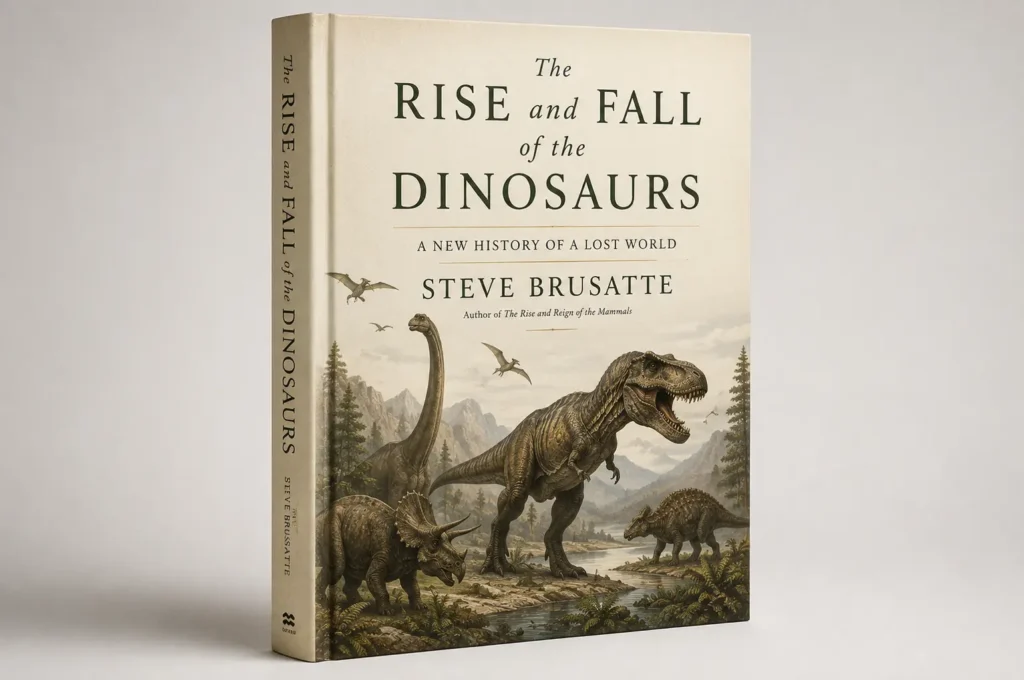
The Rise and Fall of the Dinosaurs
A compelling history of dinosaurs, tracing their origins, diversification, 200-million-year reign, extinction, and enduring legacy.
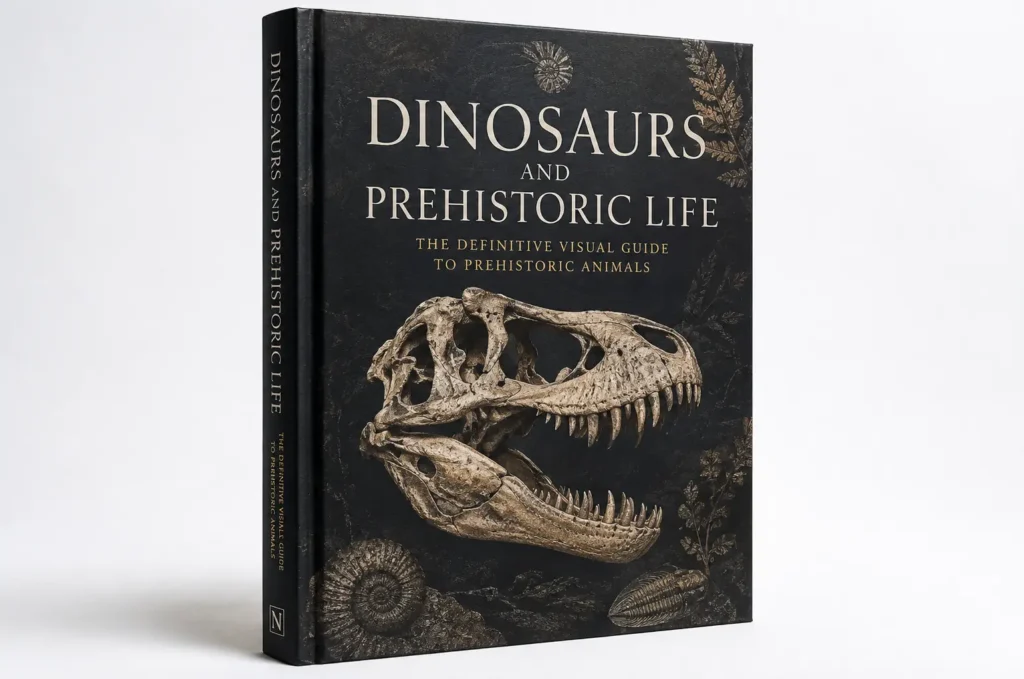
Dinosaurs and Prehistoric Life
A richly illustrated visual reference exploring dinosaurs, fossils, evolution, and prehistoric life across geological time.
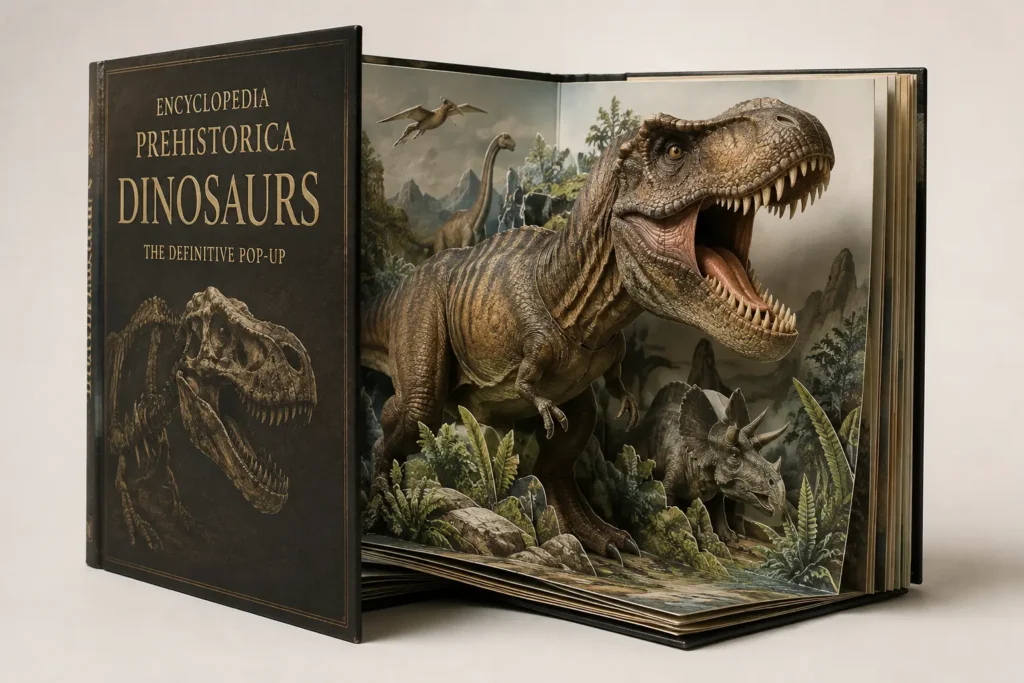
Encyclopedia Prehistorica: Dinosaurs
An interactive dinosaur book featuring spectacular three-dimensional pop-ups, particularly suited to young readers and families.
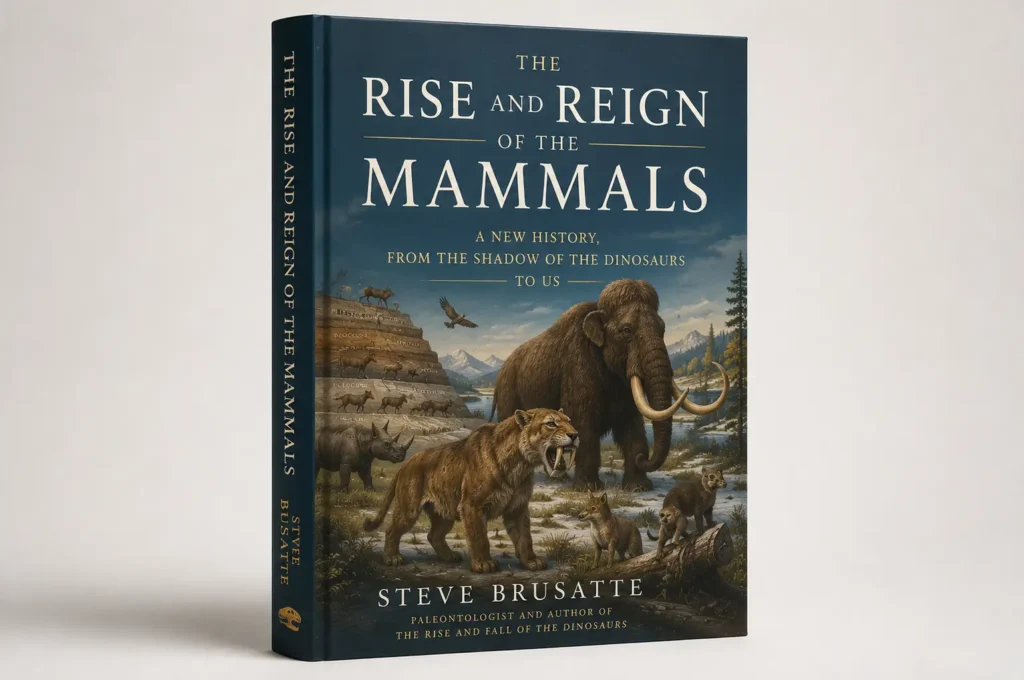
The Rise and Reign of the Mammals
A sweeping history of mammalian evolution, from their origins alongside dinosaurs through the Cenozoic and the emergence of humans.