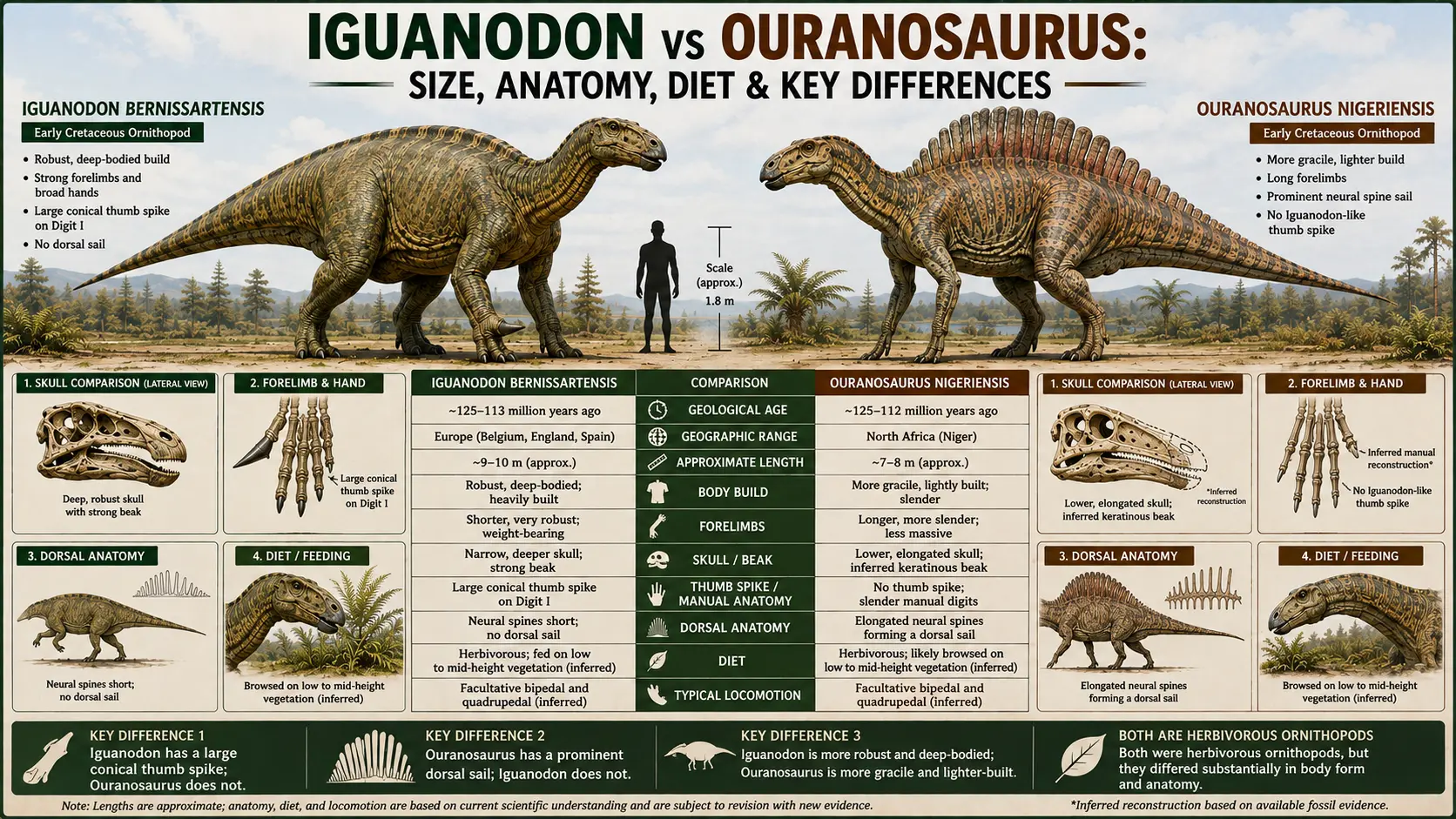
Quick Answer
Iguanodon and Ouranosaurus were large Early Cretaceous iguanodontian ornithopods within Styracosterna. They shared several important anatomical features, including enlarged thumb spikes, specialized herbivorous feeding apparatuses, and forelimbs capable of supporting substantial body weight. Ouranosaurus differed most conspicuously in having greatly elongated neural spines along the dorsal vertebrae. These produced a distinctive raised back and have been reconstructed as supporting an inferred dorsal soft-tissue structure, often depicted as a sail or hump, although the actual soft tissues are not preserved. Iguanodon, by contrast, retained comparatively short neural spines and a more robust overall skeletal construction.

Comparison Summary
| Feature | Iguanodon | Ouranosaurus |
|---|---|---|
| Geological age | Early Cretaceous; I. bernissartensis is associated with the Barremian–early Aptian interval | Early Cretaceous; generally associated with the Aptian–Albian interval, although the precise age of the Elrhaz Formation has been debated |
| Representative species | Iguanodon bernissartensis | Ouranosaurus nigeriensis |
| Approximate length | About 9–11 m for I. bernissartensis | About 7 m in traditional reconstructions; complete adult length remains uncertain |
| Geographic setting | Western Europe | Niger, northern Africa |
| Thumb spike | Enlarged manual thumb spike | Enlarged manual thumb spike |
| Neural spines | Not unusually elongated | Extremely elongated along the dorsal series |
| Dorsal soft-tissue structure | No comparable structure known | Often reconstructed as a sail or hump; soft tissue is unknown |
| General body form | Robust | More gracile in overall proportions |
| Evolutionary position | Styracosternan iguanodontian | Styracosternan iguanodontian |
The available evidence does not support assigning precise, directly comparable body-mass values to the two genera without specifying the reconstruction method. Accordingly, mass is omitted from the primary comparison rather than presenting potentially misleading numerical ranges.
Introduction
Iguanodon and Ouranosaurus were large herbivorous ornithopods that lived during the Early Cretaceous. Both belong within the broader iguanodontian radiation and share numerous skeletal characteristics, but they are distinct genera representing separate evolutionary lineages.
Iguanodon is particularly well represented by the extensive Bernissart material in Belgium, while Ouranosaurus nigeriensis is known principally from well-preserved material from the Elrhaz Formation of Niger. The latter is especially notable for its extremely elongated dorsal neural spines, which are among its most distinctive anatomical characteristics.
The comparison is therefore useful not because one dinosaur represents a direct successor to the other, but because both demonstrate how related Early Cretaceous ornithopods could retain a broadly similar body plan while evolving distinctive anatomical proportions.
What Are the Main Differences?
Side-by-Side Comparison
| Characteristic | Iguanodon | Ouranosaurus |
|---|---|---|
| Geological age | Early Cretaceous | Early Cretaceous |
| Geographic range | Western Europe | Northern Africa, particularly Niger |
| Length | About 9–11 m for I. bernissartensis | About 7 m in the traditional reconstruction; exact adult length uncertain |
| Body mass | Estimates vary with reconstruction method | Estimates vary with reconstruction method |
| Body construction | Relatively robust | Generally more gracile in overall proportions |
| Forelimbs | Strongly built and adapted for substantial weight bearing | Strongly built, with anatomy consistent with substantial forelimb support |
| Hands | Iguanodontian hand with an enlarged thumb spike and specialized digits | Iguanodontian hand with an enlarged thumb spike |
| Thumb spike | Large and robust | Present; proportions differ from those of Iguanodon |
| Dorsal neural spines | Not exceptionally elongated | Extremely elongated |
| Dorsal soft tissue | No comparable structure known | Often reconstructed as a sail or hump, but soft-tissue form is uncertain |
| Locomotion | Capable of quadrupedal locomotion; bipedal capability also recognized | Strongly adapted for quadrupedal locomotion; bipedal capability has also been proposed |
| Evolutionary position | Styracosternan iguanodontian | Styracosternan iguanodontian |
Diagnostic Characteristics
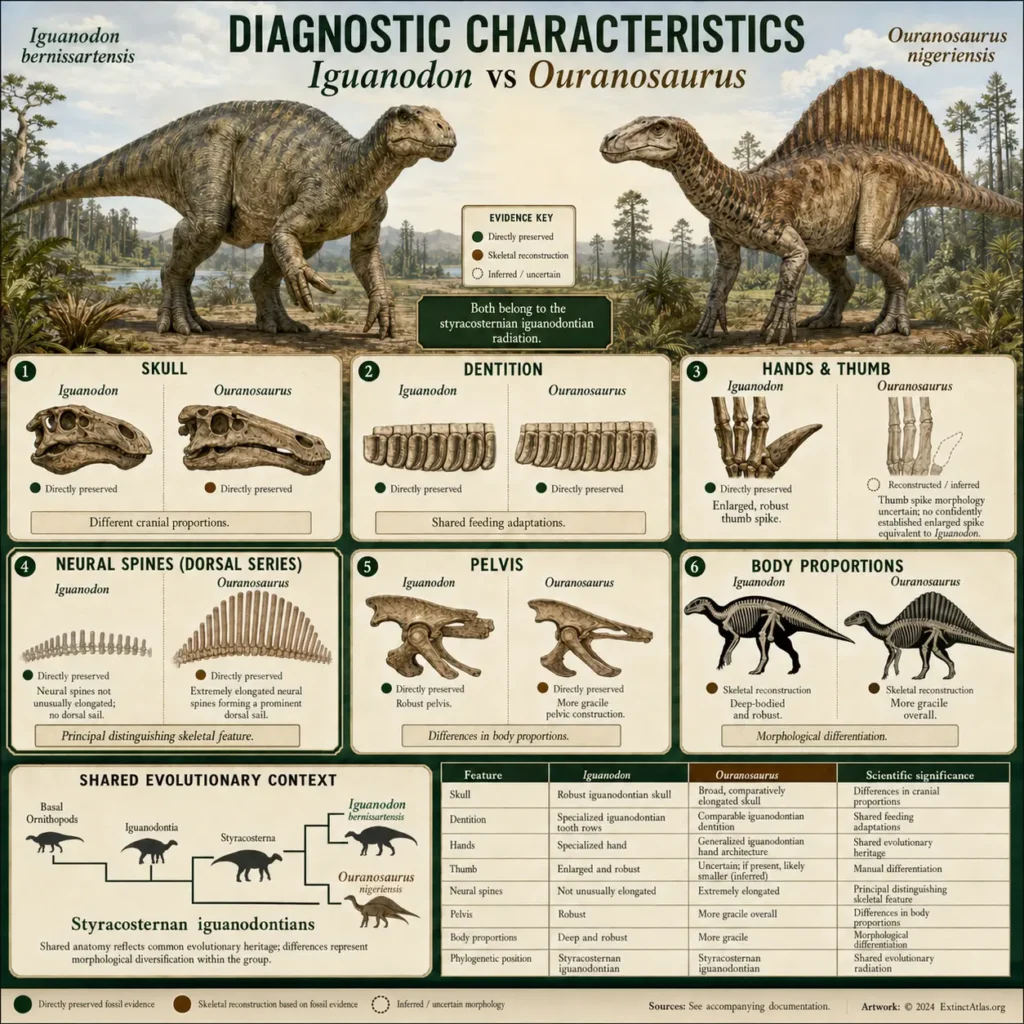
| Feature | Iguanodon | Ouranosaurus | Scientific significance |
|---|---|---|---|
| Skull | Robust iguanodontian skull | Broad, comparatively elongated skull | Reflects differences in cranial proportions |
| Dentition | Specialized iguanodontian tooth rows | Comparable iguanodontian dentition | Indicates shared feeding adaptations |
| Hands | Specialized iguanodontian hand with enlarged thumb spike | Similar generalized hand architecture with enlarged thumb spike | Supports shared evolutionary heritage |
| Thumb spike | Enlarged and robust | Enlarged but proportionally different | Shared iguanodontian characteristic |
| Neural spines | Not unusually elongated | Extremely elongated | Principal distinguishing skeletal feature |
| Pelvis | Robust | More gracile in overall construction | Contributes to differences in body proportions |
| Body proportions | Relatively deep and robust | More gracile overall proportions | Demonstrates morphological differentiation |
| Phylogenetic position | Styracosternan iguanodontian | Styracosternan iguanodontian | Shows membership in the same broader evolutionary radiation |
Scientific Explanation
Iguanodon and Ouranosaurus share numerous anatomical features because both belong to the broader iguanodontian radiation. Their similarities include specialized herbivorous feeding anatomy, enlarged manual thumb spikes, and forelimb anatomy capable of supporting substantial body weight. Their exact branching relationship within Styracosterna has been treated differently in different phylogenetic analyses, so they are better described as related members of the same broader evolutionary radiation rather than as a simple pair of closely adjacent branches.
The most obvious skeletal difference is the series of greatly elongated neural spines along the back of Ouranosaurus. Taquet’s original description documented their extreme elongation, with the tallest spine reaching approximately 630 mm in the material described. The bones themselves are directly preserved, but the soft tissues that would have covered them are not. Consequently, reconstructions as a thin sail, fleshy hump, or another form of dorsal structure remain interpretations rather than directly demonstrated anatomy.
The two genera also differed in overall body proportions. Iguanodon is generally reconstructed as a robust-bodied animal, whereas Ouranosaurus is generally depicted with more gracile proportions. These differences are observable in the skeletons, although their precise functional and ecological significance cannot be established from body form alone.
Despite these differences, both genera retained the characteristic anatomical architecture of large Early Cretaceous iguanodontian herbivores.
Evidence Strength
High
Evidence Assessment
The major anatomical differences between Iguanodon and Ouranosaurus are supported by well-preserved fossil material, including extensive skeletal evidence for Iguanodon and important articulated specimens of Ouranosaurus. The extremely elongated neural spines of Ouranosaurus are directly preserved and represent an unequivocal anatomical feature.
The principal uncertainties concern interpretation rather than basic anatomy. The total adult length of Ouranosaurus remains uncertain because no complete adult skeleton is known, and the soft tissues associated with its elongated neural spines are not preserved. Similarly, precise body-mass comparisons should be treated cautiously because reconstructed mass depends substantially on the methods and assumptions used.
The strongest conclusion is therefore that Iguanodon and Ouranosaurus shared a broad iguanodontian anatomical foundation but evolved distinctive body proportions and, most notably, very different dorsal vertebral morphology.
Classification and Evolution
Taxonomic Comparison
| Category | Iguanodon | Ouranosaurus |
|---|---|---|
| Kingdom | Animalia | Animalia |
| Phylum | Chordata | Chordata |
| Clade | Dinosauria | Dinosauria |
| Order | Ornithischia | Ornithischia |
| Clade | Ornithopoda | Ornithopoda |
| Major clade | Iguanodontia; within Styracosterna | Iguanodontia; within Styracosterna |
| Formal family | No universally accepted family-level treatment is necessary for this comparison | Not currently regarded as a member of Iguanodontidae |
| Genus | Iguanodon | Ouranosaurus |
| Representative species | Iguanodon bernissartensis | Ouranosaurus nigeriensis |
The classification of non-hadrosaurid iguanodontians has changed as new taxa and anatomical information have become available. Ouranosaurus nigeriensis was historically described as an iguanodontid, but subsequent phylogenetic work no longer places it within the formal family Iguanodontidae. Its precise position within Styracosterna has varied among published analyses.
Evolutionary Relationship
| Topic | Current understanding |
|---|---|
| Shared ancestry | Both belong to the broader iguanodontian radiation and share numerous derived anatomical features |
| Evolutionary relationship | Distinct genera within Styracosterna; their exact relative branching position has varied among phylogenetic analyses |
| Geographic diversification | Iguanodon is associated principally with western Europe, whereas Ouranosaurus is known from northern Africa |
| Major innovation | Ouranosaurus evolved exceptionally elongated neural spines extending through the dorsal and parts of the sacral and proximal caudal series |
| Feeding adaptations | Both retained specialized iguanodontian herbivorous feeding anatomy |
| Evolutionary significance | They illustrate morphological diversification among Early Cretaceous styracosternan ornithopods |
Scientific Explanation
Iguanodon and Ouranosaurus are both members of the broader iguanodontian radiation within Styracosterna, but their exact phylogenetic relationship is not as firmly resolved as a simple “close relatives” description might imply. Published analyses have placed Ouranosaurus in different positions within Styracosterna and Hadrosauroidea, and subsequent reassessment has continued to refine its placement.
Their shared anatomy nevertheless demonstrates common evolutionary history. Both possessed the characteristic iguanodontian feeding apparatus and enlarged manual thumb spikes, while their skeletons retained adaptations associated with large-bodied herbivorous ornithopods.
The most distinctive innovation of Ouranosaurus is its extraordinary series of elongated neural spines. In the reassessed material, these structures extend beyond the dorsal vertebrae into the sacral and proximal caudal regions and form a characteristic sinusoidal dorsal profile. The tallest dorsal neural spines reached approximately seven times the height of the corresponding centrum.
The function of this structure remains uncertain. A display function has been considered particularly plausible in the recent reassessment, but the fossil record does not preserve the associated soft tissues directly. Consequently, reconstructions as a thin sail or another fleshy dorsal structure remain interpretive.
Evidence Strength
High
Evidence Assessment
The broad classification of both genera as iguanodontian ornithopods is well established, but their precise branching relationship within Styracosterna remains subject to phylogenetic revision. The major anatomical distinction—the extremely elongated neural spines of Ouranosaurus—is directly documented by fossil material.
The strongest conclusion is therefore that Iguanodon and Ouranosaurus represent distinct Early Cretaceous iguanodontian lineages that share substantial anatomical heritage but cannot be placed into a simple direct evolutionary sequence.
Size and Body Shape
Body Measurements
| Measurement | Iguanodon | Ouranosaurus |
|---|---|---|
| Length | About 9–11 m for I. bernissartensis in commonly cited reconstructions | About 7 m in the original reconstruction; complete adult length remains uncertain |
| Estimated mass | Published estimates vary with reconstruction method | Published estimates vary with reconstruction method |
| Hip height | Approximately 2.5–3 m in commonly cited reconstructions | Exact adult value uncertain |
| Skull length | Approximately 1 m in large Iguanodon reconstructions | Approximately 0.8–0.9 m in published material |
| Forelimbs | Robust and adapted for substantial weight bearing | Strongly built, although overall proportions differ from Iguanodon |
| Neural spines | Not exceptionally elongated | Extremely elongated; tallest dorsal spines reach about seven times centrum height |
The numerical body measurements should be treated as approximate rather than as directly comparable standardized measurements. In particular, the total adult length of Ouranosaurus remains uncertain because a complete adult skeleton is not known. The later reassessment specifically rejects the original 7 m figure as a diagnostic species measurement because complete adult length remains unknown.
Skeletal Differences
| Anatomical feature | Iguanodon | Ouranosaurus |
|---|---|---|
| Skull | Robust iguanodontian skull | Elongate skull with distinctive expanded rostral region |
| Neck | Robust cervical series | Proportionally distinctive cervical and dorsal construction |
| Torso | Relatively robust | More gracile overall proportions |
| Limbs | Strong forelimbs and hind limbs | Strong limbs with distinctive proportional differences |
| Hands | Iguanodontian hand with enlarged thumb spike | Specialized iguanodontian hand with enlarged thumb spike |
| Neural spines | Relatively short compared with Ouranosaurus | Extremely elongated through the dorsal and proximal caudal region |
| Pelvis | Robust styracosternan construction | Distinctive pelvic morphology, including a petaloid brevis shelf |
| Tail | Long caudal series | Long caudal series; proximal caudal neural spines contribute to the dorsal profile |
Scientific Explanation
Although Iguanodon and Ouranosaurus were both large-bodied ornithopods, their skeletal proportions were not identical.
Iguanodon is generally reconstructed as a robust animal with strongly developed forelimbs and hind limbs. Its neural spines were relatively short compared with the extreme condition seen in Ouranosaurus. In I. bernissartensis, the tallest mid-dorsal neural spines are approximately 2.4 times the height of their centra, substantially less than the ratio documented in Ouranosaurus.
Ouranosaurus retained the general styracosternan body plan but developed exceptionally elongated neural spines. These structures are present not only in the dorsal series but also in the sacral and proximal caudal region, producing a distinctive dorsal profile.
The precise adult body proportions of Ouranosaurus remain less certain than those of well-represented Iguanodon because the known skeletons are incomplete and some elements in the paratype and later mounted specimens have been restored or incorporated from other individuals.
The difference between the two genera is therefore best expressed through skeletal proportions and diagnostic anatomy, rather than through precise claims that one had a definitively heavier or more gracile body.
Evidence Strength
High
Evidence Assessment
The major skeletal differences are directly supported by fossil material. The extraordinary neural-spine development of Ouranosaurus is particularly well documented and provides one of the clearest anatomical distinctions between the two genera.
Greater caution is required for reconstructed total size, hip height, body mass, and soft-tissue proportions because these depend on incomplete specimens and reconstruction methodology.
Skull and Feeding Adaptations
Skull Comparison
| Feature | Iguanodon | Ouranosaurus |
|---|---|---|
| Skull shape | Robust iguanodontian skull | Elongate skull with a relatively low profile |
| Rostrum | Broad herbivorous rostrum | Broad, dorsoventrally flattened terminal rostrum |
| Premaxilla | Specialized ornithopod cropping apparatus | Dorsally reflected oral margin forming a distinctive rim |
| Dentition | Specialized iguanodontian tooth rows | Specialized dentition with several distinctive cranial and mandibular features |
| Dentary | Robust herbivorous jaw | Long diastema and distinctive anterior dentary morphology |
| Feeding apparatus | Adapted for processing vegetation | Adapted for herbivory, with several features approaching the condition seen in more derived ornithopods |
The skull of Ouranosaurus has several distinctive features that make it more than simply a slightly modified version of the Iguanodon skull. The modern reassessment describes an elongate skull with a length-to-height ratio of approximately 3.2, a laterally expanded and dorsoventrally flattened terminal rostrum, a dorsally reflected oral margin of the premaxilla, and a relatively long dentary diastema.
Feeding Adaptations
| Adaptation | Iguanodon | Ouranosaurus |
|---|---|---|
| Feeding mode | Herbivorous | Herbivorous |
| Beak | Keratinous cropping structure inferred from the preserved rostral anatomy | Broad cropping structure associated with the expanded rostrum |
| Teeth | Specialized iguanodontian tooth rows | Specialized iguanodontian dentition |
| Tooth replacement | Continuous replacement characteristic of dinosaurian herbivorous dentitions | Continuous replacement |
| Food processing | Specialized for processing plant material | Specialized for processing plant material |
| Precise diet | Cannot be reconstructed to individual plant taxa with confidence | Cannot be reconstructed to individual plant taxa with confidence |
Scientific Explanation
The skulls of Iguanodon and Ouranosaurus show a shared evolutionary foundation in herbivorous feeding, but their cranial morphology also demonstrates that the two genera were not anatomically interchangeable.
Ouranosaurus possesses a particularly distinctive elongated skull and expanded rostral region. Its premaxilla and dentary also contain features that are unusual among non-hadrosaurid styracosternans, including a dorsally reflected oral margin of the premaxilla and a relatively long dentary diastema. Some of these features resemble conditions found in more derived ornithopods, but the reassessment indicates that at least some may have evolved independently rather than representing direct evidence of close hadrosaurid ancestry.
Both genera possessed specialized herbivorous dentitions and jaws adapted for processing vegetation. However, the available fossil evidence does not justify assigning them an identical diet or identifying particular plant taxa as their principal food without additional ecological evidence.
It is therefore safer to describe their feeding systems as broadly comparable iguanodontian herbivorous adaptations, rather than claiming identical chewing efficiency or identical dietary preferences.
Evidence Strength
High
Evidence Assessment
The principal cranial and dental characteristics of Ouranosaurus are directly documented by well-preserved fossil material, while the broader herbivorous feeding adaptations of Iguanodon are extensively documented.
Functional interpretations of the feeding apparatus are supported by comparative anatomy, but precise dietary reconstruction remains more uncertain. The evidence supports a broadly similar herbivorous feeding strategy while also demonstrating meaningful differences in skull proportions and rostral anatomy.
The most defensible conclusion is that Iguanodon and Ouranosaurus shared the specialized feeding architecture characteristic of advanced iguanodontians, but each genus developed its own distinctive cranial morphology.
Locomotion and Lifestyle
Locomotion Comparison
| Feature | Iguanodon | Ouranosaurus |
|---|---|---|
| Quadrupedal locomotion | Strongly supported; forelimbs were capable of substantial weight bearing | Strongly supported by forelimb and limb anatomy |
| Bipedal locomotion | Bipedal capability has been proposed; modern interpretations emphasize substantial quadrupedal use | Bipedal capability has been proposed, but the evidence is less secure than for quadrupedal locomotion |
| Forelimbs | Robust and adapted for weight bearing | Robust and adapted for weight bearing |
| Hind limbs | Strongly developed hind limbs | Strongly developed hind limbs |
| Tail | Long tail contributed to body balance during locomotion | Long tail contributed to body balance; elongated neural spines altered the dorsal profile |
| Locomotor certainty | Moderate to high | Moderate |
| Effect of neural spines on locomotion | Not applicable | No demonstrated locomotor function for the elongated neural spines |
Scientific Explanation
The locomotion of Iguanodon has undergone a major reinterpretation since the famous Bernissart skeletons were first mounted in an upright, bipedal posture. Modern assessments emphasize that Iguanodon possessed forelimbs capable of substantial weight bearing and that quadrupedal locomotion formed an important part of its locomotor repertoire. The Royal Belgian Institute of Natural Sciences notes that David B. Norman’s 1980 reassessment rejected the earlier “kangaroo” posture and concluded that the animal’s vertebral column was held more horizontally during walking and running.
The locomotor interpretation of Ouranosaurus is less securely resolved. Its forelimbs and other skeletal features indicate substantial quadrupedal capability, while bipedal locomotion has been proposed from the broader anatomy of non-hadrosaurid iguanodontians. It is therefore preferable to describe Ouranosaurus as a dinosaur with well-developed quadrupedal capability rather than assigning it a confidently demonstrated bipedal-versus-quadrupedal locomotor pattern.
The elongated neural spines of Ouranosaurus are an important anatomical feature, but there is no direct evidence that their inferred soft-tissue covering played a specific role in locomotion. Their functional significance remains uncertain.
Claims about running speed or overall agility are substantially less secure. The fossil record does not provide a sufficiently robust basis for assigning either genus a qualitative rating such as “moderate agility” or “moderate running ability,” so those categories are omitted.
Lifestyle Comparison
| Ecological trait | Iguanodon | Ouranosaurus |
|---|---|---|
| Diet | Herbivorous | Herbivorous |
| Feeding ecology | Large terrestrial herbivore | Large terrestrial herbivore |
| Geographic setting | Western Europe | Northern Africa, particularly Niger |
| Habitat | Terrestrial floodplain and associated environments | Fluvial and floodplain environments of the Elrhaz Formation |
| Climate | Exact climatic conditions varied among European localities | Northern African Early Cretaceous environment; precise climatic reconstruction remains dependent on geological context |
| Social behaviour | Direct evidence for social organization is limited | Direct evidence for social organization is limited |
| Ecological role | Large-bodied herbivore | Large-bodied herbivore |
Scientific Explanation
Both genera were large terrestrial herbivores, but their environmental contexts were geographically distinct. Iguanodon bernissartensis is documented from western European Early Cretaceous deposits, including the exceptionally well-known Bernissart locality. The Royal Belgian Institute of Natural Sciences places the Bernissart material in the Upper Barremian–Lower Aptian interval.
Ouranosaurus nigeriensis is associated with the Elrhaz Formation of Niger. The fossil assemblage from this formation provides evidence for a diverse terrestrial and aquatic ecosystem, but the precise ecological preferences of Ouranosaurus itself should not be reconstructed beyond what its anatomy and geological context support.
Both dinosaurs occupied the ecological role of large herbivorous ornithopods, but direct evidence for details such as social organization, browsing height, or precise plant preferences is limited. Such characteristics should therefore be treated as hypotheses rather than established biological facts.
There is also insufficient evidence to conclude that differences in environment directly caused the evolution of the elongated neural spines of Ouranosaurus. The association is an interesting evolutionary possibility, but the causal relationship cannot be demonstrated from the fossil record alone.
Evidence Strength
Moderate to High
Evidence Assessment
The basic locomotor anatomy of both genera is well documented, particularly the substantial forelimb development associated with quadrupedal weight bearing. The interpretation of habitual or facultative bipedal locomotion is more dependent on biomechanical reconstruction and comparative anatomy. For Iguanodon, the locomotor interpretation has changed substantially over the history of research, and the modern view gives greater importance to quadrupedal locomotion than the original Bernissart mounts suggest.
Ecological interpretations are supported by fossil assemblages, sedimentology, and regional geological evidence, but taxon-specific claims about behaviour and social organization remain limited.
Fossil Evidence
Fossil Record Comparison
| Topic | Iguanodon | Ouranosaurus |
|---|---|---|
| Principal fossil record | Numerous specimens from western Europe | Important specimens from the Elrhaz Formation of Niger |
| Bernissart material | Approximately 30 relatively complete skeletons | Not applicable |
| Specimen completeness | Exceptional for an Early Cretaceous ornithopod | Important articulated and relatively complete material, but the total skeletal record is more limited |
| Geographic distribution | Western Europe, including Belgium, England, Germany, and Spain | Northern Africa, principally Niger |
| Historical importance | One of the earliest scientifically described dinosaurs and one of the best-documented Early Cretaceous ornithopods | One of the most important African Early Cretaceous ornithopods |
| Research history | Described in 1825; extensively revised after the Bernissart discoveries | Described by Philippe Taquet in 1976 and subsequently reassessed |
Important Specimens
| Taxon | Important material | Scientific importance |
|---|---|---|
| Iguanodon | Bernissart assemblage | Provides exceptionally detailed information on the skeleton and variation of Iguanodon |
| Iguanodon | Maidstone specimen | Historically important early material that contributed to the original understanding of the genus |
| Ouranosaurus nigeriensis | Holotype material from Gadoufaoua, Niger | Establishes the species and preserves the distinctive elongated neural spines |
| Ouranosaurus nigeriensis | Additional referred material from the Elrhaz Formation | Provides additional information on anatomy and variation |
Scientific Explanation
The fossil records of Iguanodon and Ouranosaurus differ substantially in abundance, geographic distribution, and historical documentation.
Iguanodon has an exceptionally rich fossil record for an Early Cretaceous ornithopod. The Bernissart discovery alone produced approximately 30 relatively complete skeletons, providing an unusually detailed record of the genus’s skeletal anatomy. Additional European material has expanded knowledge of its geographic distribution and morphological variation.
Ouranosaurus is known from important and relatively well-preserved material from the Elrhaz Formation of Niger. The fossils preserve the distinctive elongated neural spines and provide substantial information about the skull, vertebral column, limbs, pelvis, and other parts of the skeleton. The later reassessment of the genus emphasizes that the known material is sufficiently informative to reconstruct its distinctive anatomy, while also noting limitations caused by incomplete specimens and reconstruction history.
The two records should therefore not be described simply as “good” versus “poor.” Iguanodon has an exceptional abundance and completeness advantage, particularly because of Bernissart, whereas Ouranosaurus nevertheless has sufficiently informative specimens to establish a detailed anatomical profile.
The difference is especially important when interpreting body size. Iguanodon bernissartensis is represented by exceptionally complete individuals, and the Royal Belgian Institute of Natural Sciences gives adult lengths of approximately 9–11 m. In contrast, the complete adult length of Ouranosaurus remains uncertain because no completely preserved adult skeleton establishes its total body length with the same confidence.
Evidence Strength
Very High for major skeletal anatomy; High for comparative completeness
Evidence Assessment
The fossil evidence provides a strong basis for comparing the major anatomy of the two genera. Iguanodon has an exceptional record because of the Bernissart assemblage, while Ouranosaurus is represented by important articulated material that preserves its defining skeletal characteristics, particularly the elongated neural spines.
The principal uncertainties concern reconstruction rather than the existence of the major anatomical features. The soft tissues associated with the neural spines of Ouranosaurus are unknown, and the total adult body dimensions of the genus remain less certain than those of the best-preserved Iguanodon specimens.
The most defensible conclusion is that Iguanodon has the substantially richer fossil record, while Ouranosaurus is nevertheless sufficiently well represented to permit a detailed comparison of its anatomy and evolutionary significance.
Comparison with Other Styracosternans
Styracosternan Comparison
| Taxon | Relationship / Context | Key Difference |
|---|---|---|
| Camptosaurus | Earlier-diverging iguanodontian ornithopod | Generally smaller and less specialized than later styracosternans |
| Mantellisaurus | European iguanodontian closely associated with the Iguanodon lineage in many classifications | More gracile body proportions and distinctive limb proportions |
| Barilium | European styracosternan | Robust body and distinctive pelvic morphology |
| Lurdusaurus | African iguanodontian | Exceptionally robust, heavily built body |
| Ouranosaurus | African styracosternan iguanodontian | Extremely elongated dorsal neural spines and distinctive skull morphology |
| Hadrosaurus | Early hadrosaurid; part of the later hadrosaurid radiation | More specialized hadrosaurid dental and cranial anatomy |
Evolutionary Context
| Group | Shared features | Distinguishing features |
|---|---|---|
| Basal ornithopods | Herbivory and ornithopod locomotor adaptations | Generally smaller bodies and less specialized feeding anatomy |
| Early iguanodontians | Enlarged manual thumb structures and increasingly specialized herbivorous feeding anatomy | Increasing body size and forelimb development |
| Styracosternans | Robust forelimbs, specialized feeding apparatus, and generally larger body size | Substantial variation in body proportions and cranial morphology |
| Non-hadrosaurid styracosternans | Advanced herbivorous adaptations | Strong regional and morphological diversification |
| Hadrosauroids and hadrosaurids | Highly specialized herbivorous feeding systems inherited from the broader iguanodontian radiation | Increasingly complex dental batteries and derived cranial anatomy |
Scientific Explanation
Iguanodon and Ouranosaurus belong to the broader Early Cretaceous radiation of iguanodontian ornithopods within Styracosterna. They share numerous anatomical characteristics, but their exact phylogenetic relationship has varied among analyses. Consequently, they should not be presented as a simple pair of directly adjacent evolutionary branches or as members of a single well-resolved lineage.
Other styracosternans demonstrate the considerable morphological diversity that developed during this radiation. European taxa such as Mantellisaurus and Barilium differed in body proportions and pelvic anatomy, while African taxa such as Lurdusaurus and Ouranosaurus evolved their own distinctive morphologies. Lurdusaurus became exceptionally robust, whereas Ouranosaurus developed extremely elongated dorsal neural spines and a distinctive cranial construction.
The comparison with hadrosaurids should also be framed carefully. Hadrosaurids did not simply “inherit” the exact specialized anatomy of Iguanodon or Ouranosaurus. Instead, hadrosaurids represent a later radiation within the broader iguanodontian evolutionary history and independently evolved increasingly specialized dental and cranial feeding systems.
The diversity of these taxa demonstrates that Early Cretaceous iguanodontian evolution was not a linear progression toward hadrosaurids. It was a branching radiation in which different lineages evolved different combinations of body size, locomotor anatomy, skull morphology, and other specializations.
Scientific Debate
Scientific Debate Summary
| Question | Current understanding | Confidence |
|---|---|---|
| What was the function of the elongated neural spines? | Several functions have been proposed, including display and thermoregulatory or other soft-tissue-related functions; no single function is established | Moderate |
| Did the neural spines support a sail or a hump? | The skeletal structures are certain, but their associated soft tissues are unknown; both sail-like and fleshy reconstructions have been proposed | Moderate |
| How closely related are Iguanodon and Ouranosaurus? | Both are styracosternan iguanodontians, but their precise branching relationship has varied among phylogenetic analyses | Moderate |
| What is the significance of their body proportions? | The differences are genuine anatomical features, but their precise ecological or functional causes remain uncertain | Moderate |
| How reliable are body-mass estimates? | Estimates can be useful when based on explicit reconstruction methods, but values vary according to assumptions and should not be treated as exact | Moderate |
| Did European and African styracosternans differ ecologically? | Their fossil assemblages and environments differed geographically, but the extent to which environmental differences drove anatomical divergence remains uncertain | Moderate |
Competing Interpretations
| Topic | Earlier or commonly proposed interpretation | Current evidence-based treatment | Supporting evidence |
|---|---|---|---|
| Function of the elongated neural spines | Primarily a display or thermoregulatory structure | Display and other functions remain possible; no single function is demonstrated | Neural-spine morphology and comparative functional interpretation |
| Sail or hump | Thin skin sail | A sail-like structure and other soft-tissue reconstructions remain possible | Preserved neural spines; absence of preserved soft tissue |
| Relationship between Iguanodon and Ouranosaurus | Sometimes grouped closely within Iguanodontidae | Both are styracosternan iguanodontians, but their precise relative position is not uniformly resolved | Comparative anatomy and cladistic analyses |
| Body proportions | Primarily treated as taxonomic differences | Anatomical differences are established; ecological and functional significance remains partly uncertain | Comparative skeletal anatomy |
| Body-mass estimates | Broad estimates from linear dimensions | Modern approaches can incorporate volumetric reconstruction, but results remain method-dependent | Volumetric and biomechanical modelling |
| Ecological differences | Limited regional interpretation | Geological context supports different environmental settings, but causal links to anatomical evolution remain uncertain | Sedimentology, associated faunas, and palaeoenvironmental studies |
Scientific Explanation
The most distinctive unresolved feature in this comparison is the extremely elongated neural-spine series of Ouranosaurus. Since the genus was described, these structures have prompted hypotheses involving display, thermoregulation, energy storage, and other functions. The preserved bones establish the unusual morphology but do not reveal the soft tissues that covered them, so the exact function remains uncertain. A recent reassessment considers display among the more plausible interpretations but does not establish it conclusively.
The related question of whether Ouranosaurus possessed a thin dorsal sail or a fleshy hump is likewise unresolved. The neural spines themselves are directly preserved, whereas the proposed external structure is reconstructed. It is therefore important to distinguish the demonstrated skeletal feature from the inferred soft-tissue anatomy.
The phylogenetic relationship between Iguanodon and Ouranosaurus also requires careful wording. Both belong to Styracosternan iguanodontians, but phylogenetic analyses have not produced a universally stable placement for Ouranosaurus. McDonald’s analysis of Styracosterna illustrates the broader difficulty of resolving relationships among non-hadrosaurid iguanodontians, while later anatomical reassessment has continued to refine the placement of Ouranosaurus.
Body-mass estimates should likewise be treated as reconstructions rather than measurements. Modern volumetric methods can improve estimates by incorporating three-dimensional models of the skeleton and reconstructed soft tissues, but different assumptions about body shape and tissue distribution can produce different results. This is why the comparison should emphasize skeletal dimensions rather than presenting a single mass value as definitive.
The broader evolutionary significance is clearer. Iguanodon, Ouranosaurus, Lurdusaurus, Mantellisaurus, Barilium, and other styracosternans demonstrate substantial morphological diversification during the Early Cretaceous. Their evolution was not a simple linear sequence from primitive ornithopods to hadrosaurids, but a branching radiation containing numerous specialized lineages.
Evidence Strength
High for major anatomical and phylogenetic framework; Moderate for functional and ecological interpretations
Evidence Assessment
The major skeletal characteristics of Iguanodon and Ouranosaurus are strongly supported by fossil evidence. The elongated neural spines of Ouranosaurus are directly preserved, while the associated soft-tissue structure and its function remain uncertain.
The broad placement of both genera within the styracosternan iguanodontian radiation is well established, but their precise branching relationship should not be described as completely settled. Similarly, differences in body proportions are directly observable, whereas explanations involving specific environmental selection pressures remain interpretive.
The most defensible conclusion is that Iguanodon and Ouranosaurus are distinct Early Cretaceous iguanodontian dinosaurs that share a broad evolutionary heritage while exhibiting significant anatomical differentiation. Their comparison provides a useful example of morphological diversification within Styracosterna, but the evidence does not support a simple linear evolutionary narrative.
Current Scientific Understanding
Current Consensus
| Topic | Current scientific understanding |
|---|---|
| Taxonomic relationship | Both are Early Cretaceous iguanodontian ornithopods within Styracosternan; they represent distinct genera |
| Evolutionary relationship | Both belong to the same broader evolutionary radiation, but their precise branching relationship has varied among phylogenetic analyses |
| Feeding adaptations | Both possessed specialized herbivorous feeding anatomy characteristic of iguanodontians |
| Thumb spike | Both possessed an enlarged manual thumb spike, a characteristic feature of iguanodontian ornithopods |
| Neural spines | Ouranosaurus evolved exceptionally elongated dorsal neural spines; Iguanodon lacks a comparable condition |
| Locomotion | Both possessed forelimbs capable of substantial weight bearing; the extent and frequency of bipedal versus quadrupedal locomotion remain matters of biomechanical interpretation |
| Body size | Iguanodon bernissartensis is generally reconstructed as the larger animal, but precise comparison with Ouranosaurus is limited by incomplete material and reconstruction uncertainty |
| Soft-tissue reconstruction | The elongated neural spines of Ouranosaurus are directly preserved, but their associated soft tissues are unknown |
| Scientific confidence | High for the major skeletal differences; moderate for some functional, ecological, and phylogenetic interpretations |
Current research supports placing Iguanodon and Ouranosaurus within the broader radiation of Early Cretaceous styracosternan iguanodontians. Their shared anatomy reflects common evolutionary heritage, while their differences demonstrate substantial morphological diversification within the group. The precise phylogenetic position of Ouranosaurus has varied among analyses, so the two genera should not be portrayed as a simple pair of directly adjacent evolutionary branches.
The most conspicuous anatomical distinction is the extremely elongated neural-spine series of Ouranosaurus. The bones themselves are unequivocal, but the soft tissues that surrounded them are not preserved. Consequently, proposed reconstructions as a sail, hump, or another dorsal structure remain interpretations rather than established anatomy.
Current evidence favors predominantly or obligately quadrupedal locomotion in both Iguanodon bernissartensis and Ouranosaurus nigeriensis. A 2026 osteological reassessment found that both taxa scored as quadrupeds for nine of eleven locomotor correlates and interpreted them as best regarded as obligate quadrupeds, although the authors note that the result is sensitive to assumptions concerning hadrosaur locomotion. Earlier hypotheses of facultative bipedalism therefore remain historically important but are no longer the strongest current interpretation.
For Ouranosaurus, substantial quadrupedal capability is supported by its anatomy, whereas the extent of habitual or facultative bipedal locomotion remains less certain. The evidence therefore supports locomotor versatility within the broader iguanodontian context without requiring the two genera to have used identical locomotor strategies.
Frequently Asked Questions
Was Ouranosaurus simply an African Iguanodon?
No. They were distinct genera with their own anatomical characteristics. Both belong to the broader iguanodontian radiation within Styracosternan, but Ouranosaurus is not simply an African version of Iguanodon. Its extremely elongated dorsal neural spines, distinctive skull morphology, and other skeletal features distinguish it clearly from Iguanodon.
Which dinosaur was larger?
Iguanodon bernissartensis is generally reconstructed as the larger of the two. The Royal Belgian Institute of Natural Sciences gives adult lengths of approximately 9–11 m for I. bernissartensis. The commonly cited length of Ouranosaurus is about 7 m in the original reconstruction, but the total length of a complete adult remains uncertain because no complete adult skeleton is known.
Did both have thumb spikes?
Yes. Both possessed an enlarged manual thumb spike, one of the characteristic features of iguanodontian ornithopods. The exact proportions and morphology of the spike differed between the genera, but the basic anatomical feature was present in both.
Why did Ouranosaurus have elongated neural spines?
Their exact function is unknown. The elongated neural spines are directly preserved, but the soft tissues associated with them are not. Proposed functions have included visual display and thermoregulatory or other physiological roles, but no single explanation has been demonstrated conclusively. A recent reassessment considers display among the plausible interpretations.
Did Ouranosaurus have a sail or a hump?
This remains uncertain. The fossil evidence establishes the exceptionally elongated neural spines, but it does not preserve the soft tissues that would have surrounded them. A thin sail-like structure and a more substantial fleshy covering have both been proposed. The safest scientific description is therefore an inferred dorsal soft-tissue structure rather than a confirmed sail or hump.
Did they eat the same plants?
Both were herbivores with specialized iguanodontian feeding adaptations, so their diets probably overlapped at a broad ecological level. However, the specific plants consumed by each species cannot be reconstructed with sufficient confidence to say that they ate the same plant species. Their European and African environments also contained different regional floras.
Were they capable of bipedal locomotion?
Earlier interpretations allowed facultative bipedalism in large iguanodontians, and Iguanodon was historically reconstructed in an upright bipedal posture. However, a 2026 reassessment based on multiple osteological correlates found that both Iguanodon and Ouranosaurus are best interpreted as obligate quadrupeds. The possibility of occasional hindlimb-supported behaviour cannot be completely excluded, but habitual bipedal locomotion is not currently the preferred interpretation.
Where did each dinosaur live?
Iguanodon is known principally from western Europe, including Belgium, England, Germany, and Spain. Ouranosaurus nigeriensis is known from northern Africa, particularly the Elrhaz Formation of Niger.
Are Iguanodon and Ouranosaurus closely related?
They are both members of the broader styracosternan iguanodontian radiation and share numerous anatomical characteristics. However, their precise branching relationship has varied among phylogenetic analyses. It is therefore more accurate to describe them as related members of the same major evolutionary radiation rather than claim that their exact relationship is completely settled.
Is the sail of Ouranosaurus preserved?
No. The fossil record preserves the greatly elongated neural spines that formed the underlying skeletal framework. The skin, fat, connective tissue, or other soft tissues that may have surrounded them have not been preserved. The external appearance of the structure therefore remains a reconstruction.
What does this comparison reveal about ornithopod evolution?
It demonstrates that Early Cretaceous iguanodontian evolution was a branching radiation rather than a simple linear progression. Iguanodon and Ouranosaurus retained a broadly comparable iguanodontian anatomical foundation while developing substantially different skeletal proportions and specializations. Their comparison illustrates how large herbivorous ornithopods diversified across different regions while retaining common evolutionary characteristics.
Conclusion
Iguanodon and Ouranosaurus were distinct Early Cretaceous iguanodontian dinosaurs that shared a broad styracosternan anatomical heritage while developing substantially different skeletal characteristics. Iguanodon is best known for its robust construction, enlarged thumb spike, and exceptionally rich fossil record, particularly the Bernissart assemblage. Ouranosaurus is distinguished by its elongated dorsal neural spines, distinctive skull morphology, and African fossil record.
Their comparison illustrates that Early Cretaceous ornithopod evolution was not a simple progression from one body form to another. Instead, styracosternans diversified into multiple lineages with different combinations of skeletal proportions and anatomical specializations.
The most distinctive difference is the elongated neural-spine series of Ouranosaurus. The bones are directly preserved, but the soft tissues associated with them are unknown, so interpretations of a sail, hump, display structure, or other function remain provisional. Likewise, differences in locomotion, ecology, body size, and phylogenetic position should be interpreted according to the strength of the available evidence rather than treated as completely resolved.
Overall, Iguanodon and Ouranosaurus provide a useful example of how related herbivorous dinosaurs could retain a common anatomical foundation while evolving markedly different forms during the Early Cretaceous.
References
Primary Literature
- Taquet, P. (1976). Géologie et paléontologie du gisement de Gadoufaoua (Aptien du Niger). Cahiers de Paléontologie, Centre National de la Recherche Scientifique, Paris.
- Norman, D. B. (1980). On the ornithischian dinosaur Iguanodon bernissartensis from the Lower Cretaceous of Bernissart (Belgium). Mémoires de l’Institut Royal des Sciences Naturelles de Belgique, 178, 7–83.
- Norman, D. B. (1986). On the anatomy of Iguanodon atherfieldensis (Ornithischia: Ornithopoda). Bulletin de l’Institut Royal des Sciences Naturelles de Belgique, Sciences de la Terre, 56, 281–372.
- McDonald, A. T., Barrett, P. M., & Chapman, S. D. (2010). A new basal iguanodont (Dinosauria: Ornithischia) from the Wealden (Lower Cretaceous) of England. Zootaxa, 2569(1), 1–43.
- McDonald, A. T. (2012). Phylogeny of the Styracosterna (Dinosauria: Ornithopoda). PLoS ONE, 7(3), e36745.
Ouranosaurus Anatomy and Systematics
- Bertozzo, F., Dalla Vecchia, F. M., & Fabbri, M. (2017). The Venice specimen of Ouranosaurus nigeriensis (Dinosauria, Ornithopoda). PeerJ, 5, e3443.
- Sereno, P. C. (1986). Phylogeny of the bird-hipped dinosaurs (Order Ornithischia). National Geographic Research, 2, 234–256.
- Taquet, P., & Russell, D. A. (1999). A massively-constructed iguanodont from Gadoufaoua, Lower Cretaceous of Niger. Annales de Paléontologie, 85(1), 85–96.
Body Size and Biomechanics
- Bates, K. T., Manning, P. L., Hodgetts, D., & Sellers, W. I. (2009). Estimating mass properties of dinosaurs using laser imaging and 3D volumetric reconstruction. PLoS ONE, 4(2), e4532.
- Campione, N. E., & Evans, D. C. (2012). A universal scaling relationship between body mass and limb bone circumference in quadrupedal terrestrial tetrapods. BMC Biology, 10, 60.
Standard Reference Works
- Weishampel, D. B., Dodson, P., & Osmólska, H. (Eds.). (2004). The Dinosauria (2nd ed.). University of California Press.
- Paul, G. S. (2016). The Princeton Field Guide to Dinosaurs (2nd ed.). Princeton University Press.
Featured Museum Collections
Museum-quality paleoart and educational poster
collections based on evidence-informed prehistoric
Life reconstructions.