Quick Answer
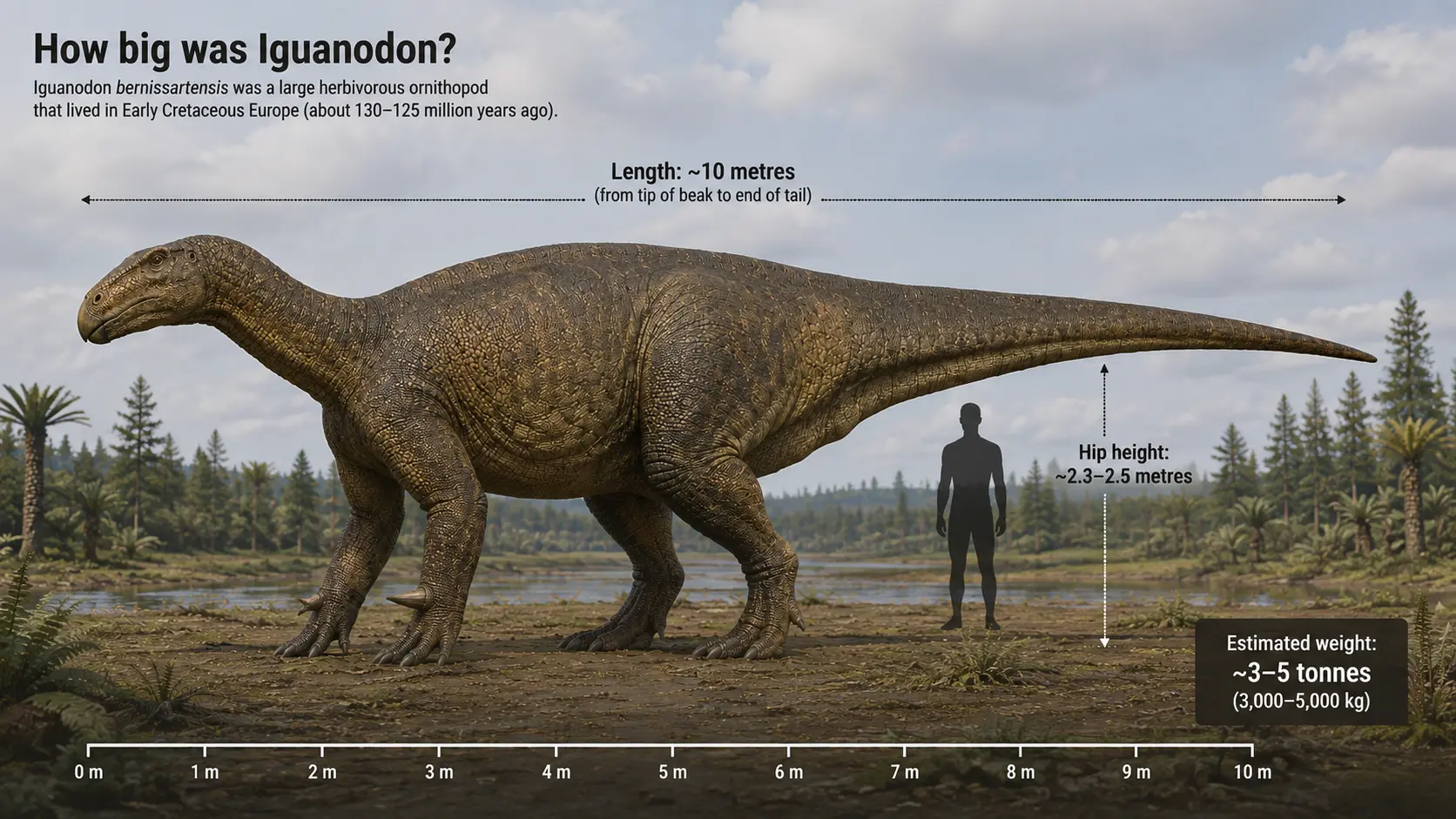
Iguanodon bernissartensis was one of the largest herbivorous dinosaurs of the Early Cretaceous. Most adult individuals measured 9–11 metres (30–36 feet) in total length and weighed approximately 3–5 tonnes (3,000–5,000 kg). These estimates are supported by numerous articulated skeletons, particularly the exceptionally preserved Bernissart specimens from Belgium, making the overall body size of Iguanodon one of the best-constrained among non-hadrosaurian ornithopods.

Size Summary
| Measurement | Estimate | Evidence Source |
|---|---|---|
| Adult Length | 9–11 m (30–36 ft) | Complete articulated skeletons |
| Largest Estimated Individuals | Slightly over 11 m (uncertain) | Large adult specimens |
| Juvenile Length | Variable; substantially smaller than adults | Ontogenetic specimens |
| Estimated Body Mass | 3–5 tonnes | Volumetric and biomechanical models |
| Hip Height | Approximately 2–3 m | Skeletal reconstruction |
| Body Build | Robust, deep-bodied herbivore | Direct skeletal evidence |
| Tail Length | Approximately half the total body length | Articulated skeletons |
Introduction
Body size is one of the most thoroughly studied aspects of Iguanodon biology because the genus is represented by numerous articulated skeletons preserving nearly the entire skeleton. Unlike many dinosaurs known from isolated bones, these fossils allow palaeontologists to reconstruct overall body proportions with relatively high confidence.
Understanding the size of Iguanodon is important for more than simple measurements. Body size influences locomotion, feeding height, energy requirements, growth, ecological role, and evolutionary relationships. Consequently, size estimates are frequently incorporated into biomechanical studies, palaeoecological reconstructions, and analyses of ornithopod evolution.
Although estimates have become increasingly refined over the past century, they continue to evolve as reconstruction techniques improve and new analytical methods are developed.
Estimated Length
Historical Length Estimates
| Period | Typical Estimate | Basis |
|---|---|---|
| Early 19th century | Often >12 m | Fragmentary fossils and speculative reconstructions |
| Early–Mid 20th century | 10–12 m | Improved skeletal material |
| Modern studies | 9–11 m | Bernissart skeletons and digital reconstruction |
Adult Length
Most adult specimens of Iguanodon bernissartensis measured between 9 and 11 metres in total length. This estimate is derived primarily from the exceptionally complete Bernissart skeletons, which preserve nearly every major skeletal element and provide a reliable basis for reconstructing the animal’s overall proportions.
Compared with many dinosaurs known only from partial remains, Iguanodon benefits from an unusually complete fossil record. Multiple adult individuals display broadly similar body proportions, giving researchers considerable confidence in published length estimates.
Length is measured from the tip of the snout to the end of the tail following anatomical reconstruction rather than by simply summing preserved bones. Minor variation between specimens reflects differences in preservation, individual biology, and skeletal completeness.
Largest Known Individuals
Most complete adult skeletons fall within the accepted 9–11 metre range. Some historical publications proposed individuals exceeding 12 metres in length, but these estimates often relied on fragmentary material, outdated reconstructions, or assumptions about posture and body proportions.
Modern studies generally consider animals exceeding approximately 11 metres to be uncertain because no completely preserved specimen clearly demonstrates substantially larger dimensions. Consequently, exceptionally large estimates should be regarded cautiously unless supported by complete skeletal material.
Juvenile Length
Juvenile Iguanodon individuals were considerably smaller than adults and possessed proportionally different body proportions. Fossil evidence indicates that young animals had relatively longer hind limbs, lighter bodies, and more gracile skeletons than mature individuals.
Because the fossil record preserves individuals representing different stages of growth, palaeontologists can examine how body size changed throughout development. Rather than growing uniformly, Iguanodon experienced changes in body proportions as skeletal maturity progressed.
Although complete juvenile skeletons are less common than adult specimens, available material demonstrates that substantial growth occurred before full adult size was reached.
Historical vs Modern Estimates
Early nineteenth-century reconstructions frequently overestimated the size of Iguanodon. Limited fossil material and incomplete understanding of dinosaur anatomy resulted in speculative body proportions, often portraying the animal as considerably larger than supported by later discoveries.
The Bernissart discoveries dramatically improved these estimates by providing complete skeletons that allowed direct anatomical reconstruction. Throughout the twentieth and twenty-first centuries, advances in comparative anatomy, digital modelling, and phylogenetic research further refined length estimates.
Today, most researchers agree that adult Iguanodon bernissartensis measured approximately 9–11 metres, with relatively little variation among modern studies.
Length Comparison Table
| Individual or Estimate | Estimated Length | Confidence |
|---|---|---|
| Juvenile | Variable; substantially below adult size | Moderate |
| Average Adult | 9–10 m | High |
| Large Adult | 10–11 m | High |
| Historical Maximum Estimates | >12 m | Low |
| Modern Credible Upper Range | Approximately 11 m | Moderate–High |
Scientific Explanation
Length estimates for Iguanodon are among the most reliable for non-hadrosaurian ornithopods because they are based on numerous articulated skeletons rather than isolated bones. Complete skeletal preservation allows researchers to reconstruct body proportions directly instead of relying heavily on comparisons with related species.
Small differences between published estimates primarily reflect varying reconstruction methods, differing interpretations of incomplete specimens, and uncertainty regarding cartilage thickness and soft tissues. Nevertheless, the scientific consensus has remained remarkably stable, with most modern studies converging on an adult length of approximately 9–11 metres.
Evidence Strength
Very High
Evidence Assessment
Adult length estimates are supported by direct fossil evidence from multiple articulated skeletons, particularly those recovered from the Bernissart Coal Mine. Because skeletal dimensions can be measured directly, overall body length is one of the best-supported aspects of Iguanodon biology. Remaining uncertainty concerns exceptionally large individuals and minor variation between specimens rather than the overall size range itself.
Estimated Body Mass
Modern Mass Estimates
Current research generally estimates that adult Iguanodon bernissartensis weighed between 3 and 5 tonnes. These estimates are derived from digital volumetric reconstructions that calculate body volume before converting it into body mass using tissue-density assumptions.
Independent studies employing different modelling techniques typically produce estimates within this general range, indicating broad agreement despite methodological differences.
Historical Estimates
Historical Body Mass Estimates
| Time Period | Typical Estimate | Primary Method |
|---|---|---|
| Historical reconstructions | Highly variable | Skeletal scaling |
| Early biomechanical studies | Moderate variation | Limb-bone scaling |
| Modern studies | 3–5 tonnes | Volumetric modelling and biomechanics |
Historical body mass estimates varied considerably because early reconstructions often assumed body proportions unlike those supported by modern anatomical evidence. Some nineteenth- and early twentieth-century estimates suggested extremely heavy animals based on oversized skeletal reconstructions.
As knowledge of dinosaur musculature, posture, and biomechanics improved, estimated body mass became progressively lower and more consistent.
Evidence Used for Size Estimation
| Evidence | Used For | Direct or Inferred |
|---|---|---|
| Complete skeletons | Length | Direct |
| Limb bones | Scaling | Direct |
| Articulated skeletons | Body proportions | Direct |
| Digital body models | Mass | Inferred |
| Biomechanical analyses | Validation | Inferred |
Why Estimates Vary
Unlike body length, body mass cannot be measured directly from fossils because muscles, organs, fat, and skin are rarely preserved. Researchers must reconstruct these soft tissues using anatomical modelling.
Differences arise because various studies make different assumptions regarding:
- Muscle volume
- Fat distribution
- Neck and tail musculature
- Overall body density
- Respiratory structures
Even small differences in reconstructed body shape can produce substantial changes in estimated weight.
Body Mass Summary Table
| Estimate Type | Typical Value | Primary Method |
|---|---|---|
| Modern Consensus | 3–5 tonnes | Volumetric modelling |
| Lower Published Estimates | Approximately 3 tonnes | Digital reconstruction |
| Upper Published Estimates | Approximately 5 tonnes | Biomechanical modelling |
| Historical Estimates | Variable | Skeletal scaling and reconstruction |
Scientific Explanation
Modern body mass estimation combines complete skeletal reconstructions with digital three-dimensional models that approximate the volume occupied by soft tissues. These models are then converted into body mass using density values derived from living vertebrates.
Although exact body weight cannot be known, modern techniques are considerably more rigorous than historical approaches because they incorporate complete skeletal anatomy, comparative biomechanics, and sensitivity analyses that evaluate how modelling assumptions influence final estimates.
Consequently, current mass estimates are regarded as scientifically robust despite remaining uncertainty.
Evidence Strength
High
Evidence Assessment
Body mass estimates are supported by indirect rather than direct evidence. While the skeleton provides reliable anatomical constraints, muscles and other soft tissues must be reconstructed using biomechanical modelling. Independent studies consistently converge on similar values, providing high confidence in the approximate mass range while recognising that an exact body weight cannot be determined.
How Size Is Estimated
Skeletal Measurements
The foundation of all size estimates is direct measurement of fossil bones. Researchers measure the lengths and proportions of the skull, vertebral column, limb bones, pelvis, and tail before reconstructing the complete skeleton.
These measurements provide the most objective evidence for overall body dimensions.
Bernissart Specimens and Their Importance
| Contribution | Importance for Size Studies |
|---|---|
| Multiple articulated skeletons | Confirms adult body proportions |
| Different growth stages | Documents ontogenetic change |
| Complete vertebral columns | Accurate length reconstruction |
| Preserved limb bones | Reliable scaling measurements |
| Associated individuals | Allows comparison of size variation |
The Bernissart Coal Mine in Belgium yielded more than thirty articulated Iguanodon skeletons, many preserving nearly complete bodies. These fossils provide an unparalleled reference for estimating size because they preserve the relationships between skeletal elements rather than isolated bones.
As a result, most modern reconstructions rely heavily on Bernissart material.
Scaling Equations
When complete skeletons are unavailable, palaeontologists may estimate body size using scaling relationships between limb bone dimensions and body mass observed in living vertebrates.
Although useful, these equations are less precise than complete volumetric reconstructions because they simplify complex body shapes.
Volumetric Reconstructions
Digital three-dimensional models reconstruct the entire body around the preserved skeleton. Researchers estimate the volume occupied by muscles, internal organs, and other soft tissues before calculating body mass using estimated tissue density.
This approach is currently regarded as one of the most reliable methods for estimating dinosaur body mass.
Biomechanical Models
Biomechanical analyses evaluate whether reconstructed body proportions are consistent with locomotion, balance, and skeletal loading. Unrealistic body masses can often be identified because they produce implausible mechanical stresses or unstable centres of mass.
Consequently, biomechanics serves as an important independent test of size estimates.
Methods Comparison Table
| Method | Measures | Reliability | Main Limitation |
|---|---|---|---|
| Skeletal Measurements | Bone dimensions | Very High | Soft tissues absent |
| Bernissart Skeletons | Complete anatomy | Very High | Limited to preserved individuals |
| Scaling Equations | Estimated mass | Moderate | Simplifies body shape |
| Volumetric Modelling | Whole-body volume | High | Depends on soft tissue reconstruction |
| Biomechanical Modelling | Functional plausibility | High | Model assumptions influence results |
Scientific Explanation
Modern estimates of Iguanodon size integrate several complementary methods rather than relying on a single technique. Direct skeletal measurements establish anatomical dimensions, complete Bernissart specimens constrain body proportions, volumetric modelling estimates body volume, and biomechanical analyses test whether reconstructed bodies are mechanically realistic.
The convergence of these independent approaches increases confidence that current estimates accurately represent the approximate size of adult Iguanodon, even though the precise body mass of any individual animal cannot be measured directly.
Evidence Strength
Very High
Evidence Assessment
The methods used to estimate Iguanodon size are supported by exceptionally complete fossil material and well-established quantitative techniques. Skeletal dimensions are derived directly from fossil evidence, while volumetric and biomechanical approaches provide independent validation of body mass estimates. Although modelling assumptions introduce some uncertainty, the agreement among multiple methods makes the overall size estimates highly reliable.
Body Proportions
Body Proportions Table
| Body Region | Characteristics | Scientific Significance |
|---|---|---|
| Skull | Long, narrow skull with tooth-bearing jaws | Adapted for herbivory and efficient food processing |
| Neck | Moderately long and flexible | Extended browsing range without moving the entire body |
| Torso | Deep, barrel-shaped ribcage | Large digestive system for processing plant material |
| Tail | Long and stiffened by ossified tendons | Counterbalanced the front of the body during locomotion |
| Forelimbs | Robust but shorter than hind limbs | Weight-bearing during quadrupedal movement and vegetation gathering |
| Hind Limbs | Long, powerful, muscular | Primary source of locomotor power |
| Centre of Mass | Positioned near the hips | Facilitated both bipedal and quadrupedal locomotion |
Skull
The skull of Iguanodon measured approximately one metre in large adults and was proportionally elongated compared with many earlier ornithopods. It possessed a toothless beak at the front of the jaws for cropping vegetation, followed by rows of leaf-shaped teeth adapted for slicing plant material.
The jaw joints allowed relatively complex chewing movements for an ornithopod, increasing feeding efficiency compared with more basal herbivorous dinosaurs. Although skull size contributed only a modest proportion of total body length, it reflects important adaptations associated with large-bodied herbivory.
Neck
The neck was moderately long and composed of strong cervical vertebrae capable of supporting the relatively heavy skull while maintaining flexibility during feeding.
Unlike the extremely elongated necks of sauropods, the neck of Iguanodon appears to have been optimized for browsing within a moderate vertical range. Combined with its ability to shift between quadrupedal and bipedal postures, this flexibility allowed access to vegetation at multiple heights.
Torso
The torso formed the largest region of the body and gave Iguanodon its characteristic deep-bodied appearance. Broad ribs enclosed a spacious body cavity capable of accommodating an extensive digestive system required for fermenting fibrous plant material.
The pelvis and ribcage indicate a robust trunk supported by strong vertebral connections capable of bearing substantial body mass. This body shape is consistent with other large styracosternan ornithopods and reflects the energetic demands of herbivory.
Tail
The tail accounted for approximately half of the animal’s total body length and consisted of numerous caudal vertebrae strengthened by ossified tendons.
These tendons reduced flexibility while increasing structural rigidity, allowing the tail to function as a counterbalance to the heavy front portion of the body. Rather than dragging on the ground as depicted in early reconstructions, the tail was held elevated during life.
The stiffened tail also contributed to balance during locomotion by stabilising the body’s centre of mass.
Forelimbs
The forelimbs were shorter than the hind limbs but considerably more robust than those of many earlier ornithopods. The shoulder girdle, humerus, radius, and ulna indicate that the forelimbs were capable of supporting substantial body weight.
The hand displayed a distinctive arrangement of digits. The enlarged thumb spike projected laterally, the central digits formed a weight-bearing hand, and the flexible fifth digit may have assisted in manipulating vegetation.
These adaptations reflect the dual role of the forelimbs in locomotion and feeding.
Hind Limbs
The hind limbs were the primary propulsive structures of Iguanodon. Large femora, tibiae, and metatarsals supported powerful locomotor muscles capable of moving a multi-tonne animal.
Compared with the forelimbs, the hind limbs remained proportionally longer throughout life, although the difference became less pronounced as individuals matured. Their robust construction reflects the substantial forces generated during walking and occasional bipedal movement.
Centre of Mass
Biomechanical studies indicate that the centre of mass was located close to the hips rather than over the shoulders. This placement enabled stable locomotion on either two or four limbs.
A hip-centred mass distribution reduced the energetic cost of locomotion and allowed efficient transfer between quadrupedal and bipedal postures. The long tail played an important role in maintaining this balance by counteracting the weight of the skull and torso.
Modern biomechanical modelling strongly supports this interpretation and rejects the upright “kangaroo-like” posture commonly depicted in nineteenth-century reconstructions.
Scientific Explanation
The body proportions of Iguanodon reflect an animal adapted for large-bodied herbivory while retaining considerable locomotor flexibility. Rather than possessing highly specialised anatomy for a single mode of movement or feeding strategy, its skeleton combines features suited to efficient browsing, weight-bearing, and terrestrial locomotion.
The robust torso housed a large digestive system, the hind limbs generated locomotor power, the forelimbs supported quadrupedal movement and food gathering, and the stiffened tail maintained balance. Together, these features positioned Iguanodon as an important transitional form between smaller basal ornithopods and the later hadrosaurids.
Evidence Strength
Very High
Evidence Assessment
Body proportions are exceptionally well documented because Iguanodon bernissartensis is represented by numerous articulated skeletons preserving nearly every major skeletal element. The proportions of the skull, trunk, limbs, and tail are based directly on fossil evidence. Functional interpretations—including centre of mass and locomotor balance—are supported by biomechanical analyses and therefore involve limited inference, but the underlying anatomical evidence is exceptionally strong.
Growth and Ontogeny
Growth Stage Comparison Table
| Growth Stage | Characteristics | Evidence |
|---|---|---|
| Juvenile | Small body, slender limbs, relatively long legs | Juvenile skeletal material |
| Subadult | Rapid increase in body size, strengthening limbs | Intermediate-sized specimens |
| Adult | Robust skeleton, deep torso, fully developed muscle attachments | Numerous articulated skeletons |
| Skeletal Maturity | Fusion of skeletal elements and fully developed proportions | Osteological studies |
Juveniles
Juvenile Iguanodon differed from adults in more than absolute size. Young individuals possessed proportionally longer hind limbs, narrower bodies, and lighter skeletal construction.
These proportions likely improved agility and reduced energetic costs during growth while allowing juveniles to occupy ecological roles somewhat different from those of adults.
Subadults
Subadult individuals represent an intermediate stage between juvenile and fully mature animals. During this period, body mass increased rapidly, muscle attachment sites became more pronounced, and the torso deepened considerably.
The forelimbs also became increasingly robust, reflecting the gradual transition toward the body proportions characteristic of adult individuals.
Adults
Adult Iguanodon possessed the robust proportions most familiar from skeletal reconstructions. The torso became deep and barrel-shaped, the forelimbs strengthened sufficiently to support quadrupedal locomotion, and the hind limbs reached their maximum dimensions.
Most published size estimates are based on these mature individuals.
Skeletal Maturity
Determining skeletal maturity involves examining the degree of fusion between bones, surface texture, and microscopic bone structure where histological studies are available.
These indicators show that body growth slowed significantly once adulthood was reached, although minor skeletal remodelling likely continued throughout life.
Growth-Related Proportional Changes
Growth involved more than simple enlargement of the skeleton. Body proportions changed progressively as individuals matured.
Major ontogenetic trends include:
- Increasing body depth.
- More robust forelimbs.
- Greater muscle attachment development.
- Increased overall body mass.
- Reduced relative hind limb length compared with juveniles.
These changes reflect the transition from relatively agile young animals to the massive herbivores represented by mature adults.
Scientific Explanation
The growth of Iguanodon illustrates a common pattern among large ornithopod dinosaurs. Juveniles were proportionally lighter and more cursorial, whereas adults developed the robust anatomy necessary to support several tonnes of body mass.
Ontogenetic changes affected not only overall size but also biomechanics, posture, and ecological function. Understanding these changes helps explain variation among fossil specimens and prevents juvenile individuals from being mistaken for separate species.
Evidence Strength
High
Evidence Assessment
Evidence for growth and ontogeny is supported by fossil specimens representing multiple life stages and by comparative studies of ornithopod development. However, juvenile material is considerably less abundant than adult Bernissart specimens, and histological sampling remains limited. Consequently, the overall pattern of growth is well supported, while finer details of growth rates and life history remain subjects of ongoing research.
Comparison with Related Dinosaurs
Size Comparison Table
| Dinosaur | Geological Age | Estimated Length | Estimated Mass | Relative Size |
|---|---|---|---|---|
| Camptosaurus | Late Jurassic | 7–8 m | 1–2 tonnes | Smaller |
| Mantellisaurus | Early Cretaceous | 6–7 m | 700–1,200 kg | Much smaller |
| Iguanodon | Early Cretaceous | 9–11 m | 3–5 tonnes | Reference |
| Ouranosaurus | Early Cretaceous | 7–8 m | 2–4 tonnes | Slightly smaller |
| Edmontosaurus | Late Cretaceous | 12–13 m | 4–6 tonnes | Larger |
Evolutionary Trends in Body Size
Comparison with closely related ornithopods shows a general trend toward increasing body size during ornithopod evolution.
Earlier genera such as Camptosaurus remained moderately sized and relatively lightly built. By the Early Cretaceous, Mantellisaurus and Iguanodon represented two different approaches within Styracosterna. While Mantellisaurus retained a comparatively slender body, Iguanodon evolved a substantially larger and more robust skeleton capable of supporting several tonnes of body mass.
Later hadrosauriforms and hadrosaurids continued this trend. Genera such as Edmontosaurus reached even greater lengths while developing more specialised feeding adaptations and highly efficient locomotor systems.
The increase in body size throughout ornithopod evolution likely reflects multiple interacting factors, including improved feeding efficiency, enhanced digestive capacity, reduced predation risk for adults, and the occupation of increasingly dominant herbivore niches within Cretaceous ecosystems.
Scientific Explanation
The body size of Iguanodon represents an important evolutionary stage between earlier medium-sized ornithopods and the giant hadrosaurids of the Late Cretaceous. Its robust proportions, large digestive capacity, and efficient locomotor anatomy demonstrate how increasing size influenced the evolution of herbivorous dinosaurs.
Comparisons with related taxa also illustrate that body size evolution was not strictly linear. Closely related genera could differ substantially in size, indicating that ecological specialization and evolutionary history both influenced adult body dimensions.
Evidence Strength
High
Evidence Assessment
Comparisons with related dinosaurs are supported by well-described fossil material and modern phylogenetic analyses. Estimates for Iguanodon are particularly reliable because of its exceptional fossil record, while the size of some related genera is based on fewer complete specimens. Overall evolutionary trends are well supported, although the precise ecological drivers behind increasing body size remain subjects of active scientific investigation.
Comparison with Modern Animals
Modern Animal Comparison Table
| Animal | Average Length | Average Mass | Comparison with Iguanodon |
|---|---|---|---|
| Iguanodon | 9–11 m | 3–5 tonnes | Reference |
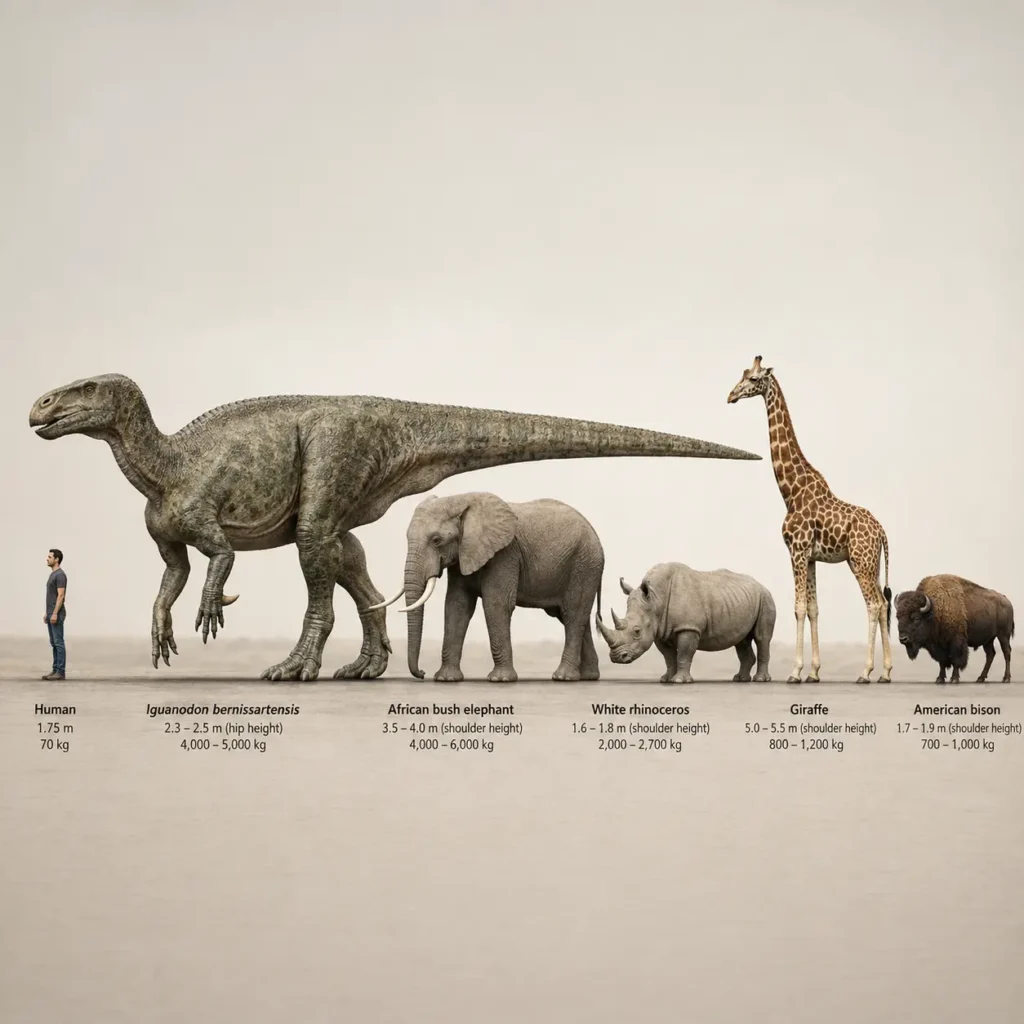
| African Elephant (Loxodonta africana) | 6–7.5 m | 4–7 tonnes | Similar body mass but considerably shorter |
| White Rhinoceros (Ceratotherium simum) | 3.5–4.5 m | 1.8–2.7 tonnes | Much shorter and lighter |
| Giraffe (Giraffa camelopardalis) | 5–6 m tall | 800–1,900 kg | Much lighter despite greater height |
| Hippopotamus (Hippopotamus amphibius) | 3.5–5 m | 1.5–3 tonnes | More compact and generally lighter |
Ecological and Anatomical Differences
Comparisons with modern animals provide useful context for understanding the size of Iguanodon, although no living species represents a close ecological or anatomical equivalent.
The African elephant is the closest modern comparison in terms of body mass. Mature elephants commonly weigh within or above the estimated mass range of Iguanodon, yet their bodies are considerably shorter and supported by column-like limbs adapted for graviportal locomotion. In contrast, Iguanodon possessed a long tail, elongated trunk, and hind limbs capable of both quadrupedal and bipedal movement.
White rhinoceroses approach the lower end of Iguanodon‘s estimated mass but are far more compact animals. Their barrel-shaped bodies resemble Iguanodon superficially in robustness, but their anatomy reflects a mammalian lineage with a completely different posture, gait, and feeding strategy.
Giraffes exceed Iguanodon in height because of their elongated necks and limbs, yet they weigh less than half as much. This comparison highlights the distinction between overall height and total body mass.
Hippopotamuses are among the heaviest living terrestrial herbivores but possess extremely compact bodies adapted for semi-aquatic life. Despite overlapping body masses with smaller estimates for Iguanodon, their proportions and ecology differ substantially.
These comparisons illustrate that Iguanodon combined the body mass of today’s largest terrestrial mammals with a uniquely dinosaurian body plan characterized by a long balancing tail, powerful hind limbs, and a deep herbivorous torso.
Scientific Debate
Largest Credible Size Estimates
Most modern studies estimate adult Iguanodon bernissartensis at 9–11 metres in length and 3–5 tonnes in body mass. Historical estimates exceeding 12 metres or substantially greater body masses are generally considered unreliable because they were based on incomplete fossil material, outdated reconstructions, or assumptions that predate modern anatomical understanding.
Although exceptionally large individuals may have existed, no articulated skeleton currently provides definitive evidence for specimens substantially exceeding the accepted size range.
Variation Between Specimens
Like modern large vertebrates, individual Iguanodon specimens differed in overall size and robustness. Some variation reflects biological factors such as age, sex, and individual development, while other differences arise from fossil preservation and reconstruction.
The Bernissart assemblage includes multiple individuals, allowing palaeontologists to distinguish normal biological variation from measurement error. Nevertheless, the available evidence indicates that adult Iguanodon exhibited relatively consistent body proportions.
Taxonomic Revisions Affecting Size Estimates
Historically, numerous species were assigned to Iguanodon, many based on fragmentary fossils. As systematic revisions progressed, several of these species were reassigned to separate genera, including Mantellisaurus.
These taxonomic changes influenced published size estimates because measurements from different animals were no longer combined under a single genus. Modern estimates focus primarily on Iguanodon bernissartensis, resulting in a more consistent and scientifically robust understanding of its adult size.
Limitations of Body Mass Reconstruction
Estimating the body mass of extinct animals remains inherently uncertain because muscles, fat, skin, and internal organs are rarely preserved.
Modern volumetric reconstructions are constrained by complete skeletons and validated using biomechanical principles, but they still require assumptions regarding:
- Muscle volume
- Soft tissue thickness
- Respiratory anatomy
- Tissue density
- Body shape
For this reason, published body mass values should be interpreted as scientifically informed estimates rather than precise measurements.
Remaining Uncertainties
Although Iguanodon is one of the best-known ornithopods, several questions remain:
- The maximum size attained by the largest individuals.
- Possible sexual differences in body size.
- Regional variation among populations.
- Growth rates during different life stages.
- Soft tissue distribution affecting body mass.
- The influence of taxonomy on fragmentary specimens.
Future discoveries and improved digital reconstruction techniques may refine these estimates further.
Evidence Strength
High
Evidence Assessment
Current scientific debate concerns the precision of size estimates rather than whether Iguanodon was a large-bodied ornithopod. Adult length is strongly constrained by articulated skeletons, whereas body mass remains partially dependent on modelling assumptions. Taxonomic revisions have significantly improved estimate reliability by restricting modern analyses primarily to Iguanodon bernissartensis.
Current Scientific Understanding
Modern research indicates that Iguanodon bernissartensis consistently reached lengths of approximately 9–11 metres and body masses of 3–5 tonnes, making it one of the largest known non-hadrosaurian ornithopods.
The exceptional Bernissart skeletons provide one of the strongest fossil datasets available for reconstructing dinosaur size. Combined with digital modelling, comparative anatomy, and biomechanical analyses, these specimens have produced a scientific consensus that is considerably more robust than historical estimates.
Although future discoveries may refine estimates for exceptionally large individuals or improve body mass modelling, the overall size range of Iguanodon is unlikely to change substantially because it is supported by abundant, well-preserved fossil material.
Frequently Asked Questions
How long was Iguanodon?
Most adult Iguanodon bernissartensis measured between 9 and 11 metres (30–36 feet).
How much did Iguanodon weigh?
Current estimates place adult body mass between 3 and 5 tonnes, although exact weight cannot be measured directly.
Was Iguanodon larger than an elephant?
It was generally longer than an African elephant but often similar in body mass. Their body shapes, however, were fundamentally different.
Was Iguanodon larger than a rhinoceros?
Yes. Adult Iguanodon was substantially longer and significantly heavier than even the largest living rhinoceroses.
How do scientists estimate the size of Iguanodon?
Researchers combine measurements from complete skeletons with volumetric reconstruction, scaling equations, and biomechanical modelling to estimate body dimensions and mass.
Why do different studies report different weights?
Body mass depends on reconstructed soft tissues rather than preserved fossils. Different assumptions about muscle volume and body shape produce slightly different estimates.
Did all Iguanodon individuals reach the same size?
No. Juveniles, subadults, and adults differed considerably in size, and adult individuals also showed normal biological variation.
Is the Bernissart material important for size estimates?
Yes. The Bernissart skeletons are among the most complete dinosaur fossil assemblages ever discovered and provide the primary evidence for modern size reconstructions.
Could Iguanodon have been larger than current estimates?
Possibly, but no articulated specimen currently demonstrates dimensions substantially exceeding the accepted range.
Which aspect of Iguanodon‘s size is least certain?
Body mass remains less certain than body length because muscles and other soft tissues must be reconstructed rather than measured directly.
References
Primary Literature
- Mantell, G. A. (1825). Notice on the Iguanodon, a newly discovered fossil reptile from the sandstone of Tilgate Forest, Sussex. Philosophical Transactions of the Royal Society of London, 115, 179–186.
- Dollo, L. (1882–1885). Première note sur les dinosauriens de Bernissart. Bulletin du Musée royal d’Histoire naturelle de Belgique.
- Norman, D. B. (1980). On the ornithischian dinosaur Iguanodon bernissartensis from the Lower Cretaceous of Bernissart (Belgium). Institut royal des Sciences naturelles de Belgique.
- Norman, D. B. (1986). On the anatomy of Iguanodon atherfieldensis (Ornithischia: Ornithopoda). Bulletin de l’Institut Royal des Sciences Naturelles de Belgique.
- Norman, D. B. (1987). A mass accumulation of vertebrates from the Lower Cretaceous of Nehden (Sauerland), West Germany. Proceedings of the Royal Society B.
- Norman, D. B. (1988). A review of the family Iguanodontidae and its relationships. In The Phylogeny and Classification of the Tetrapods.
Body Size and Mass Estimation
- Bates, K. T., Manning, P. L., Hodgetts, D., & Sellers, W. I. (2009). Estimating mass properties of dinosaurs using laser imaging and 3D volumetric reconstruction. PLoS ONE, 4(2), e4532.
- Campione, N. E., & Evans, D. C. (2012). A universal scaling relationship between body mass and limb bone circumference in quadrupedal terrestrial tetrapods. BMC Biology, 10, 60.
- Campione, N. E., & Evans, D. C. (2020). Reviews of dinosaur body-mass estimation and scaling methodology.
- Benson, R. B. J., Campione, N. E., Carrano, M. T., et al. (2014). Rates of dinosaur body mass evolution indicate 170 million years of sustained ecological innovation on the avian stem lineage. PLoS Biology, 12(5), e1001853.
Biomechanics and Locomotion
- Sellers, W. I., Manning, P. L., Crompton, R. H., & colleagues. Studies on dinosaur locomotion using musculoskeletal computer models.
- Bates, K. T., Falkingham, P. L., Macaulay, S., et al. Studies on centre of mass and locomotor biomechanics in dinosaurs.
- Hutchinson, J. R. Selected publications on dinosaur locomotion, limb mechanics, and musculoskeletal reconstruction.
Growth and Ontogeny
- Erickson, G. M. Selected studies on dinosaur growth rates and life history.
- Horner, J. R., Padian, K., & de Ricqlès, A. Selected studies on dinosaur bone histology and ontogeny.
- Woodward, H. N., Freedman Fowler, E. A., & colleagues. Reviews of dinosaur growth and skeletal development.
Ornithopod Evolution and Systematics
- Norman, D. B. (2004). Basal Iguanodontia. In The Dinosauria (2nd ed.). University of California Press.
- McDonald, A. T. (2012). Phylogeny and systematics of Styracosterna (Dinosauria: Ornithopoda). PLoS ONE, 7, e50673.
- Verdú, F. J., Royo-Torres, R., & Cobos, A. (2015). Studies on basal styracosternan phylogeny.
- Boyd, C. A. (2015). Reviews of ornithopod systematics and evolutionary history.
Comparative Anatomy
- Maidment, S. C. R., Barrett, P. M., & colleagues. Reviews of ornithopod skeletal anatomy.
- Galton, P. M. Selected publications on ornithopod anatomy and taxonomy.
- Sereno, P. C. Works on ornithischian phylogeny and anatomical terminology.
Standard Reference Works
- Weishampel, D. B., Dodson, P., & Osmólska, H. (eds.). (2004). The Dinosauria (2nd ed.). University of California Press.
- Paul, G. S. (2016). The Princeton Field Guide to Dinosaurs (2nd ed.). Princeton University Press.
- Holtz, T. R. Jr. (latest edition). Dinosaurs: The Most Complete, Up-to-Date Encyclopedia for Dinosaur Lovers of All Ages.
- Brusatte, S. L. (2018). The Rise and Fall of the Dinosaurs. William Morrow.
Featured Museum Collections
Museum-quality paleoart and educational poster
collections based on evidence-informed prehistoric
Life reconstructions.