
Quick Answer
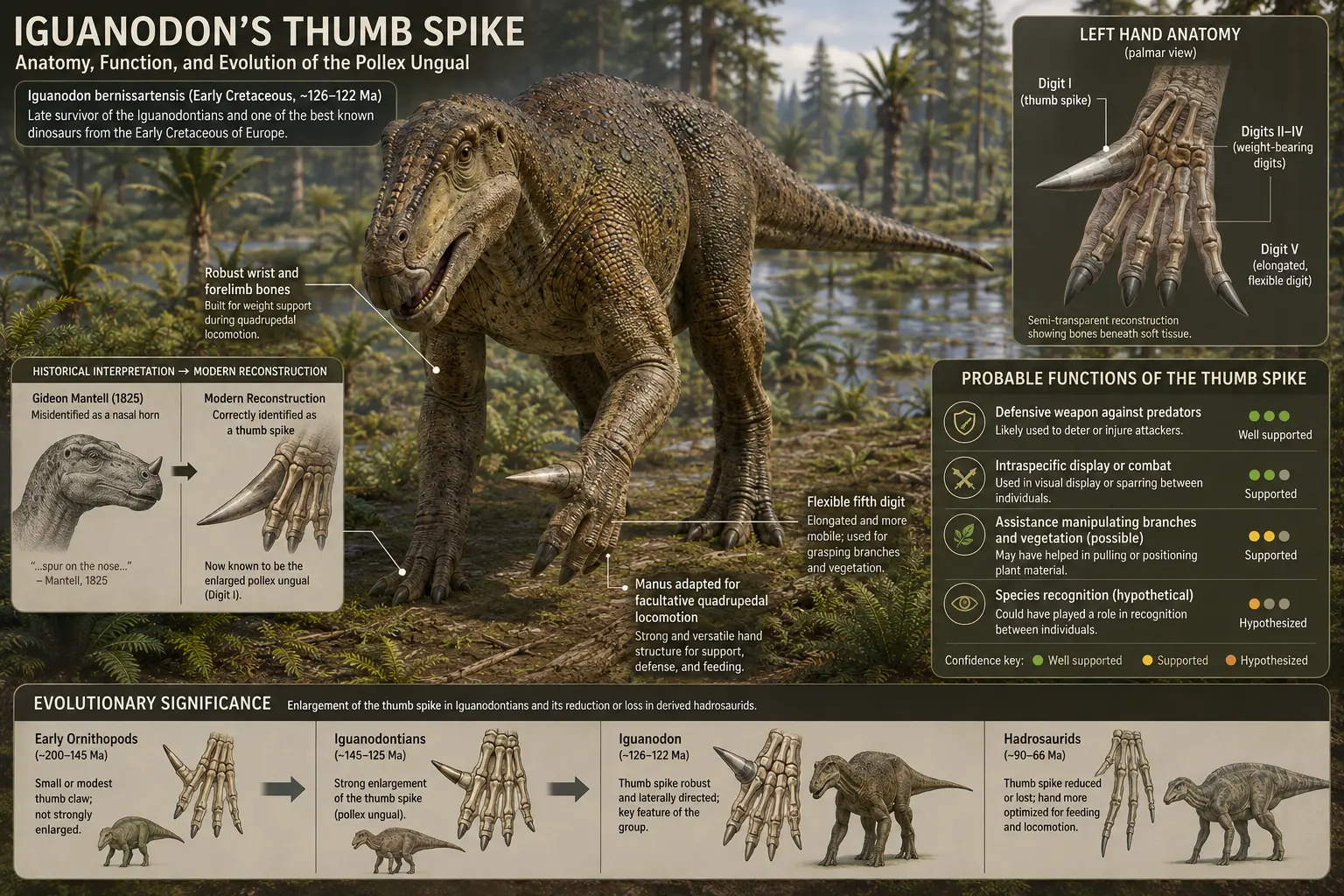
The thumb spike of Iguanodon was a large, conical spike formed by the modified first digit (thumb) of the hand. Once mistakenly reconstructed as a horn on the animal’s nose, it is now recognized as one of the defining anatomical features of iguanodontian dinosaurs. Although its exact function remains uncertain, current evidence strongly suggests that it served primarily as a defensive weapon, while also potentially playing roles in intraspecific interactions and display. The thumb spike represents an important evolutionary adaptation that distinguished Iguanodon from both earlier ornithopods and later hadrosaurids.

Thumb Spike Summary
| Characteristic | Information |
|---|---|
| Structure | Modified thumb (Digit I) forming a large conical spike |
| Bone Type | Enlarged ungual (terminal phalanx) |
| Position | First digit of the forelimb |
| Composition | Bone covered by a keratin sheath in life |
| Estimated Length | Approximately 15–20 cm in large adults (bony core) |
| Primary Proposed Function | Defence |
| Secondary Proposed Functions | Display, combat between individuals, possible foraging assistance |
| Scientific Certainty | High for anatomy; moderate for function |
Introduction
Few dinosaur anatomical features are as iconic as the thumb spike of Iguanodon. Since its discovery in the nineteenth century, this distinctive structure has played a central role in understanding the anatomy, evolution, and behaviour of ornithopod dinosaurs.
The thumb spike is particularly significant because it illustrates how scientific interpretations change as new fossil evidence becomes available. Initially reconstructed as a nasal horn, it was only after the discovery of complete articulated skeletons at Bernissart that palaeontologists correctly identified it as a specialized thumb claw.
Today, the thumb spike is recognised as one of the defining characteristics of Iguanodon. Although its anatomy is well understood from numerous fossil specimens, its precise biological function continues to be investigated through anatomical comparisons, biomechanical analyses, and studies of living animals.
What Was the Thumb Spike?
Thumb Spike Anatomy Summary
| Feature | Description |
|---|---|
| Position | First digit (Digit I) of the hand |
| Bone Identity | Enlarged terminal ungual (thumb claw) |
| Shape | Robust, conical, sharply pointed |
| Size | Approximately 15–20 cm bony core in large adults; larger when covered by keratin |
| Composition | Dense bone supporting a keratin sheath during life |
| Preservation | Preserved in numerous articulated skeletons, particularly from Bernissart |
Discovery History Summary
| Year | Scientist | Interpretation |
|---|---|---|
| 1825 | Gideon Mantell | Isolated spike interpreted as a horn-like structure |
| 1834 | Gideon Mantell | Continued uncertainty regarding anatomical position |
| 1878 | Discovery at Bernissart | Complete skeletons revealed the spike belonged to the thumb |
| 1880s | Louis Dollo | Correct anatomical reconstruction established |
| Modern Research | Numerous researchers | Thumb spike recognised as a specialised manual adaptation with multiple possible functions |
Scientific Explanation
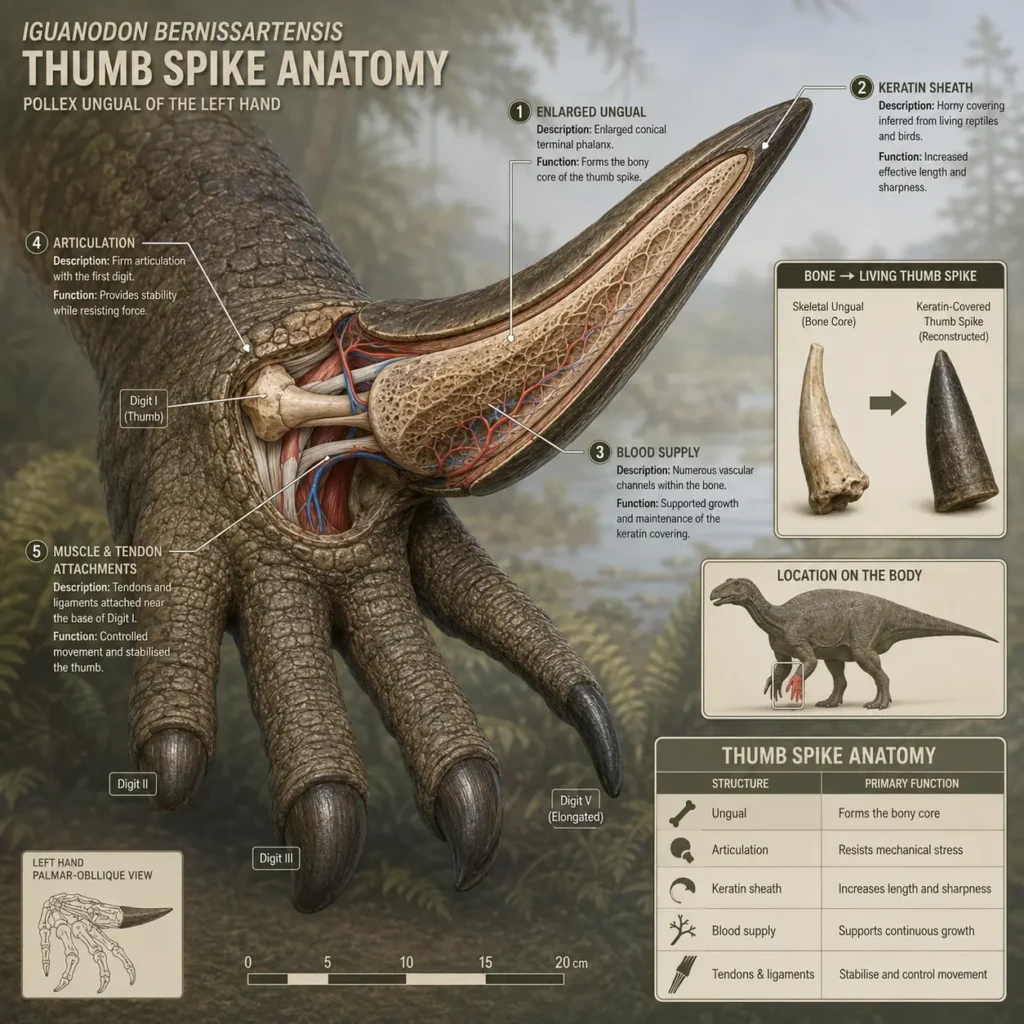
The thumb spike is one of the most distinctive features of Iguanodon and is formed by the greatly enlarged ungual bone of the first digit. Unlike the broad, weight-bearing fingers that supported locomotion, the thumb projected laterally from the hand as a stout, sharply pointed spike.
Its robust construction indicates that it was capable of resisting considerable mechanical stress. The bony core would almost certainly have been covered by a keratin sheath during life, increasing both its length and sharpness in much the same way that claws and horns are enlarged in many living vertebrates.
The history of its discovery is equally significant. Gideon Mantell originally interpreted the isolated spike as a nasal horn because no articulated skeletons were known. This reconstruction persisted until the remarkable Bernissart discoveries of 1878, where dozens of articulated skeletons preserved the hand in its natural position. Louis Dollo subsequently demonstrated that the spike belonged to the thumb, fundamentally changing scientific understanding of Iguanodon anatomy.
Today, the thumb spike is regarded as one of the defining anatomical characteristics of iguanodontian dinosaurs and an important example of how exceptional fossil discoveries can overturn long-standing scientific interpretations.
Evidence Strength
Very High
Evidence Assessment
The anatomy and anatomical position of the thumb spike are supported by numerous exceptionally preserved articulated skeletons, making this one of the best-documented skeletal features of Iguanodon. Historical interpretations are also well documented through nineteenth-century scientific publications. While the existence and structure of the thumb spike are unequivocal, aspects of its biological function remain less certain.
Anatomy of the Thumb Spike
Anatomical Features Summary
| Structure | Description | Function |
|---|---|---|
| Ungual | Enlarged conical terminal phalanx | Forms the bony core of the thumb spike |
| Articulation | Firm articulation with the first digit | Provides stability while resisting force |
| Keratin Sheath | Horny covering inferred from living reptiles and birds | Increased effective length and sharpness |
| Blood Supply | Numerous vascular channels within the bone | Supported growth and maintenance of the keratin covering |
| Muscle Attachment | Tendons and ligaments attached to the base of the digit | Controlled movement and stabilised the thumb |
Comparison with Other Digits Summary
| Digit | Structure | Primary Function |
|---|---|---|
| I (Thumb) | Large conical spike | Defence and specialised manipulation |
| II | Robust finger with hoof-like ungual | Weight support and locomotion |
| III | Largest weight-bearing digit | Primary support during quadrupedal movement |
| IV | Broad supportive digit | Weight distribution and stability |
| V | Flexible fifth finger | Grasping vegetation and limited manipulation |
Scientific Explanation
The hand of Iguanodon was highly specialised, with each digit performing a distinct function. Unlike the weight-bearing central fingers, the thumb evolved into a rigid spike that projected away from the rest of the hand.
The thumb spike itself consisted of an enlarged ungual bone that was considerably more robust than the claws on the other digits. Internal vascular channels indicate that it supported living tissues during life and almost certainly carried a keratin sheath similar to those found in modern reptiles and birds. This sheath would have increased both its length and effectiveness.
The remaining fingers demonstrate functional differentiation within the hand. Digits II, III, and IV formed a broad, weight-bearing structure suitable for quadrupedal locomotion, while the elongated fifth digit retained considerable flexibility and may have assisted in grasping branches or manipulating vegetation.
This remarkable division of labour made the forelimb one of the most specialised appendages among Early Cretaceous herbivorous dinosaurs.
Evidence Strength
Very High
Evidence Assessment
The anatomy of the hand is exceptionally well documented through articulated skeletons from Bernissart and numerous additional specimens. Functional interpretations of the keratin sheath, blood supply, and muscle attachments rely partly on comparative anatomy with living vertebrates, but these inferences are strongly supported by the preserved bone morphology. Overall, the anatomical reconstruction of the thumb spike is considered highly reliable.
How Was the Thumb Spike Used?
Functional Hypotheses Summary
| Proposed Function | Supporting Evidence | Current Support |
|---|---|---|
| Defence | Robust spike, strong forelimbs, strategic position | High |
| Intraspecific Display | Prominent visible structure | Moderate |
| Combat Between Individuals | Similar structures used in modern animals | Moderate |
| Foraging | Possible manipulation of branches or vegetation | Low to Moderate |
| Climbing | No supporting anatomical evidence | Very Low |
| Digging | Limited biomechanical support | Low |
Biomechanical Evidence Summary
| Feature | Functional Implication |
|---|---|
| Robust Construction | Capable of withstanding substantial mechanical loads |
| Limited Range of Motion | Optimised for forceful thrusting rather than grasping |
| High Resistance to Bending | Suitable for resisting impact forces |
| Lateral Position on Hand | Effective defensive orientation during close encounters |
Scientific Explanation
The precise function of the thumb spike remains one of the most widely discussed aspects of Iguanodon biology. Although several hypotheses have been proposed, the majority of current evidence favours a defensive role.
Its robust construction, reinforced articulation, and prominent position on the hand would have made it an effective weapon against predators. During a defensive encounter, Iguanodon could potentially have used powerful forelimb movements to thrust or slash with the spike while maintaining stability on either two or four limbs.
The thumb spike may also have played a role in interactions between members of the same species. Many living animals possess enlarged anatomical structures that function in display or ritualised combat, and similar behaviours have been suggested for Iguanodon. However, direct evidence for these behaviours has not been preserved.
Alternative hypotheses include using the spike to manipulate vegetation or assist with foraging. While these ideas are mechanically plausible, current anatomical and biomechanical evidence provides less support than the defensive interpretation. Suggestions that the thumb spike was used for climbing or extensive digging are generally regarded as unlikely because the forelimb anatomy is poorly suited to these activities.
Overall, the thumb spike most likely served multiple functions during the animal’s lifetime, with defence representing its primary evolutionary advantage.
Evidence Strength
Moderate to High
Evidence Assessment
The defensive interpretation is supported by the thumb spike’s robust anatomy, biomechanical modelling, and comparisons with functional structures in living vertebrates. However, because behaviour rarely fossilizes, all functional hypotheses remain inferential. Current evidence strongly supports the thumb spike’s capability to withstand substantial forces but cannot determine with certainty how frequently it was used for defence, display, combat, or other behaviours.
Evolution of the Thumb Spike
Evolutionary Development Summary
| Group | Thumb Condition | Evolutionary Trend |
|---|---|---|
| Basal Ornithischians | Small clawed thumb | Generalized grasping and support |
| Early Ornithopods | Slightly enlarged thumb claw | Beginning of thumb specialization |
| Basal Iguanodontians | Enlarged conical thumb spike | Development of specialized defensive structure |
| Iguanodon | Large robust thumb spike | Peak development of the iguanodontian thumb spike |
| Hadrosauriforms | Reduced thumb spike | Declining importance of the thumb |
| Hadrosaurids | Thumb greatly reduced or absent | Evolution toward specialized grazing forelimbs |
Comparative Anatomy Summary
| Taxon | Thumb Structure | Similarities | Differences |
|---|---|---|---|
| Camptosaurus | Enlarged thumb claw | Early thumb specialization | Smaller and less robust |
| Mantellisaurus | Prominent thumb spike | Nearly identical overall anatomy | More slender proportions |
| Ouranosaurus | Large thumb spike | Robust conical spike | Different forelimb proportions |
| Iguanodon | Large conical thumb spike | Highly specialized | One of the best-developed thumb spikes |
| Hadrosaurids | Reduced thumb | Shared ornithopod ancestry | Thumb no longer formed a defensive spike |
Scientific Explanation
The thumb spike evolved gradually during the diversification of ornithopod dinosaurs rather than appearing suddenly in Iguanodon. Early ornithischians possessed relatively unspecialized hands with modest clawed digits used primarily for locomotion and simple manipulation.
As iguanodontians evolved larger body sizes and more advanced herbivorous adaptations, the first digit became increasingly specialized. The thumb transformed from a conventional claw into a stout conical spike capable of resisting substantial mechanical forces. This modification coincided with other changes in the forelimb, including stronger weight-bearing fingers and a more flexible fifth digit, producing a highly specialized hand with distinct functional roles for each digit.
Iguanodon represents one of the clearest examples of this evolutionary trend. Its thumb spike is considerably more robust than those of earlier ornithopods and demonstrates the highest degree of specialization among classic iguanodontians.
Later hadrosauriforms and hadrosaurids followed a different evolutionary pathway. As their feeding systems became increasingly sophisticated through the development of complex dental batteries, the thumb gradually lost its enlarged spike-like form. In these later dinosaurs, the forelimb became more specialized for locomotion than defence, illustrating that evolutionary innovations can both arise and disappear as ecological pressures change.
The evolutionary history of the thumb spike therefore reflects broader changes in ornithopod anatomy, ecology, and behaviour throughout the Cretaceous.
Evidence Strength
High
Evidence Assessment
The evolution of the thumb spike is supported by numerous fossil taxa spanning ornithopod evolution and by modern phylogenetic analyses. Anatomical changes can be traced directly through preserved skeletal material, although the selective pressures driving these modifications remain partly inferential. Overall, the evolutionary sequence is well supported, while functional explanations remain hypotheses based on comparative anatomy and biomechanics.
Fossil Evidence
Important Specimens Summary
| Specimen | Locality | Importance |
|---|---|---|
| Bernissart Skeletons | Bernissart, Belgium | Preserve complete articulated hands showing the thumb spike in life position |
| NHMUK R5764 (Mantell Specimen) | Isle of Wight, England | Well-preserved hand contributing to anatomical interpretation |
| IRSNB Iguanodon Skeletons | Royal Belgian Institute of Natural Sciences | Multiple complete specimens allowing comparison of thumb anatomy |
| Wealden Specimens | Southern England | Demonstrate variation within the genus and confirm thumb morphology |
Preservation Summary
| Fossil Element | Preservation Quality | Scientific Value |
|---|---|---|
| Thumb Ungual | Excellent | Defines spike morphology |
| Manual Skeleton | Excellent in articulated specimens | Demonstrates digit arrangement |
| Articular Surfaces | Very Good | Reveals joint mechanics |
| Internal Bone Structure | Good | Indicates strength and vascularization |
| Keratin Sheath | Not preserved | Inferred from bone anatomy and living analogues |
Scientific Explanation
The thumb spike is among the best-preserved anatomical features of Iguanodon. The discovery of numerous articulated skeletons at Bernissart revolutionized scientific understanding by preserving the hand in its natural anatomical position. Before this discovery, isolated thumb spikes had been incorrectly reconstructed as nasal horns because their true location within the skeleton was unknown.
The Bernissart specimens demonstrated conclusively that the spike belonged to the first digit of the hand. Their exceptional preservation also revealed the relative positions of the remaining fingers, confirming that the thumb projected laterally while the central digits supported body weight.
Additional specimens from England and elsewhere in Europe have consistently confirmed this interpretation. Differences between individuals are generally limited to body size and minor anatomical variation rather than fundamental differences in thumb structure.
Although soft tissues such as the keratin sheath have not been preserved, the texture and vascular channels within the ungual strongly indicate that the bony spike supported a living keratin covering. This reconstruction is supported by comparisons with claws and horns in living reptiles and birds.
Together, these fossils provide one of the clearest examples of how exceptional preservation can transform scientific understanding of dinosaur anatomy.
Evidence Strength
Very High
Evidence Assessment
Evidence for the anatomy of the thumb spike is exceptionally strong because numerous articulated skeletons preserve the hand in its natural position. The absence of preserved soft tissues introduces some uncertainty regarding the precise size and shape of the keratin sheath, but the skeletal anatomy itself is among the best-documented features of Iguanodon. Consequently, interpretations of thumb morphology are considered highly reliable.
Comparison with Other Dinosaurs
Dinosaur Comparison Summary
| Dinosaur | Thumb Anatomy | Probable Function |
|---|---|---|
| Camptosaurus | Enlarged thumb claw | Defence and limited manipulation |
| Mantellisaurus | Robust thumb spike | Defence and possible display |
| Ouranosaurus | Large conical thumb spike | Defence and social interactions |
| Iguanodon | Highly developed thumb spike | Primarily defence; possible display and combat |
| Hadrosaurus | Reduced thumb | Limited functional role |
| Edmontosaurus | Greatly reduced thumb | Locomotion rather than weaponry |
Evolutionary Innovation Summary
| Group | Hand Adaptation |
|---|---|
| Basal Ornithischians | Generalized grasping hand |
| Early Ornithopods | Enlarged thumb claw begins to develop |
| Iguanodontians | Specialized defensive thumb spike and differentiated digits |
| Hadrosauriforms | Increased forelimb support with reduced thumb |
| Hadrosaurids | Highly specialized weight-bearing forelimb with minimal thumb function |
Scientific Explanation
The thumb spike distinguishes Iguanodon from many other herbivorous dinosaurs and represents one of the defining innovations of iguanodontian evolution. While earlier ornithopods possessed enlarged thumb claws, Iguanodon exhibits one of the most robust and specialized examples known.
Close relatives such as Mantellisaurus and Ouranosaurus evolved similar thumb spikes, suggesting that this adaptation was characteristic of advanced iguanodontians rather than unique to a single genus. These similarities support the hypothesis that the thumb spike played an important functional role throughout the group.
In contrast, later hadrosaurids underwent a different evolutionary trajectory. Their forelimbs became increasingly specialized for quadrupedal locomotion, while feeding efficiency shifted toward the skull through the evolution of extensive dental batteries. As a result, the thumb gradually lost its enlarged spike-like form and became greatly reduced.
This comparison illustrates that evolutionary innovation is not always permanent. The thumb spike became highly specialized in iguanodontians but was subsequently reduced as changing ecological pressures favoured alternative anatomical solutions.
Evidence Strength
High
Evidence Assessment
Comparisons among ornithopods are supported by abundant fossil material and well-established phylogenetic relationships. Differences in thumb anatomy can be observed directly in preserved skeletons, while functional interpretations rely on comparative biomechanics and evolutionary context. The anatomical evidence is strong, whereas the precise behavioural significance of these evolutionary changes remains less certain.
Comparison with Modern Animals
Modern Animal Comparison Summary
| Animal | Comparable Structure | Primary Function | Comparison with Iguanodon |
|---|---|---|---|
| Rhinoceros | Horn | Defence and intraspecific combat | Similar defensive role but composed entirely of keratin rather than bone with a keratin sheath |
| Monitor Lizard (Varanus) | Enlarged claws | Climbing, digging, defence | Similar claw composition but different hand function and mobility |
| Cassowary | Inner toe claw | Defence | Similar use as a defensive weapon but located on the foot rather than the hand |
| Horned Chameleon | Cranial horns | Display and combat | Comparable display structure but anatomically unrelated |
| Pangolin | Large forelimb claws | Digging and defence | Similar robust claws but adapted for excavation rather than a specialized thumb spike |
Functional Comparison Summary
| Animal | Similar Structure | Major Difference |
|---|---|---|
| Rhinoceros | Horn | Horn develops on the skull and lacks a bony core equivalent to the thumb spike |
| Monitor Lizard | Claw | Used primarily for climbing and prey handling rather than as a dedicated thumb weapon |
| Cassowary | Inner toe claw | Located on the hind limb instead of the forelimb |
| Horned Chameleon | Horn | Cranial ornament rather than a modified digit |
| Pangolin | Enlarged claws | Adapted for digging rather than defence through thrusting |
Scientific Explanation
No living animal possesses a structure directly homologous to the thumb spike of Iguanodon. Nevertheless, several modern species provide useful functional comparisons that help palaeontologists evaluate its possible roles.
The rhinoceros offers perhaps the closest behavioural analogue because its horn functions primarily in defence and contests between individuals. Although the rhinoceros horn differs structurally, being composed entirely of keratin rather than bone, both structures are robust projections capable of resisting substantial forces.
Monitor lizards and pangolins possess powerful claws that demonstrate how enlarged keratin-covered unguals can withstand repeated mechanical stress. However, these claws are primarily adapted for climbing, digging, or prey capture rather than functioning as specialised defensive spikes.
The cassowary’s enlarged inner toe claw provides another useful comparison because it serves as an effective defensive weapon. Unlike the thumb spike, however, it is located on the hind limb and is employed during kicking rather than forelimb movements.
These comparisons illustrate that similar functional adaptations have evolved independently in many vertebrate groups through convergent evolution. Although none precisely replicate the anatomy of Iguanodon, they provide valuable insight into how robust pointed structures can evolve for defence, display, or competition.
Scientific Debate
Scientific Debate Summary
| Question | Current Consensus | Confidence |
|---|---|---|
| Primary function | Defence is the leading hypothesis | High |
| Defence vs. display | Defence likely primary; display possible | Moderate |
| Predator deterrence | Probably contributed to defence | Moderate to High |
| Social interactions | Possible but unconfirmed | Moderate |
| Keratin sheath size | Present and larger than the bony core | Moderate |
| Range of motion | Limited but sufficient for forceful use | High |
Competing Hypotheses Summary
| Topic | Hypothesis | Supporting Evidence |
|---|---|---|
| Primary Function | Defensive weapon | Robust construction, biomechanics, strategic position |
| Primary Function | Multi-purpose structure | Combination of anatomy and behavioural analogues |
| Defence vs. Display | Primarily defence | Mechanical strength exceeds display requirements |
| Defence vs. Display | Primarily display | Prominent visible structure and comparison with living animals |
| Predator Deterrence | Active defensive weapon | Reinforced thumb anatomy and powerful forelimbs |
| Social Interactions | Ritualised combat between individuals | Analogies with modern horned and antlered animals |
| Keratin Sheath Size | Large keratin covering increased spike length | Bone texture and comparison with living reptiles and birds |
| Range of Motion | Limited movement for powerful thrusting | Joint anatomy and articulation surfaces |
Scientific Explanation
Although the anatomy of the thumb spike is well understood, its biological function remains one of the most actively discussed aspects of Iguanodon biology.
Most researchers regard defence as its principal function. The spike’s robust construction, reinforced articulation, and position at the front of the hand would have allowed it to resist substantial impact forces. Biomechanical analyses support the idea that it could withstand loading consistent with defensive use.
However, defence may not have been its only purpose. Prominent anatomical structures in many living vertebrates also function in display, species recognition, or ritualised combat. It is therefore plausible that the thumb spike served multiple roles depending on behavioural context.
The size of the keratin sheath also remains uncertain because keratin rarely fossilises. The preserved bone almost certainly supported a larger horny covering, but exactly how much additional length it contributed cannot be determined from fossils alone.
Similarly, the thumb’s range of motion is reconstructed from preserved joints and surrounding anatomy. Current evidence indicates that movement was relatively limited, suggesting the spike functioned best as a rigid stabbing or bracing structure rather than a flexible grasping digit.
Overall, scientific debate concerns behavioural interpretation rather than anatomical reconstruction. The thumb spike itself is unequivocally present, while its precise use remains an evidence-based inference.
Evidence Strength
High
Evidence Assessment
The anatomical evidence for the thumb spike is exceptionally strong, whereas behavioural interpretations necessarily rely on biomechanical modelling, comparative anatomy, and functional inference. Defence currently receives the greatest support because it best matches the spike’s morphology and mechanical properties, but secondary functions such as display or social interactions cannot be excluded. Consequently, confidence is high for anatomy and moderate for behavioural function.
Current Scientific Understanding
Current Consensus Summary
| Topic | Current Scientific Understanding |
|---|---|
| Anatomical Identity | Modified first manual digit forming a large thumb spike |
| Bone Composition | Enlarged ungual supporting a keratin sheath |
| Evolution | Specialized feature of advanced iguanodontians |
| Primary Function | Most likely defence |
| Secondary Functions | Possible display, combat, and limited foraging assistance |
| Fossil Evidence | Exceptionally well documented from articulated skeletons |
| Functional Certainty | High for anatomy; moderate for behaviour |
Modern research identifies the thumb spike as one of the defining anatomical innovations of Iguanodon and other advanced iguanodontians. Its anatomy is exceptionally well documented by articulated skeletons, leaving little doubt about its identity, structure, and position within the hand.
The greatest uncertainty concerns behaviour. Current evidence strongly favours a defensive function because of the spike’s robust morphology and biomechanical properties, but additional roles in display or social interactions remain plausible. Rather than representing a single-purpose adaptation, the thumb spike may have fulfilled several functions during the animal’s lifetime, as is common among specialised structures in living vertebrates.
Frequently Asked Questions
Was the thumb spike really a thumb?
Yes. It was formed by the modified first digit (Digit I) of the hand and is now recognised as the enlarged thumb claw.
Why did early scientists think it was a horn?
The first thumb spike was discovered as an isolated fossil. Without an articulated skeleton for comparison, Gideon Mantell interpreted it as a horn positioned on the animal’s nose.
How was the mistake corrected?
The discovery of articulated skeletons at Bernissart in 1878 showed the spike attached to the first digit of the hand, allowing Louis Dollo to reconstruct it correctly.
How large was the thumb spike?
The bony core measured approximately 15–20 cm in large adults, with a keratin sheath likely making it somewhat longer in life.
Was it covered in keratin?
Almost certainly. Bone texture and comparisons with living reptiles and birds strongly indicate that the bony spike supported a keratin sheath.
What was its main purpose?
Most evidence supports a defensive role, although display, combat between individuals, and limited foraging functions have also been proposed.
Could Iguanodon stab predators with it?
It is mechanically capable of resisting substantial forces, making defensive thrusting a plausible interpretation, although this behaviour cannot be observed directly in the fossil record.
Did all Iguanodon species have thumb spikes?
The thumb spike is a defining characteristic of advanced iguanodontians, including Iguanodon bernissartensis, although its size and proportions varied among related taxa.
Did later hadrosaurs have thumb spikes?
No. In hadrosaurids, the thumb became greatly reduced as the forelimb evolved toward greater locomotor specialization.
Is the thumb spike unique among dinosaurs?
It is one of the most distinctive manual adaptations known in dinosaurs and remains a defining feature of iguanodontians, although other dinosaur groups evolved different types of claws, horns, and defensive structures.
References
Primary Literature
- Mantell, G. A. (1825). Notice on the Iguanodon, a newly discovered fossil reptile from the sandstone of Tilgate Forest, Sussex. Philosophical Transactions of the Royal Society of London, 115, 179–186.
- Dollo, L. (1882). Première note sur les dinosauriens de Bernissart. Bulletin du Musée royal d’Histoire naturelle de Belgique.
- Dollo, L. (1883). Iguanodontidae et leurs rapports avec les reptiles actuels. Bulletin du Musée royal d’Histoire naturelle de Belgique.
- Norman, D. B. (1980). On the ornithischian dinosaur Iguanodon bernissartensis from the Lower Cretaceous of Bernissart (Belgium). Institut royal des Sciences Naturelles de Belgique, Mémoire 178.
- Norman, D. B. (1986). On the anatomy of Iguanodon atherfieldensis (Ornithischia: Ornithopoda). Bulletin de l’Institut Royal des Sciences Naturelles de Belgique, Sciences de la Terre, 56, 281–372.
Functional Anatomy and Biomechanics
- Barrett, P. M., & Rayfield, E. J. Selected studies on ornithischian functional morphology and feeding mechanics.
- Bates, K. T., Manning, P. L., Sellers, W. I., & colleagues. Selected publications on dinosaur biomechanics, forelimb function, and musculoskeletal reconstruction.
- Hutchinson, J. R. Selected studies on dinosaur limb mechanics and functional anatomy.
- Maidment, S. C. R., Barrett, P. M., & colleagues. Comparative studies of ornithopod skeletal anatomy and locomotion.
Ornithopod Evolution and Systematics
- Norman, D. B. (2004). Basal Iguanodontia. In D. B. Weishampel, P. Dodson, & H. Osmólska (Eds.), The Dinosauria (2nd ed., pp. 413–437). University of California Press.
- McDonald, A. T. (2012). Phylogeny and systematics of Styracosterna (Dinosauria: Ornithopoda). PLoS ONE, 7, e50673.
- Verdú, F. J., Royo-Torres, R., & Cobos, A. Selected studies on styracosternan phylogeny and forelimb evolution.
- Boyd, C. A. (2015). Reviews of ornithopod evolutionary relationships and anatomical diversification.
Comparative Functional Morphology
- Holliday, C. M., & Witmer, L. M. (2008). Studies on vertebrate cranial and musculoskeletal anatomy relevant to functional reconstruction.
- Kardong, K. V. Vertebrates: Comparative Anatomy, Function, Evolution. Latest edition.
- Hildebrand, M., & Goslow, G. Analysis of Vertebrate Structure. Latest edition.
Evolution of Dinosaur Hands
- Sereno, P. C. Selected publications on ornithischian anatomy and character evolution.
- Galton, P. M. Selected studies on ornithopod manual anatomy and taxonomy.
- Barrett, P. M., Butler, R. J., & colleagues. Studies on the evolution of ornithischian forelimbs and herbivorous adaptations.
Historical Development of Dinosaur Reconstruction
- Desmond, A. (1975). The Hot-Blooded Dinosaurs.
- Torrens, H. S. Selected publications on Gideon Mantell, the history of Iguanodon, and nineteenth-century palaeontology.
- Norman, D. B. Historical reviews of Iguanodon research and the Bernissart discoveries.
Standard Reference Works
- Weishampel, D. B., Dodson, P., & Osmólska, H. (Eds.). (2004). The Dinosauria (2nd ed.). University of California Press.
- Paul, G. S. (2016). The Princeton Field Guide to Dinosaurs (2nd ed.). Princeton University Press.
- Brusatte, S. L. (2018). The Rise and Fall of the Dinosaurs. William Morrow.
- Holtz, T. R. Jr. (latest edition). Dinosaurs: The Most Complete, Up-to-Date Encyclopedia for Dinosaur Lovers of All Ages.
Recommended Paleontology & Natural History Books
As an Amazon Associate, Extinct Atlas may earn from qualifying purchases.
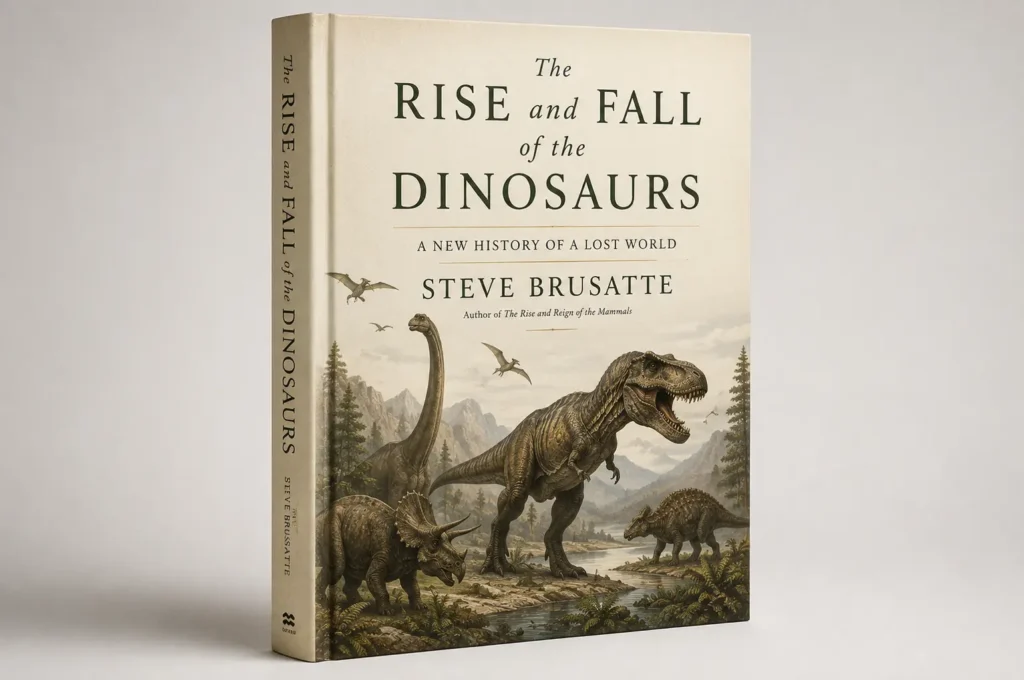
The Rise and Fall of the Dinosaurs
A compelling history of dinosaurs, tracing their origins, diversification, 200-million-year reign, extinction, and enduring legacy.
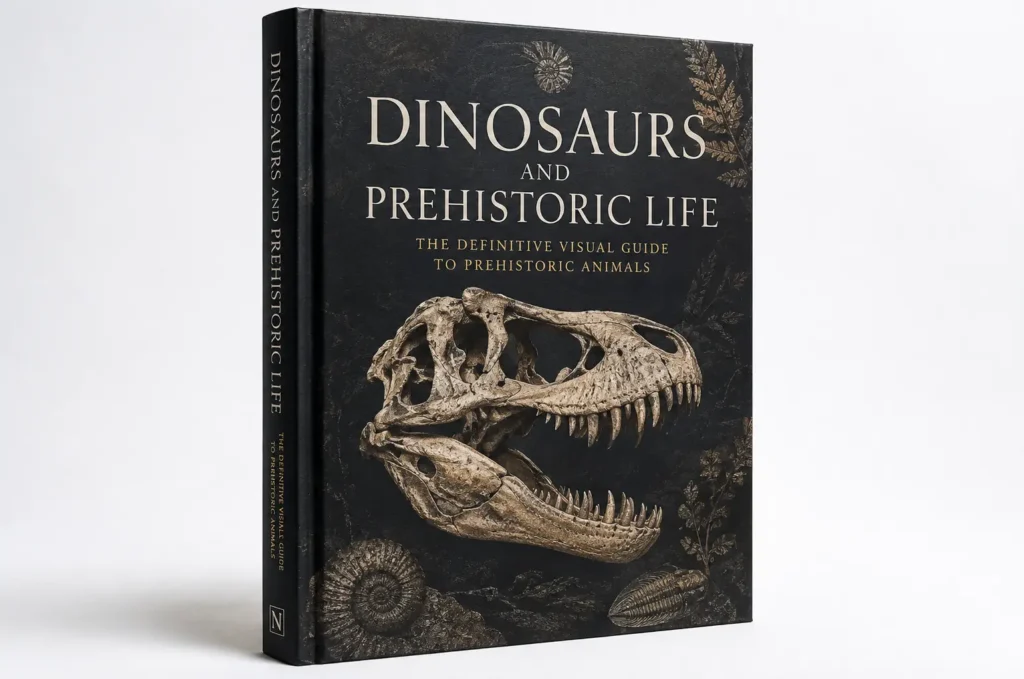
Dinosaurs and Prehistoric Life
A richly illustrated visual reference exploring dinosaurs, fossils, evolution, and prehistoric life across geological time.
Encyclopedia Prehistorica: Dinosaurs
An interactive dinosaur book featuring spectacular three-dimensional pop-ups, particularly suited to young readers and families.
The Rise and Reign of the Mammals
A sweeping history of mammalian evolution, from their origins alongside dinosaurs through the Cenozoic and the emergence of humans.