Quick Answer
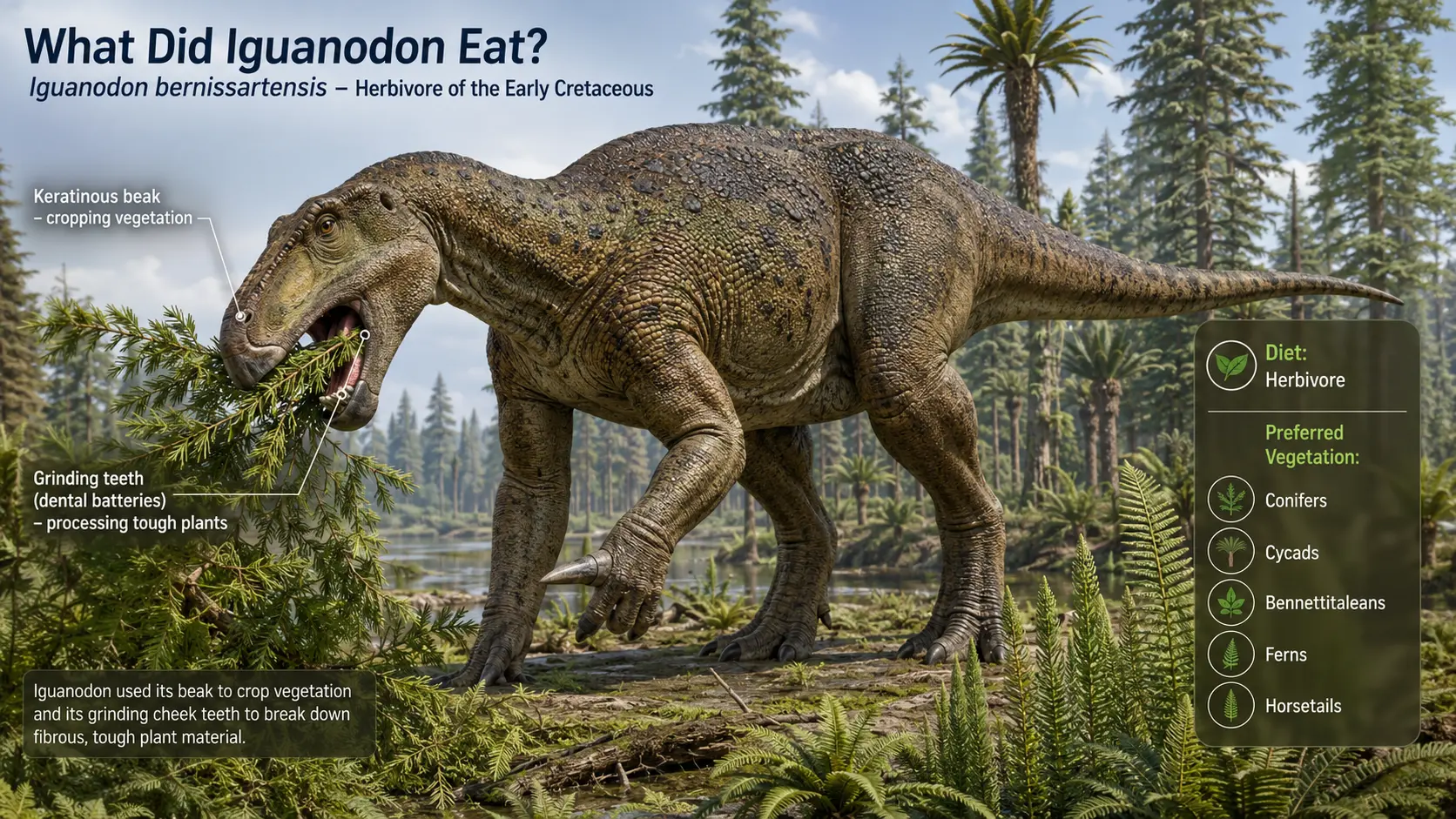
Iguanodon bernissartensis was a large herbivorous ornithopod that fed primarily on the abundant vegetation of the Early Cretaceous. Its toothless beak, rows of leaf-shaped teeth, flexible jaw mechanism, and well-developed oral processing adaptations allowed it to crop and chew a wide variety of fibrous plants more efficiently than earlier ornithopods. Although direct evidence of the exact plants it consumed has not been preserved, anatomical, biomechanical, and palaeoenvironmental evidence strongly indicate a diet dominated by conifers, ferns, horsetails, cycads, and other contemporary vegetation.

Diet Summary
| Characteristic | Information |
|---|---|
| Diet Type | Herbivore |
| Primary Food Sources | Conifers, ferns, horsetails, cycads, bennettitaleans, possibly early flowering plants |
| Feeding Strategy | Low- to mid-level browser |
| Feeding Adaptations | Beak, leaf-shaped teeth, flexible jaw joint, efficient oral processing |
| Food Processing | Extensive chewing before swallowing |
| Estimated Feeding Height | Ground level to several metres depending on posture |
| Direct Dietary Evidence | No confirmed stomach contents or diagnostic coprolites |
| Dietary Certainty | High |
Introduction
Diet is one of the best-understood aspects of Iguanodon biology because its skull, jaws, and teeth are preserved in exceptional detail. These anatomical structures provide direct evidence of how the animal acquired and processed food, while geological and palaeobotanical studies reveal the types of vegetation available within its environment.
Unlike some extinct animals whose diets remain largely speculative, Iguanodon possesses numerous anatomical features that clearly identify it as a herbivore. However, determining exactly which plant species it preferred remains challenging because preserved stomach contents and associated feeding traces have not been conclusively identified. Consequently, palaeontologists reconstruct its feeding ecology by integrating fossil anatomy, dental wear, biomechanical analyses, and the fossil plant record.
What Did Iguanodon Eat?
Overall Diet Summary
| Category | Evidence |
|---|---|
| Diet Type | Herbivore |
| Primary Food Sources | Woody shoots, leaves, ferns, horsetails, cycads, bennettitaleans, conifers, possibly early angiosperms |
| Feeding Niche | Medium- to large-bodied terrestrial browser |
| Primary Evidence | Skull anatomy, dentition, jaw mechanics, palaeobotanical reconstruction |
| Direct Stomach Contents | None confirmed |
| Dietary Certainty | High |
Early Cretaceous Plant Groups summary
| Plant Group | Likely Consumed | Evidence |
|---|---|---|
| Conifers | ✓ Likely | Dominant forest vegetation and suitable browse |
| Ferns | ✓ Likely | Common understory plants in Early Cretaceous ecosystems |
| Horsetails | ✓ Likely | Frequently abundant in wet floodplain habitats |
| Cycads | ✓ Likely | Common seed plants available throughout western Europe |
| Bennettitaleans | ✓ Likely | Widespread Mesozoic vegetation with suitable growth forms |
| Early Angiosperms | Possible | Emerging during the Early Cretaceous but probably minor dietary components |
Scientific Explanation
Iguanodon occupied the ecological role of a large terrestrial herbivore capable of exploiting a broad range of vegetation. Its diet was almost certainly composed of multiple plant groups rather than a single preferred food source, reflecting the diverse flora present across Early Cretaceous floodplains and forests.
Conifers probably formed an important component of its diet because they dominated many forested habitats. Their branches and foliage would have been accessible both while walking quadrupedally and when rearing onto the hind limbs. Ferns and horsetails likely provided abundant low-growing vegetation, particularly in moist floodplain environments.
Cycads and bennettitaleans were also widespread during the Early Cretaceous and possessed robust leaves that could be processed effectively by Iguanodon‘s dentition. Early flowering plants had begun to diversify during this period, but current evidence suggests they remained relatively uncommon compared with gymnosperms and ferns.
No confirmed stomach contents or coprolites attributable to Iguanodon have been discovered. Consequently, dietary composition is reconstructed from indirect evidence, including skull anatomy, tooth morphology, dental wear patterns, biomechanical studies, and the composition of fossil plant communities.
Evidence Strength
High
Evidence Assessment
The herbivorous diet of Iguanodon is strongly supported by direct anatomical evidence, including its beak, dentition, jaw mechanics, and dental wear. The specific plant groups consumed are inferred from palaeoenvironmental reconstructions and the known Early Cretaceous flora rather than direct feeding evidence. Consequently, while the overall herbivorous diet is well established, the exact botanical composition of its diet remains uncertain.
Feeding Adaptations
Skull and Feeding Adaptations summary
| Structure | Feeding Function |
|---|---|
| Keratinous Beak | Cropped vegetation before chewing |
| Leaf-shaped Teeth | Sliced and shredded fibrous plant material |
| Tooth Rows | Formed efficient grinding surfaces during chewing |
| Jaw Joint | Allowed complex oral processing and efficient mastication |
| Cheek Structures | Probably retained food within the mouth while chewing |
| Continuous Tooth Replacement | Maintained functional teeth despite heavy wear |
Dentition Comparison Summary
| Feature | Iguanodon | Earlier Ornithopods | Hadrosaurs |
|---|---|---|---|
| Beak | Well developed | Present but simpler | Highly developed |
| Tooth Rows | Multiple functional teeth | Fewer teeth | Extensive dental batteries |
| Chewing Efficiency | High | Moderate | Very High |
| Tooth Replacement | Continuous | Continuous | Continuous with highly specialised dental batteries |
| Jaw Complexity | Advanced | Relatively simple | Highly specialised |
Scientific Explanation
The feeding apparatus of Iguanodon represents an important evolutionary stage in ornithopod herbivory. The toothless beak efficiently cropped vegetation, while rows of closely packed leaf-shaped teeth sliced plant tissues before swallowing.
Unlike many earlier ornithopods, Iguanodon possessed a jaw mechanism capable of relatively sophisticated chewing movements. This increased the degree of oral processing before food entered the digestive tract, improving the efficiency of extracting nutrients from fibrous vegetation.
The continual replacement of worn teeth ensured that effective cutting surfaces remained throughout the animal’s life. Although Iguanodon did not possess the highly specialised dental batteries characteristic of later hadrosaurids, its feeding apparatus represents a significant evolutionary advancement over more basal ornithopods.
Muscular oral tissues (“cheek-like” soft tissues) have been proposed to help retain food during chewing. While direct fossil evidence for cheeks is lacking, this interpretation is supported by functional anatomy and remains widely accepted.
Evidence Strength
High
Evidence Assessment
The skull, jaws, and dentition of Iguanodon are preserved in numerous articulated specimens, providing exceptionally strong evidence for feeding adaptations. Functional interpretations of jaw mechanics and cheek structures rely partly on biomechanical analyses and comparative anatomy, introducing moderate inference. Overall, the anatomy supporting herbivorous feeding is among the best-documented aspects of Iguanodon biology.
How Did Iguanodon Feed?
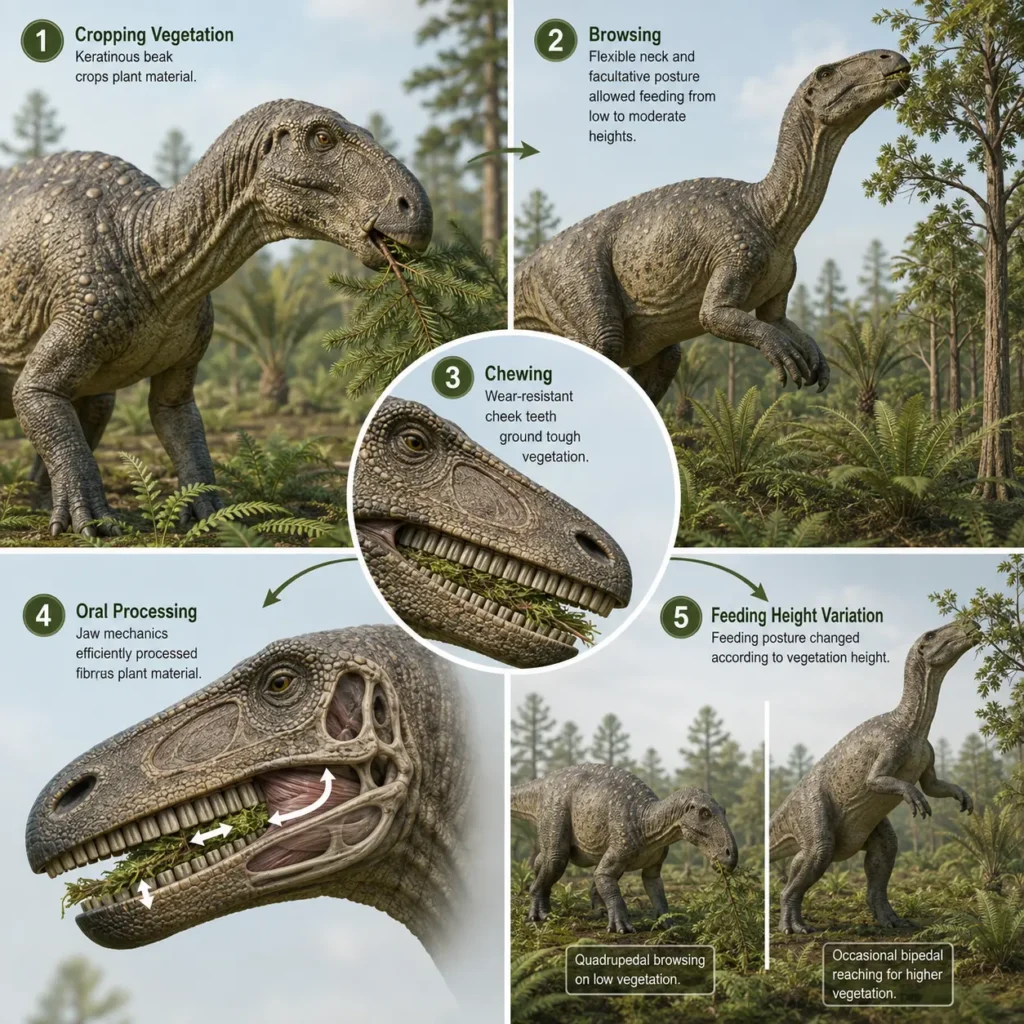
Feeding Behaviour Summary
| Behaviour | Evidence |
|---|---|
| Cropping Vegetation | Toothless beak and jaw anatomy |
| Chewing | Dental wear and jaw mechanics |
| Oral Processing | Tooth arrangement and mandibular movement |
| Browsing | Limb proportions, neck flexibility, feeding anatomy |
| Feeding Height Variation | Facultative quadrupedalism and occasional bipedal posture |
Feeding Height summary
| Feeding Height | Likely Method | Supporting Evidence |
|---|---|---|
| Ground Level | Quadrupedal browsing | Limb anatomy and neck mobility |
| Low Shrubs | Quadrupedal browsing | Shoulder height and neck flexibility |
| Medium Vegetation | Mixed quadrupedal and bipedal feeding | Limb proportions and balance |
| Higher Branches | Occasional rearing onto the hind limbs may have extended browsing height | Biomechanical modelling and skeletal anatomy |
Scientific Explanation
Iguanodon probably fed by first cropping vegetation with its keratinous beak before transferring food to its cheek teeth for extensive oral processing. Repeated chewing movements fragmented fibrous plant tissues, increasing the efficiency of digestion within the gut.
Its feeding range was likely enhanced by behavioural flexibility. During routine browsing, Iguanodon probably fed while moving quadrupedally through floodplain vegetation. When taller plants were available, it may have reared onto its hind limbs, using its tail as a counterbalance to reach higher branches.
The combination of efficient cropping, advanced chewing, and flexible feeding posture allowed Iguanodon to exploit a wider range of vegetation than many earlier herbivorous dinosaurs. These adaptations foreshadow the even more sophisticated feeding mechanisms that evolved later in hadrosaurids.
Evidence Strength
High
Evidence Assessment
Feeding behaviour is reconstructed from direct evidence preserved in the skull, jaws, dentition, and postcranial skeleton, together with biomechanical modelling. Cropping and oral processing are strongly supported by anatomy and dental wear, whereas feeding height and browsing behaviour are inferred from locomotor capabilities and neck mobility. These interpretations are well supported but cannot be observed directly because no behavioural evidence has been preserved.
Plants in the Early Cretaceous
Plant Availability summary
| Plant Group | Abundance | Evidence | Likely Role in Diet |
|---|---|---|---|
| Conifers | Very Common | Fossil wood, pollen, leaves | Major food source |
| Ferns | Very Common | Fossil fronds and spores | Common understory browse |
| Horsetails (Equisetites) | Common | Wetland fossil deposits | Moisture-rich browse |
| Cycads | Common | Leaves, trunks, pollen | Nutritious foliage |
| Bennettitaleans | Common | Leaves and reproductive structures | Likely important browse |
| Seed Ferns | Localised | Fossil foliage | Possible food source |
| Early Angiosperms | Uncommon | Early flowering plant fossils | Opportunistic food source |
Nutritional Value summary
| Plant Group | Nutritional Value | Likely Importance |
|---|---|---|
| Conifers | Moderate fibre, evergreen foliage | High |
| Ferns | Soft foliage with moderate nutrients | High |
| Horsetails | Moist but silica-rich tissues | Moderate |
| Cycads | Tough leaves with moderate nutritional value | Moderate |
| Bennettitaleans | Broad leaves with substantial biomass | High |
| Seed Ferns | Variable | Moderate |
| Early Angiosperms | Potentially nutrient-rich foliage | Low to Moderate |
Distribution summary
| Habitat | Dominant Plants |
|---|---|
| River Floodplains | Ferns, horsetails, conifers |
| Forested Lowlands | Conifers, cycads, bennettitaleans |
| Wetlands | Horsetails, ferns |
| Coastal Plains | Mixed conifers and fern communities |
| Open Woodland | Conifers, cycads, bennettitaleans |
Scientific Explanation
The vegetation available to Iguanodon differed substantially from that of modern ecosystems. During the Early Cretaceous, flowering plants were only beginning to diversify, while gymnosperms and spore-producing plants dominated terrestrial landscapes.
Conifers formed extensive forests across much of western Europe and likely represented one of the most dependable food resources for large herbivores. Ferns and horsetails flourished on moist floodplains and river margins, providing abundant low-growing vegetation that could be cropped efficiently while moving quadrupedally.
Cycads and bennettitaleans contributed additional browsing opportunities through their tough, fibrous leaves. Although these plants differed anatomically from modern flowering shrubs, their broad foliage would have been well suited to the slicing dentition of Iguanodon.
The earliest flowering plants (angiosperms) appeared during the Early Cretaceous but remained relatively uncommon throughout much of Iguanodon‘s temporal range. While they may occasionally have been consumed, they probably represented only a minor component of the overall diet.
Regional differences in climate and habitat undoubtedly influenced local vegetation. Consequently, the precise diet of Iguanodon likely varied geographically according to the plants available within individual ecosystems.
Evidence Strength
High
Evidence Assessment
Reconstructions of available vegetation are supported by extensive fossil plant assemblages, pollen records, sedimentological studies, and palaeoenvironmental analyses. Although the presence of these plants is well documented, direct evidence showing that Iguanodon consumed any particular species is absent. Dietary preferences therefore remain informed inferences based on the overlap between available vegetation and feeding anatomy.
Digestive Biology
Digestive Adaptations summary
| Adaptation | Function |
|---|---|
| Keratinous Beak | Cropped vegetation efficiently |
| Complex Dentition | Reduced food particle size before swallowing |
| Large Abdominal Cavity | Housed an extensive digestive system |
| Robust Ribcage | Protected enlarged digestive organs |
| Large Body Size | Supported prolonged microbial fermentation |
Digestive Process summary
| Stage | Function |
|---|---|
| Cropping | Beak removed leaves, shoots, and stems from plants |
| Chewing | Teeth sliced and fragmented plant tissues |
| Fermentation | Gut microorganisms likely broke down cellulose and other fibrous materials |
| Nutrient Absorption | Digestive tract absorbed nutrients released during fermentation |
Estimated Food Intake summary
| Estimate | Value |
|---|---|
| Daily Feeding Time | Likely several hours each day |
| Daily Food Intake | Unknown; probably several tens of kilograms of vegetation |
| Primary Food Type | Fibrous terrestrial plants |
| Digestive Strategy | High-volume herbivory with microbial fermentation |
Scientific Explanation
As a large-bodied herbivore, Iguanodon required an efficient digestive system capable of extracting nutrients from fibrous plant tissues that are difficult to digest.
Food processing began in the mouth, where the beak cropped vegetation and the teeth mechanically fragmented plant material. This extensive oral processing increased the surface area available for digestion and reduced the energetic demands placed on the digestive tract.
Although soft tissues are not preserved, the deep torso and expansive ribcage strongly suggest the presence of a large gastrointestinal tract capable of housing microbial communities that fermented cellulose-rich vegetation. Similar fermentation systems are employed by many large herbivorous mammals today, although the precise digestive anatomy of Iguanodon remains unknown.
Because of its large body size, Iguanodon probably consumed substantial quantities of vegetation each day. Exact intake cannot be calculated confidently because metabolic rates, digestive efficiency, and activity levels remain uncertain.
Evidence Strength
Moderate to High
Evidence Assessment
Mechanical food processing is strongly supported by skull and dental anatomy. However, digestive physiology is inferred because no digestive organs have been preserved. The interpretation of microbial fermentation is based on body size, ribcage volume, and comparisons with living herbivores rather than direct fossil evidence. Consequently, the overall digestive strategy is considered well supported, while specific physiological mechanisms remain hypothetical.
Comparison with Related Dinosaurs
Diet Comparison Summary
| Dinosaur | Diet | Feeding Adaptations | Relative Feeding Complexity |
|---|---|---|---|
| Camptosaurus | Herbivore | Simple beak and leaf-shaped teeth | Moderate |
| Mantellisaurus | Herbivore | Similar beak and dentition but more lightly built | High |
| Iguanodon | Herbivore | Advanced oral processing, robust jaws, efficient dentition | High |
| Ouranosaurus | Herbivore | Broad beak and well-developed dentition | High |
| Edmontosaurus | Herbivore | Extensive dental batteries and highly specialised chewing | Very High |
Evolution of Feeding summary
| Evolutionary Group | Major Feeding Innovation |
|---|---|
| Early Ornithopods | Simple cropping beak and leaf-shaped teeth |
| Basal Iguanodontians | Improved jaw mechanics and increased oral processing |
| Iguanodon | Efficient chewing with advanced jaw function |
| Hadrosauriforms | Greater tooth numbers and enhanced chewing efficiency |
| Hadrosaurids | Highly specialised dental batteries capable of prolonged grinding |
Scientific Explanation
The feeding adaptations of Iguanodon represent an important transitional stage in ornithopod evolution. Earlier genera such as Camptosaurus possessed effective herbivorous dentition but lacked the more sophisticated oral processing mechanisms observed in later iguanodontians.
Mantellisaurus, a close relative, shared many anatomical characteristics with Iguanodon but was generally smaller and more lightly built. Both genera demonstrate the evolutionary trend toward increasingly efficient herbivory during the Early Cretaceous.
Ouranosaurus independently evolved many comparable feeding adaptations, illustrating the success of advanced iguanodontian herbivory across different regions.
The greatest increase in feeding efficiency occurred with the evolution of hadrosaurids, whose complex dental batteries contained hundreds of continuously replacing teeth capable of prolonged grinding. Although Iguanodon lacked these specialised batteries, its jaw mechanics and dentition clearly foreshadowed the remarkable feeding systems of its descendants.
This progression illustrates a long-term evolutionary trend toward increasingly efficient processing of fibrous vegetation, enabling larger body sizes and greater ecological success among Late Cretaceous herbivorous dinosaurs.
Evidence Strength
High
Evidence Assessment
Comparisons among ornithopods are supported by extensive fossil material and modern phylogenetic analyses. Skull anatomy and dentition provide direct evidence for feeding adaptations, while evolutionary interpretations are strengthened by cladistic studies showing the sequential acquisition of increasingly specialised herbivorous features. Although ecological differences between taxa cannot always be reconstructed in detail, the overall trend toward greater feeding efficiency is strongly supported by anatomical evidence.
Comparison with Modern Herbivores
Modern Animal Comparison summary
| Animal | Primary Diet | Feeding Strategy | Comparison with Iguanodon |
|---|---|---|---|
| African Elephant (Loxodonta africana) | Leaves, bark, branches, grasses | Mixed browser and grazer | Similar body size and high-volume herbivory but completely different jaw anatomy |
| White Rhinoceros (Ceratotherium simum) | Primarily grasses | Specialized grazer | Similar large herbivore but adapted for grazing rather than browsing |
| Giraffe (Giraffa camelopardalis) | Leaves and shoots | High browser | Similar browsing behaviour but achieved through an elongated neck rather than bipedal reach |
| Green Iguana (Iguana iguana) | Leaves, flowers, fruits | Arboreal browser | Shares herbivorous reptilian ancestry but differs greatly in size and feeding mechanics |
Functional Comparison summary
| Animal | Similarity | Major Difference |
|---|---|---|
| African Elephant | Large-bodied herbivore requiring substantial daily food intake | Mammalian dentition and trunk replace beak and dinosaurian jaws |
| White Rhinoceros | Robust herbivore consuming fibrous vegetation | Specialized grazing mouth adapted to grasses |
| Giraffe | Browses woody vegetation | Height achieved through neck elongation rather than posture changes |
| Green Iguana | Herbivorous reptile using leaf-shaped teeth | Much smaller, arboreal, and incapable of extensive oral processing |
Scientific Explanation
Although no living animal is a direct analogue of Iguanodon, modern herbivores help illustrate how large terrestrial animals exploit different food resources.
African elephants provide perhaps the closest ecological comparison because they consume large quantities of woody vegetation, leaves, bark, and branches. Like Iguanodon, elephants require extensive digestive systems to process fibrous plant material, although they rely on mammalian molars and a muscular trunk instead of a keratinous beak and reptilian dentition.
White rhinoceroses demonstrate how herbivores can evolve highly specialized grazing adaptations. Their square lips are optimized for feeding on grasses, whereas Iguanodon was primarily adapted for browsing a wider variety of shrubs, leaves, and woody vegetation.
Giraffes illustrate an alternative solution for accessing elevated food sources. Instead of evolving an exceptionally long neck, Iguanodon likely extended its feeding range by shifting from quadrupedal to bipedal posture when browsing taller vegetation.
Green iguanas share certain superficial similarities in tooth shape and herbivorous feeding habits but occupy a vastly different ecological niche. Their comparison is primarily useful for illustrating that leaf-shaped teeth evolved repeatedly among herbivorous reptiles under similar dietary pressures.
These modern comparisons demonstrate convergent evolution in herbivorous feeding strategies while highlighting the distinctive anatomy of ornithopod dinosaurs.
Scientific Debate
Scientific Debate Summary summary
| Question | Current Consensus | Confidence |
|---|---|---|
| Preferred food plants | Mixed browsing on multiple plant groups | High |
| Feeding height | Variable browsing heights using both quadrupedal and occasional bipedal postures | Moderate to High |
| Seasonal dietary variation | Likely occurred but poorly documented | Low |
| Bite force | Biomechanical models indicate sufficient bite forces for processing fibrous vegetation, although precise values remain uncertain. | Moderate |
| Presence of cheeks | Probably present | Moderate |
| Oral processing efficiency | More advanced than basal ornithopods but less specialized than hadrosaurids | High |
Competing Hypotheses summary
| Topic | Hypothesis | Supporting Evidence |
|---|---|---|
| Preferred Food Plants | Mixed generalist browser | Diverse Early Cretaceous flora and generalized dentition |
| Feeding Height | Primarily low browser | Limb proportions and quadrupedal posture |
| Feeding Height | Browsed at multiple heights | Biomechanical evidence for facultative bipedalism |
| Seasonal Diet | Diet changed with plant availability | Modern herbivore ecology and changing environments |
| Bite Force | Moderate bite force | Jaw mechanics and tooth morphology |
| Presence of Cheeks | Muscular cheeks retained food during chewing | Skull anatomy and functional modelling |
| Presence of Cheeks | No true cheeks | Alternative interpretations of soft tissue reconstruction |
| Oral Processing | Extensive chewing before swallowing | Dental wear and jaw kinematics |
| Oral Processing | Limited chewing | Earlier historical interpretations based on primitive reptiles |
Scientific Explanation
Despite decades of research, several aspects of Iguanodon‘s feeding biology remain incompletely resolved.
The greatest uncertainty concerns the exact plant species that formed its diet. Because no confirmed stomach contents have been recovered, dietary composition must be reconstructed from the fossil flora preserved alongside Iguanodon fossils and from its feeding anatomy. Most researchers favour a broad, opportunistic browsing strategy rather than specialization on a single plant group.
Feeding height also remains an active area of study. Skeletal anatomy clearly indicates efficient quadrupedal browsing, while biomechanical analyses suggest that Iguanodon could occasionally rear onto its hind limbs to access taller vegetation. The frequency of this behaviour, however, remains unknown.
Another long-standing debate concerns the presence of muscular cheeks. Functional models indicate that cheeks would have improved chewing efficiency by preventing food from falling out of the mouth, but soft tissues are rarely preserved in dinosaurs. Consequently, this interpretation remains inferential despite widespread acceptance.
Similarly, estimates of bite force rely on biomechanical reconstruction because muscles do not fossilize. Current evidence indicates sufficient force to process tough vegetation but does not permit precise measurement.
Overall, ongoing debate reflects the limits of behavioural inference rather than disagreement over the herbivorous nature of Iguanodon.
Evidence Strength
High
Evidence Assessment
The scientific debates surrounding Iguanodon diet concern behavioural and physiological details rather than its fundamental herbivorous lifestyle. Direct fossil evidence strongly supports herbivory through skull anatomy and dentition, whereas questions involving feeding behaviour, bite force, and soft tissues necessarily rely on biomechanical modelling and comparative anatomy. These hypotheses are scientifically robust but remain less certain than conclusions derived directly from preserved skeletal material.
Current Scientific Understanding
Current Consensus summary
| Topic | Current Scientific Understanding |
|---|---|
| Diet | Obligate herbivore |
| Primary Food Sources | Mixed browse including conifers, ferns, horsetails, cycads, and bennettitaleans |
| Feeding Strategy | Generalist browser |
| Food Processing | Extensive oral processing before swallowing |
| Feeding Height | Variable, depending on posture and available vegetation |
| Digestive Strategy | Large-bodied microbial fermentation is widely inferred, although the precise digestive anatomy remains unknown. |
| Evolutionary Position | Transitional feeding system between basal ornithopods and hadrosaurids |
Modern research consistently identifies Iguanodon as a highly successful large herbivore with feeding adaptations that represent an important evolutionary stage in ornithopod evolution. Its beak, jaw mechanics, and dentition allowed considerably more efficient processing of plant material than earlier ornithopods, while foreshadowing the sophisticated feeding systems later perfected by hadrosaurids.
Although uncertainty remains regarding specific dietary preferences and digestive physiology, there is broad scientific agreement that Iguanodon was a versatile browser capable of exploiting a wide variety of Early Cretaceous vegetation.
Frequently Asked Questions
Was Iguanodon a herbivore?
Yes. Its skull, beak, dentition, and jaw mechanics provide overwhelming evidence that it was an obligate herbivore.
What plants did Iguanodon probably eat?
It most likely consumed conifers, ferns, horsetails, cycads, bennettitaleans, and possibly some early flowering plants.
Did Iguanodon chew its food?
Yes. Unlike many earlier herbivorous reptiles, Iguanodon possessed jaw mechanics that allowed substantial oral processing before swallowing.
Did it have a beak?
Yes. A keratinous beak at the front of the jaws was used to crop vegetation.
Could Iguanodon reach high vegetation?
Probably. It likely browsed low vegetation while quadrupedal and occasionally reared onto its hind limbs to reach higher plants.
Did it eat grasses?
Probably not. Modern grasses were not widespread during the Early Cretaceous, and they were unlikely to have formed a significant part of its diet.
Do scientists know exactly what it ate?
No. No confirmed stomach contents have been discovered, so individual plant species cannot be identified with certainty.
Did Iguanodon have cheeks?
Most researchers consider muscular cheeks likely because they would improve food retention during chewing, but this cannot be confirmed directly from fossils.
How did Iguanodon digest fibrous plants?
It probably relied on microbial fermentation within a large digestive tract, although the exact digestive anatomy remains unknown.
How did its feeding compare with hadrosaurs?
Iguanodon possessed more advanced oral processing than earlier ornithopods but lacked the highly specialized dental batteries characteristic of later hadrosaurids.
References
Primary Literature
- Mantell, G. A. (1825). Notice on the Iguanodon, a newly discovered fossil reptile from the sandstone of Tilgate Forest, Sussex. Philosophical Transactions of the Royal Society of London, 115, 179–186.
- Norman, D. B. (1980). On the ornithischian dinosaur Iguanodon bernissartensis from the Lower Cretaceous of Bernissart (Belgium). Institut Royal des Sciences Naturelles de Belgique, Memoir 178.
- Norman, D. B. (1986). On the anatomy of Iguanodon atherfieldensis (Ornithischia: Ornithopoda). Bulletin de l’Institut Royal des Sciences Naturelles de Belgique, Sciences de la Terre, 56, 281–372.
- Norman, D. B. (1988). A review of the family Iguanodontidae and its relationships. In M. J. Benton (Ed.), The Phylogeny and Classification of the Tetrapods (Vol. 1, pp. 15–52). Oxford: Clarendon Press.
Feeding Biology and Functional Anatomy
- Barrett, P. M. (2014). Palaeobiology of herbivorous dinosaurs. In The Complete Dinosaur (2nd ed.).
- Barrett, P. M., & Rayfield, E. J. Selected studies on ornithischian feeding mechanics and functional morphology.
- Holliday, C. M., & Witmer, L. M. (2008). Cranial kinesis in dinosaurs: Intracranial joints, protractor muscles, and their significance for feeding biology. In Dinosaur Paleobiology.
- Norman, D. B. (2004). Basal Iguanodontia. In D. B. Weishampel, P. Dodson, & H. Osmólska (Eds.), The Dinosauria (2nd ed., pp. 413–437). University of California Press.
Dentition, Jaw Function, and Biomechanics
- Erickson, G. M., & colleagues. Selected studies on dinosaur dental function, tooth wear, and feeding mechanics.
- Rayfield, E. J. Selected publications on vertebrate skull biomechanics and finite-element analysis applied to dinosaur feeding.
- Bates, K. T., Manning, P. L., Hodgetts, D., & Sellers, W. I. (2009). Estimating mass properties of dinosaurs using laser imaging and 3D volumetric reconstruction. PLoS ONE, 4(2), e4532.
Palaeobotany and Early Cretaceous Ecosystems
- Cleal, C. J., & Rees, P. M. Selected studies on Early Cretaceous vegetation and palaeoecology.
- Friis, E. M., Crane, P. R., & Pedersen, K. R. (2011). Early Flowers and Angiosperm Evolution. Cambridge University Press.
- Scott, A. C. Selected publications on Mesozoic terrestrial vegetation and ecosystem evolution.
Ornithopod Evolution and Systematics
- McDonald, A. T. (2012). Phylogeny and systematics of Styracosterna (Dinosauria: Ornithopoda). PLoS ONE, 7, e50673.
- Boyd, C. A. (2015). Selected reviews on ornithopod phylogeny and evolutionary history.
- Verdú, F. J., Royo-Torres, R., & Cobos, A. Selected studies on basal styracosternan evolution.
Comparative Herbivore Biology
- Clauss, M., Hummel, J., & colleagues. Selected studies on digestive physiology in large herbivores.
- Janis, C. M. Selected publications on herbivore feeding ecology and functional morphology.
- Owen-Smith, N. (1988). Megaherbivores: The Influence of Very Large Body Size on Ecology. Cambridge University Press.
Standard Reference Works
- Brusatte, S. L. (2018). The Rise and Fall of the Dinosaurs. William Morrow.
- Paul, G. S. (2016). The Princeton Field Guide to Dinosaurs (2nd ed.). Princeton University Press.
- Weishampel, D. B., Dodson, P., & Osmólska, H. (Eds.). (2004). The Dinosauria (2nd ed.). University of California Press.
- Holtz, T. R. Jr. (latest edition). Dinosaurs: The Most Complete, Up-to-Date Encyclopedia for Dinosaur Lovers of All Ages.
Featured Museum Collections
Museum-quality paleoart and educational poster
collections based on evidence-informed prehistoric
Life reconstructions.