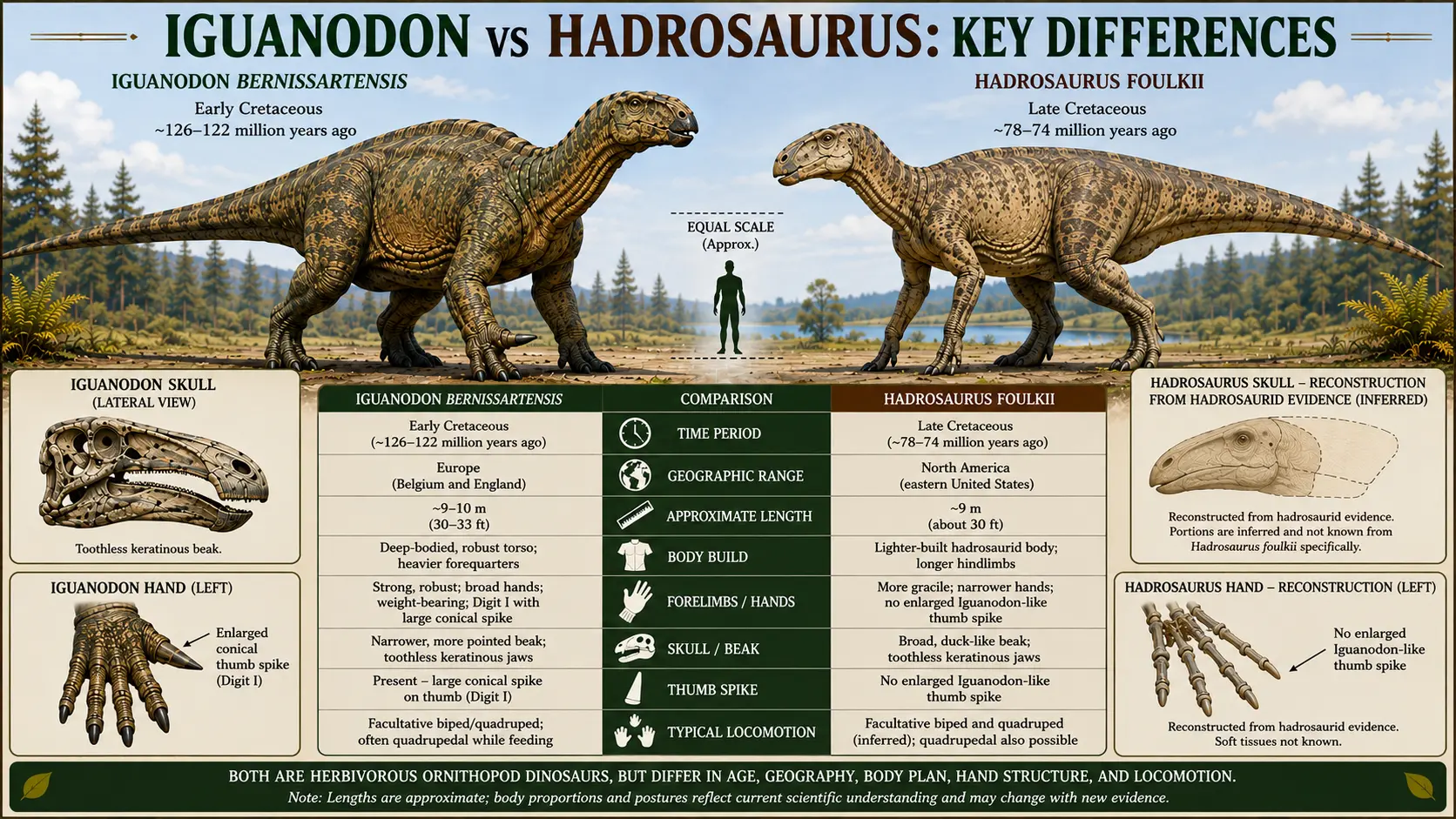
Quick Comparison
| Feature | Iguanodon | Hadrosaurus |
|---|---|---|
| Best-known species | Iguanodon bernissartensis | Hadrosaurus foulkii |
| Major group | Iguanodontian ornithopod | Hadrosaurid iguanodontian ornithopod |
| Geological age | Early Cretaceous; approximately 126–122 Ma for I. bernissartensis | Late Cretaceous; approximately 78–74 Ma in the Natural History Museum’s account |
| Principal fossil region | Western Europe; I. bernissartensis is documented from several European localities | New Jersey, USA |
| Diet | Herbivorous | Herbivorous |
| Length | About 9–11 m for I. bernissartensis | About 9 m |
| Body mass | Around 8 tonnes in one RBINS estimate; other methods produce different estimates | Historical estimates of 7–8 tonnes exist, but direct methodological comparison is uncertain |
| Locomotion | Quadrupedal use and possible bipedal locomotion; details remain debated | Bipedal running and quadrupedal support have both been proposed |
| Distinctive hand feature | Enlarged thumb spike | No comparable Iguanodon-type thumb spike |
| Fossil record | Numerous relatively complete Bernissart skeletons | Very limited type material |
| Evidence confidence | High for major anatomy | More restricted because of incomplete material |
Quick Answer
Iguanodon and Hadrosaurus were both large herbivorous ornithopod dinosaurs, but they lived tens of millions of years apart and represent different branches within iguanodontian evolution. Iguanodon bernissartensis is exceptionally well represented by relatively complete skeletons from Bernissart, Belgium, whereas Hadrosaurus foulkii is known from much more limited type material.

Iguanodon had a robust body, specialized herbivorous jaws and teeth, and a distinctive enlarged manual thumb spike. Hadrosaurus belonged to Hadrosauridae, a later-diverging lineage of iguanodontian ornithopods, associated with more specialized plant-processing jaws and dental batteries. The latter characteristics are well established for hadrosaurids as a group, although the limited H. foulkii fossil record constrains how much can be demonstrated directly for that species.
Introduction
Both dinosaurs belong to Ornithopoda, a major group of predominantly herbivorous dinosaurs. Their broad anatomical similarities reflect shared evolutionary ancestry, but Iguanodon and Hadrosaurus should not be treated as direct ancestor and descendant.
Iguanodon bernissartensis is an Early Cretaceous dinosaur best known from the Bernissart assemblage in Belgium. The Royal Belgian Institute of Natural Sciences places the principal Bernissart material in the Upper Barremian–Lower Aptian interval, approximately 126–122 million years ago.
Hadrosaurus foulkii lived much later, during the Late Cretaceous. The Natural History Museum gives an approximate range of 78–74 million years ago, while the New Jersey Geological Survey uses the broader description of about 80 million years ago.
The comparison is therefore most useful when it examines their anatomy, ecology, evolutionary relationship, and—equally importantly—the very different quality of their fossil evidence.
Size Comparison
The available evidence suggests broadly comparable overall body lengths.
The Royal Belgian Institute of Natural Sciences estimates Iguanodon bernissartensis at approximately 9–11 metres long and around 8 tonnes in one general estimate.
The Natural History Museum gives Hadrosaurus a length of approximately 9 metres, while the New Jersey Geological Survey describes H. foulkii as about 25 feet long and reports a historical mass estimate of approximately 7–8 tons.
These mass figures should not be treated as directly comparable measurements. Body mass in extinct dinosaurs is reconstructed from anatomical measurements and modelling assumptions, and different methods can produce different estimates.
The evidence therefore supports the conclusion that both were large-bodied ornithopods of broadly comparable length, but it does not justify confidently declaring one heavier.
Anatomy Comparison
Feeding Anatomy
Iguanodon possessed robust jaws and specialized teeth suited to herbivory. The unusually complete Bernissart material provides detailed evidence of its skull and jaw anatomy.
Hadrosaurus belonged to Hadrosauridae, a group characterized by specialized plant-processing jaws and dental batteries. Research on hadrosauroid evolution identifies increasing specialization of the feeding system as an important feature in the group’s history.
There is an important evidence distinction here. Specialized hadrosaurid feeding anatomy is well established at the group level, but Hadrosaurus foulkii itself is poorly represented. Prieto-Márquez’s revision emphasizes the scarcity and limited diagnostic value of the type material.
It is therefore more accurate to describe Hadrosaurus as a member of a lineage with specialized hadrosaurid feeding anatomy than to imply that every aspect of that specialization is directly demonstrated by H. foulkii fossils.
The Iguanodon Thumb Spike
One of Iguanodon‘s most distinctive features was its enlarged manual thumb spike.
In I. bernissartensis, the first digit formed an enlarged spur that would have been covered by a horny sheath in life. Its exact biological function remains uncertain. Defensive use has been proposed, but the fossil itself does not preserve a direct record of how the structure was used.
Hadrosaurus has no directly comparable Iguanodon-style thumb spike.
Locomotion
Locomotion is more interpretive than the basic skeletal differences.
The Bernissart skeletons show that Iguanodon had anatomy capable of substantial forelimb weight bearing. Earlier reconstructions placed the animal in an upright bipedal posture, but later work shifted toward a more horizontal body posture and substantial quadrupedal use. The possibility of bipedal movement remains part of the broader locomotor interpretation.
Hadrosaurus has likewise been interpreted as capable of different locomotor modes, including bipedal running and quadrupedal support. The incomplete fossil record makes highly specific reconstructions less secure.
Neither dinosaur should therefore be reduced to a simple permanent “two-legged” versus “four-legged” category.
Ecology Comparison
The ecological comparison is useful, but the evidence is not equally detailed for both taxa.
Diet
Both Iguanodon and Hadrosaurus are interpreted as herbivorous ornithopods.
For Iguanodon, herbivory is strongly supported by its teeth, jaws, and broader anatomy. Plant fossils associated with I. bernissartensis also provide information about the vegetation available in particular environments. Studies of the Morella Formation in Spain, for example, identified abundant conifer and fern remains associated with I. bernissartensis and interpreted those plants as potential food resources.
For Hadrosaurus, herbivory is consistent with its placement within Hadrosauridae and the feeding anatomy known for the group. However, because H. foulkii itself is poorly represented, the evidence for its precise diet is less direct than the extensive anatomical evidence available for Iguanodon.
Environment
Iguanodon bernissartensis is associated with Early Cretaceous terrestrial environments in western Europe. Sedimentological and palynological evidence from relevant localities provides information about floodplain environments, vegetation, and seasonality.
Hadrosaurus foulkii is known from Late Cretaceous deposits in New Jersey. Its fossil occurrence records a substantially later North American environment, but the ecological reconstruction specifically attributable to H. foulkii is more constrained by its limited fossil material.
Geographic Separation
The known records also place the two dinosaurs in different geographic contexts.
I. bernissartensis is associated with western European fossil localities, including the exceptionally important Bernissart site in Belgium. H. foulkii is associated with New Jersey in eastern North America.
They therefore occupied different geographic and geological settings and were not ecological contemporaries.
Ecological Evidence Comparison
| Ecological question | Iguanodon | Hadrosaurus |
|---|---|---|
| Herbivory | Strongly supported by anatomy and associated ecological evidence | Strongly supported at the hadrosaurid level; species-specific evidence more limited |
| Vegetation | Fossil plant evidence provides useful local context | Less directly constrained for H. foulkii |
| Habitat | Geological and botanical evidence provides meaningful reconstruction | Regional environment can be reconstructed, but taxon-specific detail is more limited |
| Seasonality | Evidence available from geological and geochemical studies at Bernissart | Less securely constrained specifically for H. foulkii |
| Geographic setting | Western European Early Cretaceous environments | Eastern North American Late Cretaceous environment |
| Behavioral ecology | Limited direct evidence | Limited direct evidence |
The ecological evidence therefore supports meaningful differences in geological setting and timing, while more detailed claims about behavior, social organization, or precise habitat preferences remain comparatively uncertain.
Evidence Assessment
The fossil record strongly favors Iguanodon in terms of anatomical completeness.
At Bernissart, approximately 30 relatively complete Iguanodon skeletons were recovered. Their preservation and association provided unusually detailed information about the animal’s skeleton.
Hadrosaurus foulkii has a much more restricted evidentiary basis. Prieto-Márquez’s revision identifies the holotype as the only known specimen and emphasizes the scarcity of diagnostic material.
This creates an important asymmetry in the comparison:
| Topic | Iguanodon | Hadrosaurus |
|---|---|---|
| Major skeletal anatomy | Strong direct evidence | Limited by incomplete material |
| Size | Moderate–Strong | More restricted |
| Feeding anatomy | Strong | More restricted at species level |
| Locomotion | Moderate–Strong, with interpretive disagreement | Moderate, with substantial limitations |
| Paleoecology | Moderate–Strong at relevant localities | More limited specifically for the taxon |
| Detailed behavior | Limited | Limited |
| Fossil completeness | Exceptionally informative Bernissart assemblage | Very limited type material |
The distinction between direct evidence and inference is especially important. Anatomy preserved in multiple relatively complete Iguanodon skeletons can be described with substantially greater confidence than behaviors inferred from the limited Hadrosaurus record.
Verdict
Overall, Iguanodon and Hadrosaurus were broadly similar in body size and herbivorous lifestyle, but they were separated by a major geological interval and differed substantially in their evolutionary and anatomical context.
If the comparison is about fossil evidence and anatomical certainty, Iguanodon is the better-documented dinosaur by a substantial margin because of the Bernissart assemblage.
If the comparison is about feeding-system evolution, Hadrosaurus is important as a hadrosaurid, but its specialized feeding anatomy should be discussed primarily in the context of Hadrosauridae rather than treated as equally well demonstrated from its own limited fossil material.
If the comparison is about size, neither can be declared decisively larger from the available estimates. Their reported lengths are broadly comparable, while mass estimates are too reconstruction-dependent for a confident winner.
If the comparison is about evolutionary relationship, Hadrosaurus was not simply a later version of Iguanodon. Both belong to the broader iguanodontian ornithopod history, but they represent different branches and different geological periods.
The most defensible conclusion is therefore that Iguanodon provides the much stronger fossil and anatomical record, while Hadrosaurus is important for understanding the later diversification and specialization of hadrosaurid ornithopods.
Frequently Asked Questions
Which was bigger, Iguanodon or Hadrosaurus?
Their estimated lengths were broadly similar. Iguanodon bernissartensis is generally estimated at 9–11 metres, while Hadrosaurus is commonly given at about 9 metres. Mass estimates are less directly comparable and do not justify a confident winner.
Did Iguanodon evolve into Hadrosaurus?
Not as a simple direct ancestor-descendant sequence. They were members of the broader iguanodontian ornithopod radiation, but Hadrosaurus represents a later hadrosaurid lineage rather than a species directly descended from Iguanodon.
Which lived first?
Iguanodon bernissartensis lived first. Its principal Bernissart material dates to approximately 126–122 million years ago, whereas Hadrosaurus foulkii lived during the Late Cretaceous, approximately 78–74 million years ago, in the Natural History Museum’s account.
Did both eat plants?
Yes. Both are interpreted as herbivorous ornithopods. Their feeding systems nevertheless differed, with hadrosaurids developing more specialized plant-processing anatomy.
Did Hadrosaurus have an Iguanodon-style thumb spike?
No comparable enlarged Iguanodon thumb spike is known for Hadrosaurus. The Iguanodon structure is one of the genus’s most distinctive anatomical features.
Which is better known from fossils?
Iguanodon is substantially better represented by relatively complete material. Around 30 relatively complete skeletons were recovered at Bernissart, whereas Hadrosaurus foulkii is known from much more limited type material.
References
Primary Literature
- Leidy, J. (1858). Hadrosaurus foulkii, a new saurian from the Cretaceous of New Jersey, related to Iguanodon. Proceedings of the Academy of Natural Sciences of Philadelphia, 10, 213–218.
- Mantell, G. A. (1825). Notice on the Iguanodon, a newly discovered fossil reptile from the sandstone of Tilgate Forest, Sussex. Philosophical Transactions of the Royal Society of London, 115, 179–186.
- Norman, D. B. (1980). On the ornithischian dinosaur Iguanodon bernissartensis from the Lower Cretaceous of Bernissart (Belgium). Mémoires de l’Institut Royal des Sciences Naturelles de Belgique, 178, 1–103.
- Prieto-Márquez, A., Weishampel, D. B., & Horner, J. R. (2006). The dinosaur Hadrosaurus foulkii, from the Campanian of the East Coast of North America, with a reevaluation of the genus. Acta Palaeontologica Polonica, 51(1), 77–98.
- Prieto-Márquez, A. (2011). Revised diagnoses of Hadrosaurus foulkii Leidy, 1858 (the type genus and species of Hadrosauridae Cope, 1869) and Claasaurus agilis Marsh, 1872 (Dinosauria: Ornithopoda) from the Late Cretaceous of North America. Zootaxa, 2765, 61–68.
Body Size and Mass Estimation
- Bates, K. T., Manning, P. L., Hodgetts, D., & Sellers, W. I. (2009). Estimating mass properties of dinosaurs using laser imaging and 3D volumetric reconstruction. PLoS ONE, 4(2), e4532.
- Campione, N. E., & Evans, D. C. (2012). A universal scaling relationship between body mass and limb bone circumference in quadrupedal terrestrial tetrapods. BMC Biology, 10, 60.
Biomechanics and Locomotion
- Bates, K. T., & Falkingham, P. L. Studies of dinosaur locomotion, centre of mass, and biomechanical reconstruction.
- Norman, D. B. (1980). On the ornithischian dinosaur Iguanodon bernissartensis from the Lower Cretaceous of Bernissart (Belgium). Mémoires de l’Institut Royal des Sciences Naturelles de Belgique, 178, 1–103.
Ornithopod Evolution and Systematics
- Norman, D. B. (2004). Basal Iguanodontia. In D. B. Weishampel, P. Dodson, & H. Osmólska (Eds.), The Dinosauria (2nd ed.). University of California Press.
- McDonald, A. T. (2012). Phylogeny and systematics of Styracosterna (Dinosauria: Ornithopoda). PLoS ONE, 7(3), e50673.
- Prieto-Márquez, A., Weishampel, D. B., & Horner, J. R. (2006). The dinosaur Hadrosaurus foulkii, from the Campanian of the East Coast of North America, with a reevaluation of the genus. Acta Palaeontologica Polonica, 51(1), 77–98.
Comparative Anatomy
- Norman, D. B. (1980). On the ornithischian dinosaur Iguanodon bernissartensis from the Lower Cretaceous of Bernissart (Belgium). Mémoires de l’Institut Royal des Sciences Naturelles de Belgique, 178, 1–103.
- Norman, D. B. (1986). On the anatomy of Iguanodon atherfieldensis (Ornithischia: Ornithopoda). Bulletin de l’Institut Royal des Sciences Naturelles de Belgique, Sciences de la Terre, 56, 281–372.
- Prieto-Márquez, A. (2011). Revised diagnoses of Hadrosaurus foulkii Leidy, 1858 (the type genus and species of Hadrosauridae Cope, 1869) and Claasaurus agilis Marsh, 1872 (Dinosauria: Ornithopoda) from the Late Cretaceous of North America. Zootaxa, 2765, 61–68.
Paleoecology and Geological Context
- Institute of Natural Sciences. (n.d.). The Bernissart Iguanodons at a glance. Royal Belgian Institute of Natural Sciences.
- Institute of Natural Sciences. (n.d.). Bernissart: Iguanodon bernissartensis and the Bernissart assemblage. Royal Belgian Institute of Natural Sciences.
- New Jersey Geological Survey. (n.d.). Hadrosaurus foulkii. New Jersey Department of Environmental Protection.
- Natural History Museum. (n.d.). Hadrosaurus. Dino Directory. Natural History Museum, London.
Standard Reference Works
- Weishampel, D. B., Dodson, P., & Osmólska, H. (Eds.). (2004). The Dinosauria (2nd ed.). University of California Press.
- Paul, G. S. (2016). The Princeton Field Guide to Dinosaurs (2nd ed.). Princeton University Press.
Featured Museum Collections
Museum-quality paleoart and educational poster
collections based on evidence-informed prehistoric
Life reconstructions.