Where Did Megalodon Live?

Otodus megalodon swimming across coastal and open ocean habitats with an inset map showing global warm-water distribution of the species

Field Information Species Otodus megalodon — Otodontidae Period Miocene to Early Pliocene, ~23–3.6 Ma Habitat type Warm, shallow coastal and epicontinental seas Global range Near-cosmopolitan — all major ocean basins Nursery evidence Warm, shallow formations with high concentrations of small teeth Quick Answer: Megalodon lived in warm, shallow coastal and epicontinental seas across virtually every … Read more

Why Was Megalodon Renamed to Otodus?

Comparison of Otodus megalodon and great white shark showing tooth differences with a bourlette in megalodon and none in great white explaining the taxonomic rename

Field Information Species Otodus megalodon (Agassiz, 1843) Former name Carcharodon megalodon — used in popular literature until ~2000s Current accepted name Otodus megalodon Reason for change Phylogenetic reassignment — megalodon is not closely related to Carcharodon Governed by International Code of Zoological Nomenclature (ICZN) Quick Answer: Megalodon was renamed to Otodus megalodon because phylogenetic analysis … Read more

Why Did Megalodon Go Extinct?

Otodus megalodon in a cooling ocean with reduced prey and competing sharks illustrating multiple factors behind megalodon extinction

Field Information Species Otodus megalodon — Otodontidae Extinction timing Early Pliocene, ~3.6 Ma [review: active debate on precise date] Primary evidence Youngest dated fossil teeth; absence from post-Pliocene deposits Leading causes Oceanic cooling; prey base collapse; competitive pressure Status Extinct — no verified post-Pliocene fossil material Quick Answer: Megalodon went extinct approximately 3.6 million years … Read more

Megalodon Discovery: Fossil History and How Science Identified the World’s Largest Shark

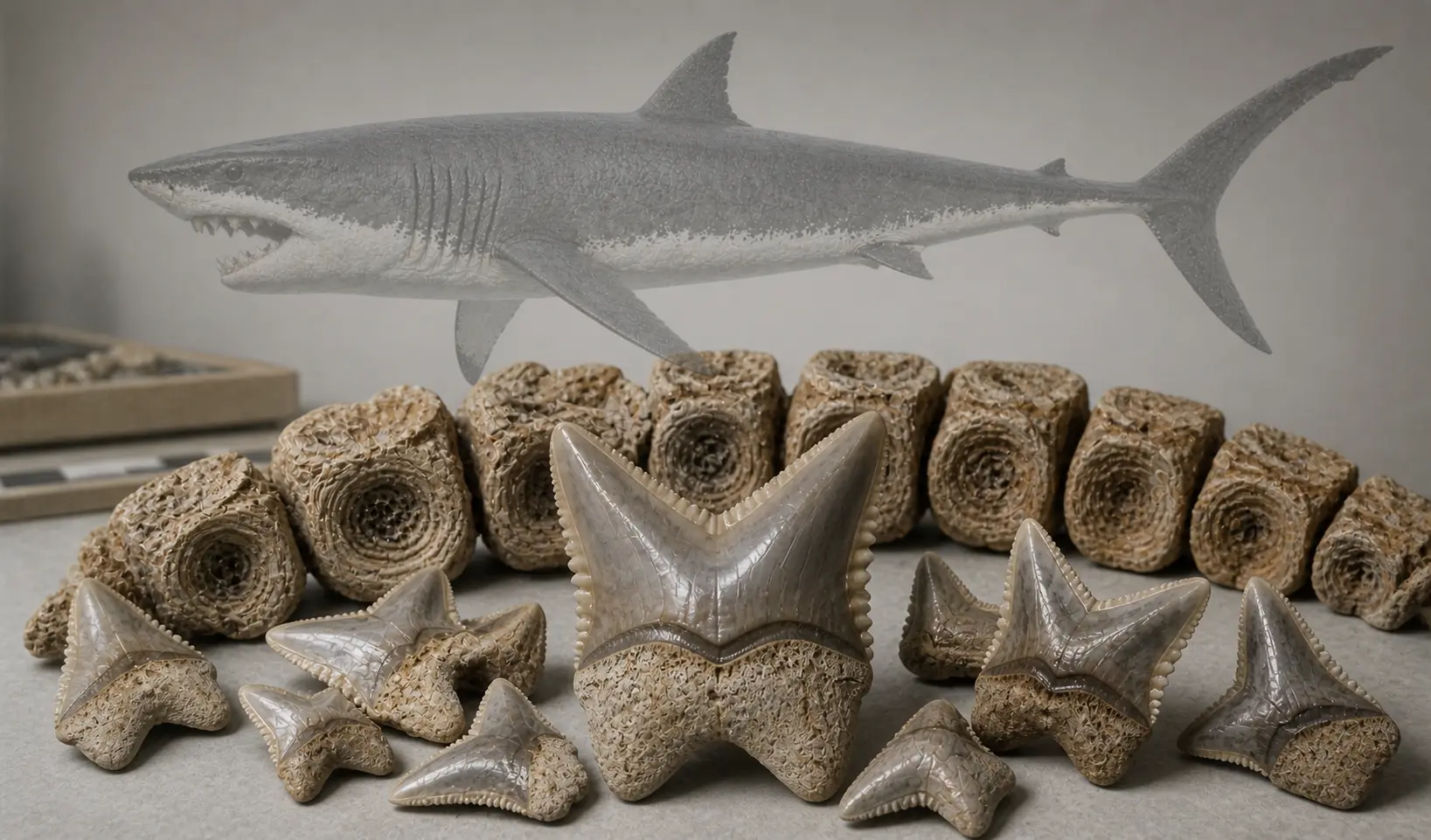
Megalodon fossil discovery showing serrated teeth and vertebral centra with a faint reconstructed Otodus megalodon illustrating how scientists identified the giant shark

Field Information Species Otodus megalodon — Otodontidae Period Miocene to Early Pliocene, ~23–3.6 Ma Formal description Louis Agassiz, 1843 Primary fossil material Teeth and vertebral centra Key collections Calvert Marine Museum; Natural History Museum (London); Smithsonian Quick Answer:Otodus megalodon was formally described by Swiss naturalist Louis Agassiz in 1843, based on fossil teeth. Before that, … Read more

Megalodon Teeth: Size, Function, and Bite Force Explained

Scientifically reconstructed megalodon (Otodus megalodon) swimming above fossil teeth and whale vertebrae, illustrating the enormous serrated teeth, jaw structure, and bite force of the extinct giant shark.

Field Information Species Otodus megalodon — Otodontidae Period Miocene to Early Pliocene, ~23–3.6 Ma Maximum tooth height Up to ~18 cm (7 in) — largest reliably measured specimens Bite force estimate Biomechanical estimates (model-dependent) suggest approximately 108,000–180,000 N Why teeth fossilise Teeth mineralise during life; skeletal cartilage does not preserve Quick Answer: Megalodon teeth are … Read more

What Did Megalodon Eat?

Otodus megalodon approaching a baleen whale in a Neogene ocean with inset close-ups of serrated teeth and fossil bite marks showing feeding evidence

Field Information Species Otodus megalodon — Otodontidae Period Miocene to Early Pliocene, ~23–3.6 Ma Diet type Apex predator — large marine mammals primary prey Key evidence Tooth marks on whale bones; stable isotope analysis Trophic level Among the highest recorded for any shark — estimated ~4.5 Quick Answer:Otodus megalodon fed primarily on large marine mammals, … Read more

How to Pronounce Stegosaurus

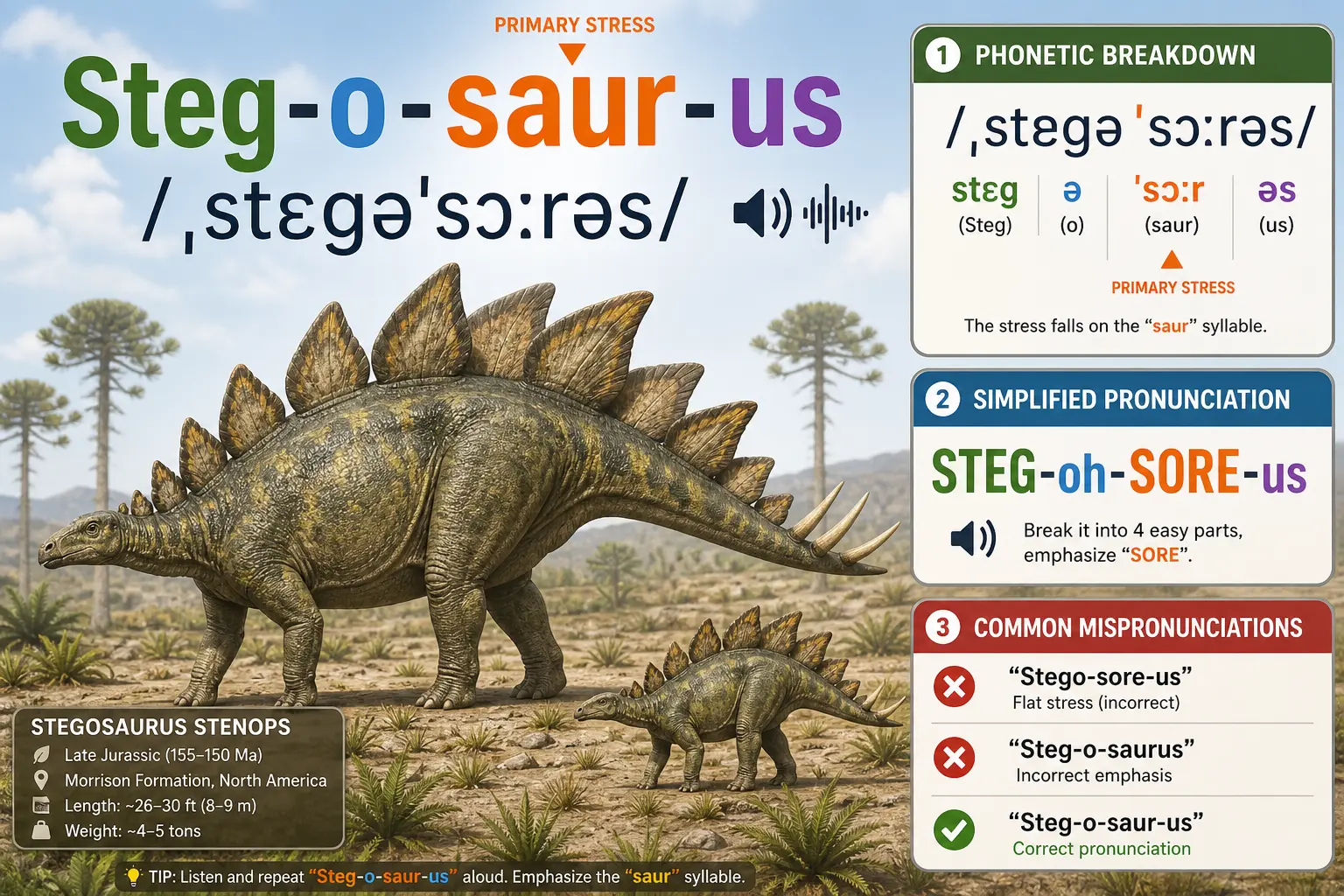
Stegosaurus pronunciation guide showing phonetic breakdown, syllable stress on “saur,” simplified pronunciation, and common mispronunciations with a Stegosaurus illustration in a Morrison Formation habitat

At a Glance Field Information Species Stegosaurus stenops — Ornithischia, Stegosauridae Pronunciation STEG-oh-SORE-us Syllable count Four syllables Name origin Ancient Greek — stegos (roof) + sauros (lizard) Named by Othniel Charles Marsh, 1877 Quick Answer: Stegosaurus is pronounced STEG-oh-SORE-us, with primary stress on the first syllable and secondary stress on the third. The name comes … Read more

Did Stegosaurus Have Two Brains? The Brain Myth Explained

Scientific infographic of Stegosaurus stenops showing small cranial brain and enlarged sacral nerve canal, debunking the two-brain myth with labeled anatomy and comparison diagram

At a Glance Field Information Species Stegosaurus stenops — Ornithischia, Stegosauridae Period Late Jurassic, approximately 155–150 Ma Brain size Approximately 70–80 cm³ (estimated) — very small relative to body size compared to most dinosaurs Sacral ganglion Enlarged nerve cluster in the hip region — not a second brain Myth status Debunked — no vertebrate animal … Read more

When Did Stegosaurus Live? Time Period and Geological Age

Stegosaurus stenops in Late Jurassic Morrison Formation with adult and juvenile, dorsal plates, tail spikes, and paleoenvironment infographic panels

At a Glance Field Information Species Stegosaurus stenops — Ornithischia, Stegosauridae Period Late Jurassic, approximately 155–150 Ma Epoch Kimmeridgian to Tithonian Continental configuration Laurasia and Gondwana partially separated; North America and Europe still connected Followed by Early Cretaceous faunal turnover; stegosaurids replaced by ankylosaurs and ceratopsians Quick Answer: Stegosaurus lived during the Late Jurassic period, … Read more

How Fast Was Stegosaurus? Speed and Locomotion

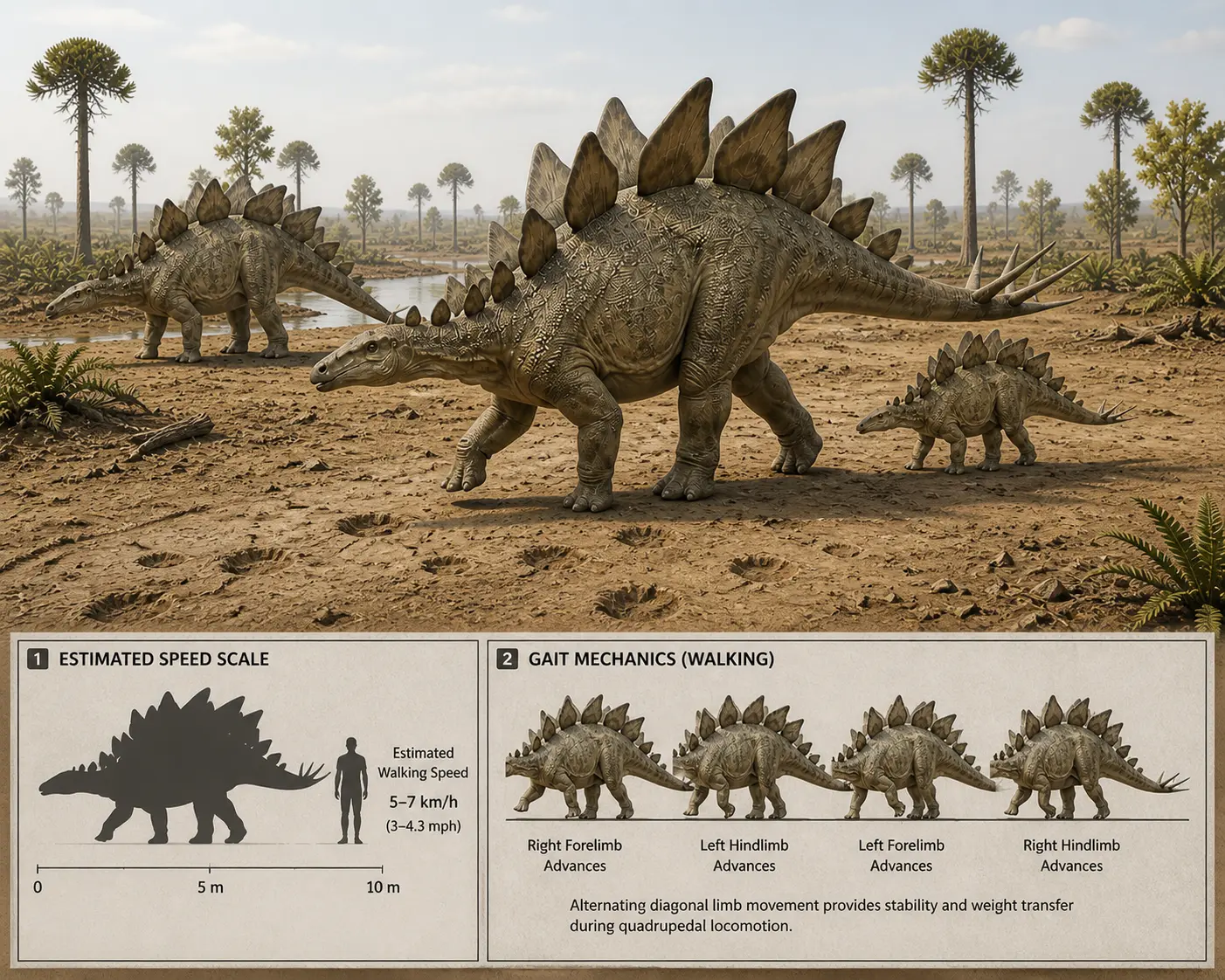
Stegosaurus stenops walking gait in a Late Jurassic Morrison Formation floodplain showing mid-stride locomotion, juvenile stride comparison, footprint impressions, and inset diagrams of speed scale and quadrupedal gait mechanics

At a Glance Field Information Species Stegosaurus stenops — Ornithischia, Stegosauridae Period Late Jurassic, approximately 155–150 Ma Speed estimate Approximately 5–7 km/h (3–4 mph) walking; maximum speed likely did not exceed ~7–8 km/h (4–5 mph) Locomotion type Quadrupedal; graviportal (weight-bearing) limb structure Gait evidence Biomechanical modelling; limited and indirect trackway evidence Quick Answer: Stegosaurus was … Read more