At a Glance
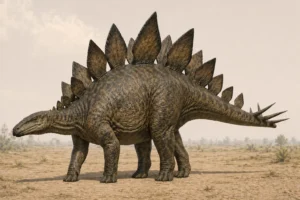
| Field | Information |
|---|---|
| Species | Stegosaurus stenops — Ornithischia, Stegosauridae |
| Period | Late Jurassic (155–150 Ma) |
| Spike count | 4 spikes arranged in 2 pairs |
| Spike length | 60–90 cm (2–3 ft) per spike |
| Orientation | Horizontal, not vertical |
| Key fossil evidence | Allosaurus vertebra UMNH 10781 — puncture wound matching spike dimensions |
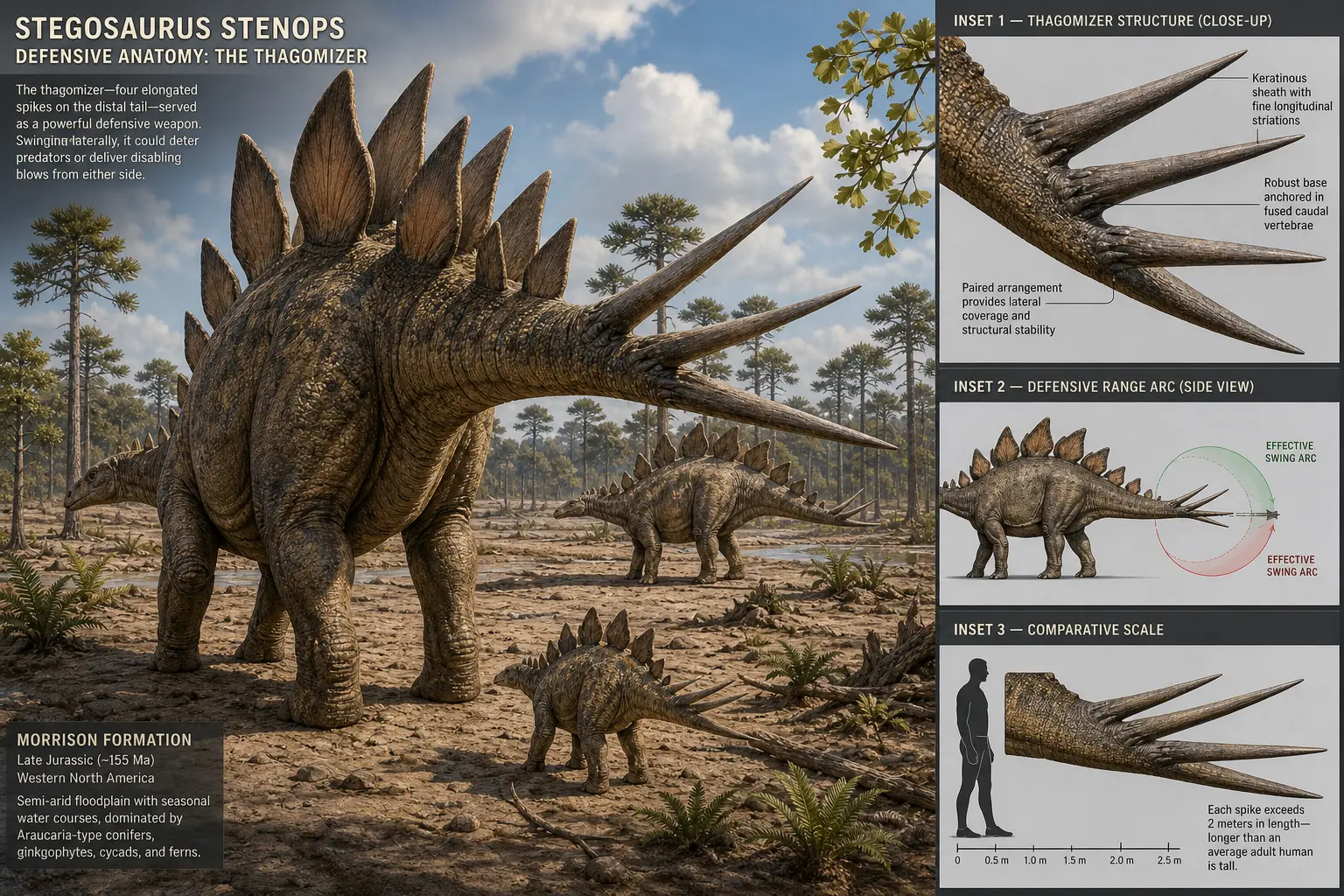
Quick Answer The stegosaurus thagomizer is the arrangement of four large bony spikes at the end of the dinosaur’s tail, each measuring roughly 60–90 cm (2–3 ft) long. Fossil evidence — including a partially healed puncture wound in an Allosaurus vertebra that precisely fits a Stegosaurus spike — confirms the thagomizer was used as an active defensive weapon, not merely for display. The term itself comes from a 1982 Gary Larson comic strip, later adopted as informal scientific vocabulary.
Stegosaurus had one of the most recognisable silhouettes of any dinosaur — plates along the back, a small head, a heavy body — but its most dangerous feature was at the other end entirely. Four large spikes, angled outward at the tail tip, made up a structure we now call the thagomizer: a weapon for which we have direct fossil evidence that was used, and used hard.
What Is the Stegosaurus Thagomizer?
The thagomizer is the cluster of four spike-shaped bony structures, called osteoderms, at the end of a Stegosaurus’s tail. In Stegosaurus stenops, the best-known species, these spikes were arranged in two side-by-side pairs, each spike measuring approximately 60–90 cm (2–3 ft) in length. Fossil evidence from articulated specimens shows they projected horizontally — pointing outward to the sides — rather than vertically upward, as they are commonly depicted in older artwork and toys.
The spikes were not hollow. They were built from dense cortical bone surrounding a central medullary cavity, with vascular grooves along their surfaces indicating a blood supply in life — meaning they were covered in a keratinous sheath, much like a modern animal’s horn or claw, which would have made them even longer and sharper than the bare fossil bone suggests.
How Many Spikes Did Stegosaurus Have?
Stegosaurus stenops had four tail spikes. This was the standard count for the genus, though early descriptions complicated the picture. When Othniel Charles Marsh first described Stegosaurus armatus in the 1870s, he initially interpreted the specimen as having eight tail spikes — a figure that was later revised as better material came to light. Both S. stenops and S. armatus are now understood to have carried four spikes in two pairs at the distal end of the tail.
How Did Stegosaurus Use Its Tail Spikes?
The tail of Stegosaurus was unusually flexible for a large ornithischian dinosaur. Unlike many of its relatives, Stegosaurus lacked ossified tendons along the tail — the stiffening structures that made most ornithischian tails relatively rigid. This gave the tail a far greater range of lateral motion, and paleontologist Robert Bakker noted that Stegosaurus could have pivoted its rear end efficiently by keeping its large hindlimbs planted while pushing off with its short, heavily muscled forelimbs — effectively swivelling to keep an attacker in the strike zone.
Biomechanical modelling on the closely related Kentrosaurus aethiopicus — published by Heinrich Mallison in 2011 — gave the clearest quantitative picture of what a stegosaur tail could do. The study found that tail-tip spikes could reach speeds exceeding 10 metres per second across a 75-degree arc, generating forces sufficient to slash open soft tissue, fracture ribs, and penetrate deeply into muscle. Whether Stegosaurus could match those precise figures is not confirmed — Mallison’s model was built on Kentrosaurus — but the two genera share the same fundamental tail architecture, and the fossil record of Stegosaurus itself supplies compelling supporting evidence.
The Smoking Gun: Allosaurus Vertebra UMNH 10781
The single most important piece of evidence for thagomizer use as a weapon is a tail vertebra from an Allosaurus, catalogued as UMNH 10781, recovered from the Cleveland-Lloyd Dinosaur Quarry in Utah. The transverse process of this vertebra — a lateral wing of bone projecting from the vertebral body — contains a puncture wound whose shape and dimensions precisely match the cross-section of a Stegosaurus tail spike. Crucially, the bone around the wound shows signs of partial healing, meaning the Allosaurus survived the encounter and lived for some time afterward, carrying the injury as a permanent record of the interaction.
This fossil is significant because it is direct physical evidence of predator-prey contact between two specific species — not an inference, not a comparison, but a preserved record of a Stegosaurus spike entering an Allosaurus vertebra during a real encounter in the Late Jurassic.
Spike Trauma in the Stegosaurus Fossil Record
The Allosaurus vertebra is not the only evidence. A 2001 study by McWhinney and colleagues examined 51 Stegosaurus tail spikes from the fossil record. Approximately 10% showed trauma: broken tips with evidence of bone remodelling — meaning the animal had snapped the end off a spike and survived long enough for the bone to begin healing. Spikes do not break and partially heal from passive display. This pattern is consistent with repeated high-impact contact, the kind produced by driving a spike into a large resisting target.
Together, the Allosaurus vertebra and the spike trauma data make the defensive weapon hypothesis the most strongly supported interpretation in the current literature.
Where Does the Word “Thagomizer” Come From?
The word has one of the most unusual origin stories in the history of science. In 1982, cartoonist Gary Larson published a panel in The Far Side depicting a prehistoric classroom. A caveman lecturer stands before an image of a Stegosaurus tail and explains to his audience that the spikes are called the “thagomizer” — named, he notes, after “the late Thag Simmons.” The implication: poor Thag had gotten too close.
Before that cartoon, the tail spikes had no agreed-upon informal name. In 1993, paleontologist Kenneth Carpenter was presenting a newly discovered Stegosaurus skeleton at the Society of Vertebrate Paleontology Annual Meeting in Denver — a specimen whose spikes showed healed damage consistent with combat use. Remembering the cartoon, he used the word “thagomizer” from the podium. It was the first professional use of the term.
The name spread quickly. The Dinosaur National Monument in Utah added it to its display labels. The Smithsonian Institution adopted it. It appeared in James Orville Farlow’s reference volume The Complete Dinosaur and in the BBC documentary series Planet Dinosaur. It has since appeared in peer-reviewed scientific papers describing stegosaur anatomy. A punchline became vocabulary — one of the few times in the history of any scientific field that a cartoonist named part of an animal.
Related and Contemporary Species
Kentrosaurus aethiopicus — A smaller East African stegosaur from the Tendaguru Formation of Tanzania, Kentrosaurus carried up to eight slender spikes along its tail and hips. It is the subject of the most detailed biomechanical analysis of stegosaur tail-strike capability to date (Mallison, 2011), making it the primary reference species for understanding thagomizer mechanics across the family.
Allosaurus fragilis — The apex predator of the Morrison Formation and the most likely natural adversary of Stegosaurus in the Late Jurassic of North America. The puncture-wounded vertebra UMNH 10781 belongs to this genus, making it directly relevant to any discussion of thagomizer function.
Huayangosaurus taibaii — An earlier and more primitive Chinese stegosaur, Huayangosaurus possessed a simpler paired tail spike arrangement representing an earlier stage in thagomizer evolution, providing evolutionary context for the more developed structure seen in Stegosaurus.
Tuojiangosaurus multispinus — Another Chinese stegosaur from the Late Jurassic, Tuojiangosaurus also bore tail spikes and is part of the broader stegosaur radiation that illustrates how the thagomizer developed across the family as a defensive adaptation.
Frequently Asked Questions
What were the tail spikes on Stegosaurus called?
The tail spikes of Stegosaurus are called a thagomizer — an informal anatomical term originally coined as a joke by cartoonist Gary Larson in a 1982 Far Side strip, then adopted by paleontologist Kenneth Carpenter in 1993 and subsequently used by institutions including the Smithsonian. Stegosaurus stenops had four spikes arranged in two pairs.
How long were Stegosaurus’ tail spikes?
Each spike in a fully grown Stegosaurus stenops measured approximately 60–90 cm (2–3 ft) in length based on fossil specimens. In life, a keratinous sheath would have covered the bone, likely extending the functional length somewhat beyond what the fossil alone shows.
Did Stegosaurus actually use its tail spikes as a weapon?
Yes — fossil evidence strongly supports active use. A partially healed puncture wound in an Allosaurus vertebra (UMNH 10781) precisely matches a Stegosaurus spike in shape and size. Separately, around 10% of examined Stegosaurus tail spikes show broken and remodelled tips consistent with high-impact contact, not passive display.
Conclusion
The thagomizer began as a cartoon joke and became one of the best-evidenced weapons in the entire dinosaur fossil record. Four horizontal spikes, built from dense bone and likely sheathed in keratin, were carried on a flexible, swivel-capable tail — and the injuries preserved in Allosaurus bone confirm they were used. Stegosaurus was an herbivore. It was not a passive one.
Featured Museum Collections
Museum-quality paleoart and educational poster
collections based on evidence-informed prehistoric
Life reconstructions.