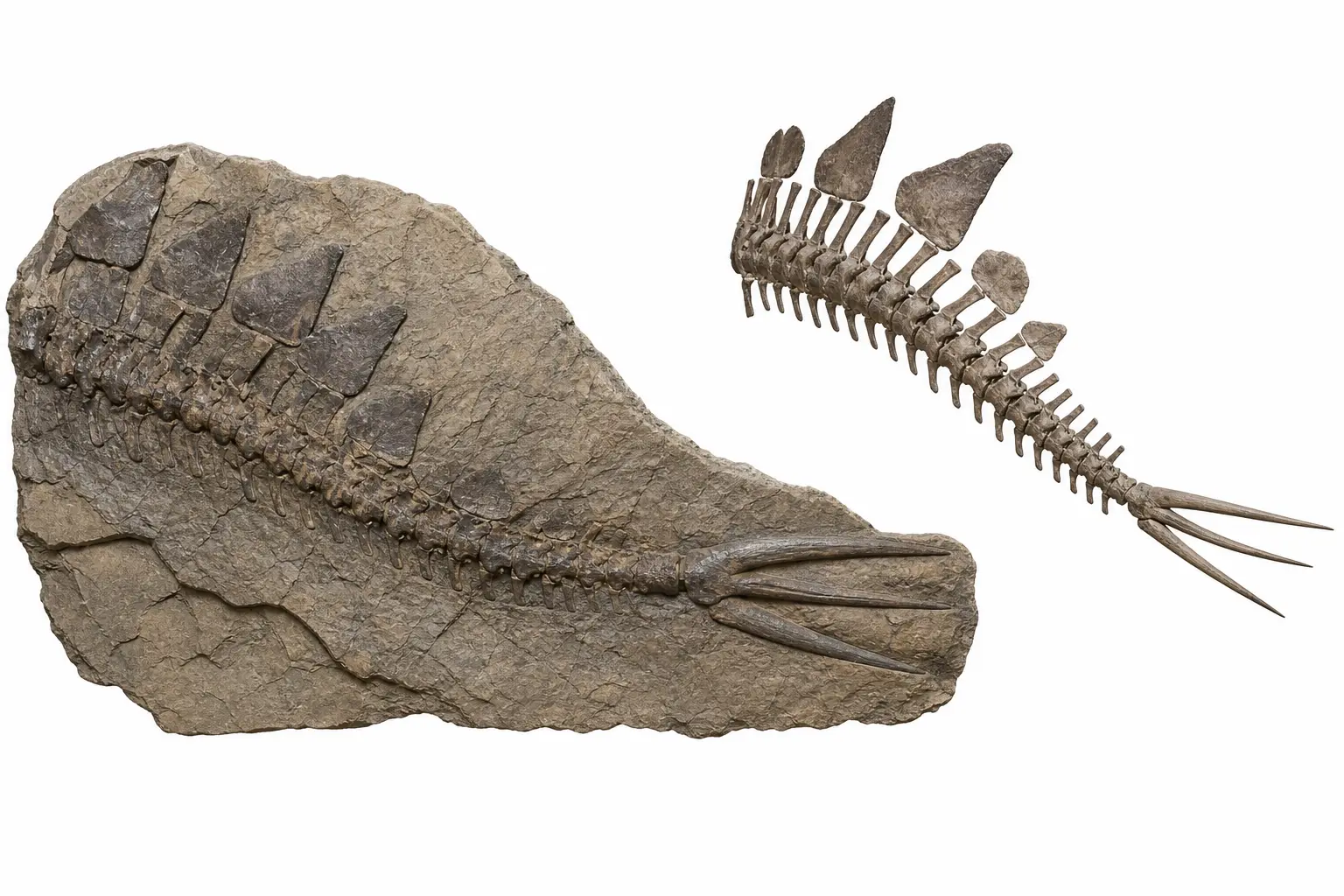
At a Glance
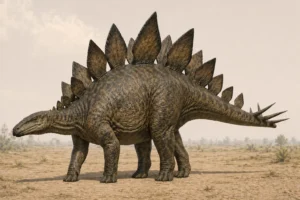
| Field | Information |
|---|---|
| Species | Stegosaurus stenops — Ornithischia, Stegosauridae |
| Period | Late Jurassic (155–150 Ma) |
| First described | 1877 by Othniel Charles Marsh, Yale University |
| Holotype | YPM 1850 — fragmentary; S. armatus (later replaced by S. stenops as type species) |
| Most complete specimen | NHMUK PV R36730 (“Sophie”) — 85% complete, Natural History Museum London |
| Formation | Morrison Formation, western North America |
Quick Answer Stegosaurus was first discovered in 1877 by Arthur Lakes near Morrison, Colorado, and formally described the same year by Yale paleontologist Othniel Charles Marsh during the Bone Wars — a period of fierce rivalry between Marsh and Edward Drinker Cope. The holotype, YPM 1850, was fragmentary. The most complete specimen ever found, NHMUK PV R36730 (“Sophie”), was excavated in Wyoming in 2004 and scientifically described in 2015, providing the first detailed anatomical description of the genus since 1914.
Stegosaurus is one of the most recognisable dinosaurs in the world, yet for most of its scientific history, it was known primarily from incomplete and composite material. Its discovery was entangled in one of the most contentious episodes in the history of paleontology, and the first genuinely complete individual was not described until 2015 — nearly 140 years after Marsh named the genus. That long gap between discovery and full understanding is part of what makes the fossil history of Stegosaurus unusually rich.
Stegosaurus Discovery: Origins and the Bone Wars
Stegosaurus was discovered in 1877 when Arthur Lakes, a teacher and fossil collector working for Marsh, uncovered several caudal vertebrae, a dermal plate, and additional postcranial elements north of the town of Morrison, Colorado. Marsh described the material the same year, naming it Stegosaurus armatus — “armoured roofed lizard” — based on his initial interpretation that the plates lay flat over the animal’s back like roof shingles, which proved to be incorrect.
The discovery came at the height of the Bone Wars, the infamous and frequently destructive rivalry between Marsh and fellow paleontologist Edward Drinker Cope. Both men raced to name new species from the Morrison Formation, often from fragmentary material and under considerable competitive pressure. The consequences for accuracy were significant: Marsh misidentified teeth belonging to the sauropod Diplodocus and a tibia belonging to Allosaurus as part of the S. armatus holotype YPM 1850, errors that were not corrected until 2001.
Marsh’s Original Misinterpretations
The holotype of S. armatus (YPM 1850) was so fragmentary that Marsh initially believed the remains came from an aquatic, turtle-like animal. The genus name Stegosaurus — “roofed lizard” — reflects this early misreading. He envisioned the plates lying horizontally across the back in overlapping rows, similar to the armour of a prehistoric chelonian. The true arrangement — two alternating rows of upright plates along the neck, back, and tail — was only established through subsequent, more complete specimens.
Marsh also initially described S. armatus as having eight tail spikes. That figure, too, was revised as better material accumulated.
Key Specimens and What They Revealed
The Garden Park Specimen — USNM 4934
The most significant early discovery after the holotype came in 1885, when collector Marshall P. Felch excavated a nearly complete, articulated skeleton from Morrison Formation strata at his quarry in Garden Park, near Cañon City, Colorado. Felch collected the skeleton between 1885 and 1886, and Marsh described it as a new species, Stegosaurus stenops, in 1887.
USNM 4934 was the first specimen to reveal previously unknown anatomical elements: a complete skull, throat ossicles (small bony nodules protecting the throat), and articulated plates in their correct in-life positions. It transformed the understanding of what Stegosaurus actually looked like. The International Commission on Zoological Nomenclature later designated S. stenops — rather than the fragmentary S. armatus — as the type species for the genus, a recognition of USNM 4934’s foundational importance.
The AMNH Mount — AMNH 5752
A partial Stegosaurus skeleton found at Como Bluff, Wyoming, by F. F. Hubbell — a collector working for Cope — in 1877 or 1878 forms the core of the mounted Stegosaurus skeleton on display at the American Museum of Natural History in New York. Though not the most complete specimen scientifically, AMNH 5752 has been viewed by millions of visitors and has shaped popular understanding of Stegosaurus anatomy for over a century.
Sophie — NHMUK PV R36730
The most scientifically significant Stegosaurus specimen ever recovered is NHMUK PV R36730, known informally as “Sophie.” The specimen was first discovered in 2003 by Bob Simon at the Red Canyon Ranch near Shell, Wyoming, when a bulldozer accidentally grazed a hillside during a windstorm and exposed bone. It was excavated in 2004 by Simon and crews from the Sauriermuseum Aathal in Switzerland, where it was initially catalogued as SMA RCR0603.
Sophie is 85% intact and contains 360 bones. There are 19 plates on the back and four tail spikes — the most complete set ever discovered. All of the individual skull bones are three-dimensional and detached from each other, making it one of the most scientifically valuable dinosaur skulls ever found. The Natural History Museum in London acquired the specimen through a private fundraising campaign and gave it the official designation NHMUK PV R36730. It went on display in December 2014 and was formally described in a landmark 2015 paper — the first detailed anatomical description of Stegosaurus since Charles Gilmore’s 1914 monograph.
Sophie’s description revised and refined understanding of Stegosaurus proportions, skull anatomy, and plate arrangement in ways not possible from earlier composite reconstructions.
Apex — On Loan to AMNH
In 2022, a large Stegosaurus stenops specimen was discovered outside Dinosaur, Colorado, by Jason Cooper. The fossil is extremely well-preserved, with more than 254 of approximately 320 bone elements. The specimen was found in a death pose, with its tail curled under its body. The animal to which it belonged was elderly, as attested by signs of rheumatoid arthritis such as the fusion of the sacral bones.
The specimen was auctioned at Sotheby’s in July 2024 and purchased by Kenneth C. Griffin for $44.6 million — the highest price ever paid for a fossilised skeleton at auction. Griffin subsequently loaned it to the American Museum of Natural History in New York, where it went on display in December 2024 under the name “Apex.” It has been described as being 30% larger than Sophie and preserves skin impressions from the neck. The acquisition generated significant debate within the paleontological community about privately owned fossil material and the conditions under which it can be accessed for research.
Specimen Table
| Specimen | Institution | Completeness | Significance |
|---|---|---|---|
| YPM 1850 | Yale Peabody Museum, New Haven | Fragmentary — vertebrae, one plate, postcranial elements | Holotype of S. armatus; first described specimen; named by Marsh 1877; later found to include misidentified Diplodocus and Allosaurus material |
| USNM 4934 | Smithsonian National Museum of Natural History, Washington D.C. | Near-complete; articulated | Basis for S. stenops; first to preserve skull, throat ossicles, and articulated plates; collected by Felch 1885–1886; type species anchor for the genus |
| AMNH 5752 | American Museum of Natural History, New York | Partial | Core of the AMNH mounted skeleton; collected at Como Bluff by Hubbell c.1877–1878 for Cope; part of the public-facing history of the genus |
| NHMUK PV R36730 (“Sophie”) | Natural History Museum, London | ~85% — 360 bones | Most complete specimen scientifically described; first description of undistorted 3D skull; described 2015; discovered 2003 by Bob Simon, Shell, Wyoming |
| “Apex” (on loan) | American Museum of Natural History, New York (on loan from Kenneth C. Griffin) | ~79% — 254+ of ~320 elements | Among the largest known individuals; preserves skin impressions and evidence of arthritis; discovered in 2022; auctioned in 2024 for $44.6 million, the highest price recorded for a fossilised skeleton. Research access and long-term institutional status remain subject to ongoing scientific and curatorial discussion. |
The Taxonomy Problem: Too Many Species
Marsh named multiple Stegosaurus species during the Bone Wars, often from incomplete material and in competitive haste. At various points, S. armatus, S. ungulatus, S. duplex, S. sulcatus, and S. affinis were all on the books. Subsequent review collapsed most of these into synonymy or declared them nomina dubia — names considered scientifically invalid due to insufficient or undiagnosable material.
Today, two species are generally accepted as valid: Stegosaurus stenops and Stegosaurus ungulatus. A third, S. sulcatus, is sometimes considered potentially distinct based on a large spike element that may represent a shoulder spike, but its status remains debated. The fragmentation of the original Bone Wars material, and the fact that many early specimens were composites assembled from multiple individuals, has made definitive species-level resolution difficult.
Related and Contemporary Species
Allosaurus fragilis — The apex predator of the Morrison Formation and the principal predatory context for Stegosaurus in life; fossil interaction evidence connects the two species directly through specimen UMNH 10781.
Kentrosaurus aethiopicus — The East African counterpart to Stegosaurus, recovered from the Tendaguru Formation of Tanzania and roughly contemporary in age; comparison between the two genera has been central to understanding stegosaur anatomy and defence mechanics.
Camptosaurus dispar — A Morrison Formation herbivore recovered from the same sites and geological horizons as Stegosaurus, providing ecological context for the community Stegosaurus inhabited.
Diplodocus carnegii — A large sauropod from the Morrison Formation whose teeth were mistakenly assigned to the S. armatus holotype by Marsh, making it directly relevant to the taxonomic history of Stegosaurus discovery.
Frequently Asked Questions
Who discovered Stegosaurus?
The first Stegosaurus fossils were collected by Arthur Lakes in 1877 near Morrison, Colorado, working as a fossil hunter for Yale paleontologist Othniel Charles Marsh. Marsh formally described and named the genus the same year. The discovery took place during the Bone Wars, a period of intense and sometimes reckless rivalry between Marsh and Edward Drinker Cope.
Where are Stegosaurus fossils found?
All confirmed Stegosaurus specimens come from the Morrison Formation of the western United States, spanning states including Colorado, Wyoming, and Utah. The formation dates to the Late Jurassic, approximately 155–150 million years ago. No confirmed Stegosaurus material has been recovered outside North America, though related stegosaur genera are known from Europe, Africa, and Asia.
What is the most complete Stegosaurus fossil ever found?
NHMUK PV R36730, known as “Sophie,” is the most completely described specimen at approximately 85% skeletal completeness with 360 bones. It is on permanent display at the Natural History Museum in London. A larger individual known as “Apex,” discovered in 2022 and now on loan to the American Museum of Natural History in New York, preserves more than 254 of approximately 320 elements and may eventually supersede Sophie in terms of research significance.
Conclusion
Stegosaurus was named in 1877 from fragments that barely hinted at the animal’s true anatomy. Nearly 150 years of subsequent discovery — from the articulated Garden Park skeleton through to Sophie and Apex — have progressively filled in the picture, though significant questions remain open. The fossil history of Stegosaurus is as much a story about the development of paleontology as it is about the dinosaur itself.
Featured Museum Collections
Museum-quality paleoart and educational poster
collections based on evidence-informed prehistoric
Life reconstructions.