At a Glance
| Field | Information |
|---|---|
| Species | Stegosaurus stenops — Ornithischia, Stegosauridae |
| Period | Late Jurassic, approximately 155–150 Ma |
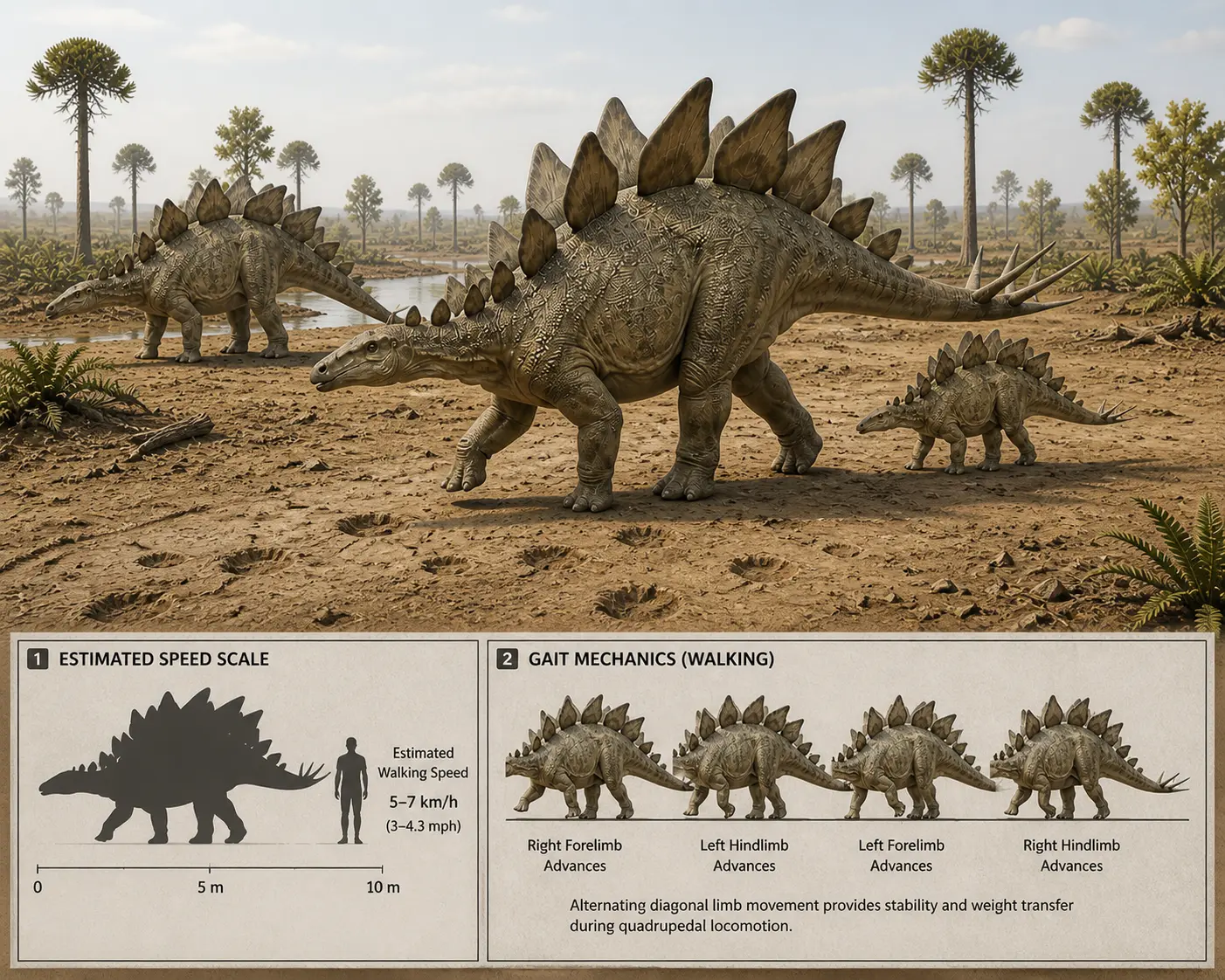
| Speed estimate | Approximately 5–7 km/h (3–4 mph) walking; maximum speed likely did not exceed ~7–8 km/h (4–5 mph) |
| Locomotion type | Quadrupedal; graviportal (weight-bearing) limb structure |
| Gait evidence | Biomechanical modelling; limited and indirect trackway evidence |
Quick Answer: Stegosaurus was almost certainly a slow-moving animal by dinosaur standards. Biomechanical estimates based on limb proportions and body mass suggest a typical walking speed of around 5–7 km/h (3–4 mph) walking; maximum speed likely did not exceed ~7–8 km/h (4–5 mph). These figures are model-dependent and should be treated as indicative ranges rather than precise values.
Stegosaurus was not built for speed. Its hind limbs were substantially longer than its forelimbs, its body mass was considerable, and its limb bones show the dense, weight-bearing structure associated with slow, steady movement rather than rapid locomotion. What it lacked in pace it likely compensated for with the defensive hardware at its tail — but the question of exactly how it moved, and how fast, is more nuanced than a single number suggests.
How Fast Was Stegosaurus?
This is an active area of research. Details here reflect current scientific consensus but may be revised as new fossil evidence or analysis emerges.
Biomechanical estimates suggest Stegosaurus stenops moved at a typical walking speed of approximately 5–7 km/h (3–4 mph), broadly comparable to a slow human walk. Maximum speed estimates vary depending on modelling approach, but most reconstructions indicate limited capacity for faster locomotion, with speeds unlikely to have exceeded roughly 7–8 km/h (4–5 mph).
No single figure should be taken as settled — speed estimates for extinct animals are model-dependent and sensitive to assumptions about body mass, muscle distribution, and gait mechanics. The most detailed biomechanical analyses for Stegosaurus locomotion date largely from the early 2010s, with limited subsequent refinement using newer modelling techniques.
Why the Uncertainty?
Speed estimation for extinct animals relies on several inputs, none of which are directly observable in living form: limb bone length and robustness, estimated body mass, inferred muscle mass and attachment geometry, and, where available, trackway data. Each of these introduces its own sources of uncertainty.
For Stegosaurus stenops specifically, body mass estimates vary across published studies — typically in the range of approximately 2,700–4,000 kg (5,950–8,820 lb), with some higher estimates depending on modelling assumptions — and mass is one of the most influential variables in locomotion modelling. Different mass assumptions produce meaningfully different speed outputs from the same skeletal data.
Limb Anatomy and What It Tells Us
Fossil evidence from well-preserved Stegosaurus skeletons documents a clear asymmetry between the forelimbs and hind limbs. The hind limbs were substantially longer and more robust than the forelimbs, producing a characteristic rump-high body posture that tilted the animal’s back upward toward the hips. This posture has implications for both feeding reach and locomotion.
The limb bones show graviportal characteristics — thick cortical walls, broad joint surfaces, and a columnar structure broadly comparable to that seen in large modern mammals such as elephants and rhinoceroses. Based on comparison with these living analogues, palaeontologists infer that Stegosaurus bore its weight through near-vertical limbs rather than a more crouched posture, a configuration associated with slow but energetically efficient movement over long distances rather than rapid acceleration.
Forelimb Structure
The forelimbs of Stegosaurus stenops are among the more unusual features of its skeleton. The manus — the forefoot — is reconstructed as a compact, weight-bearing structure, with the digits arranged closely together and the overall contact area relatively small compared to the animal’s body mass.
This configuration is consistent with a columnar support role rather than a grasping function. However, the precise implications of the manus structure for weight distribution and gait remain an area of ongoing research.
Gait and Posture
Based on skeletal geometry and biomechanical modelling, Stegosaurus most likely moved with a slow, lateral-sequence walk — the same basic gait pattern used by most large quadrupedal mammals today, in which each foot is placed in a consistent diagonal sequence. There is no strong evidence for a trotting gait in Stegosaurus, and the limb proportions make a gallop biomechanically implausible at its body mass.
The elevated hind quarters produced by the longer hind limbs would have given Stegosaurus a distinctive silhouette in motion — the back arching upward from the low-slung neck and small head to the highest point above the hips, then dropping again toward the tail. Whether this posture affected the animal’s centre of mass and turning agility is not well established in the published literature.
Trackway Evidence
Trackway evidence directly attributable to Stegosaurus is limited. Stegosaurid tracks have been documented from Late Jurassic deposits in several localities, but confidently assigning specific trackways to Stegosaurus at the genus level requires associated skeletal material, which is rarely preserved.
Where stegosaurid trackways are available, their spacing, stride length, and footprint morphology are consistent with a slow quadrupedal walk. These trackways show no convincing evidence of running or high-speed locomotion.
Speed in an Ecological Context
For a large herbivore in the Morrison Formation, outrunning a predator like Allosaurus was likely not a viable primary defence strategy. Biomechanical estimates for Allosaurus suggest a considerably higher maximum speed than any current estimate for Stegosaurus. The implication — supported by the fossil evidence of thagomizer injuries on Allosaurus bones — is that Stegosaurus relied primarily on its tail weaponry and possibly its bulk rather than flight when threatened. The mechanics of that defensive response are covered in full on the tail spikes page.
Related and Contemporary Species
- Allosaurus fragilis — primary predator of the Morrison Formation; biomechanical estimates suggest a substantially higher maximum speed than Stegosaurus, reinforcing the inference that Stegosaurus depended on defence rather than escape.
- Brachiosaurus altithorax — large sauropod of the Morrison Formation; similarly graviportal limb structure and broadly comparable slow-movement adaptations despite a very different body plan.
- Kentrosaurus aethiopicus — African stegosaurid; smaller body mass than Stegosaurus may have permitted modestly higher speed estimates, though direct comparisons are limited by available modelling data.
- Camptosaurus dispar — ornithopod herbivore of the Morrison Formation; lighter build and different limb proportions likely made it considerably more agile than Stegosaurus, representing a contrasting locomotion strategy among contemporary herbivores.
Frequently Asked Questions
How fast could Stegosaurus run?
Biomechanical estimates suggest Stegosaurus was unlikely to have run in any meaningful sense. Maximum speed estimates range from approximately 7–14 km/h (4.3–8.7 mph) depending on the model used, but these figures are indicative ranges rather than confirmed values. Its limb structure is more consistent with sustained walking than with rapid locomotion or escape behaviour.
Was Stegosaurus faster than Allosaurus?
Almost certainly not. Biomechanical estimates for Allosaurus suggest a considerably higher maximum speed than current Stegosaurus estimates. Fossil evidence of thagomizer spike injuries on Allosaurus bones supports the inference that Stegosaurus used active tail defence rather than flight when confronted by predators, which is consistent with a significant speed disadvantage.
Why was Stegosaurus so slow?
Stegosaurus’s slow movement reflects its body plan rather than any single anatomical feature. Its large body mass, graviportal limb bones, and the structural demands of supporting its weight favoured stability and endurance over speed. This is a common trade-off in large herbivores — modern elephants and rhinoceroses show broadly comparable locomotion profiles for similar reasons.
Stegosaurus was slow by any reasonable measure — but speed was probably never its primary survival strategy. Its limb anatomy, body mass, and the fossil evidence of its defensive tail weaponry together describe an animal built for endurance and resistance rather than escape.
Featured Museum Collections
Museum-quality paleoart and educational poster
collections based on evidence-informed prehistoric
Life reconstructions.